A Real Record, Start to Finish
An example of our service. It's a genuine GP record, and what we built from it, both on this page. So you can judge our offering and decide the value it will have for you.

This Is What We Build for You
Have a proper look. Pick a document from the tabs below, then move through it a page at a time, or jump straight to the part you want from the menu: every entry there says what is on that page.
A readable account of your health from birth to the present, with medical terms explained as they appear.



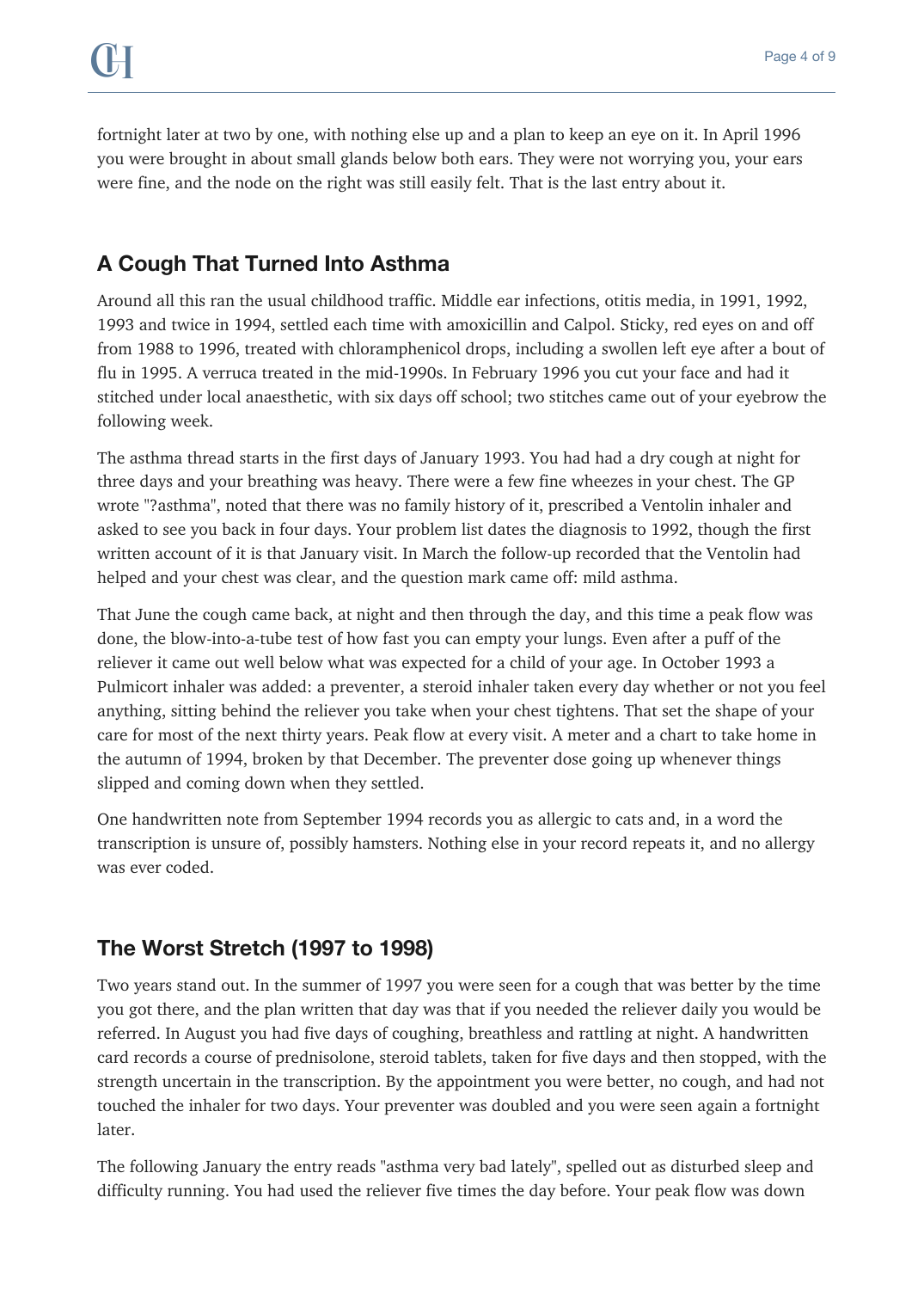
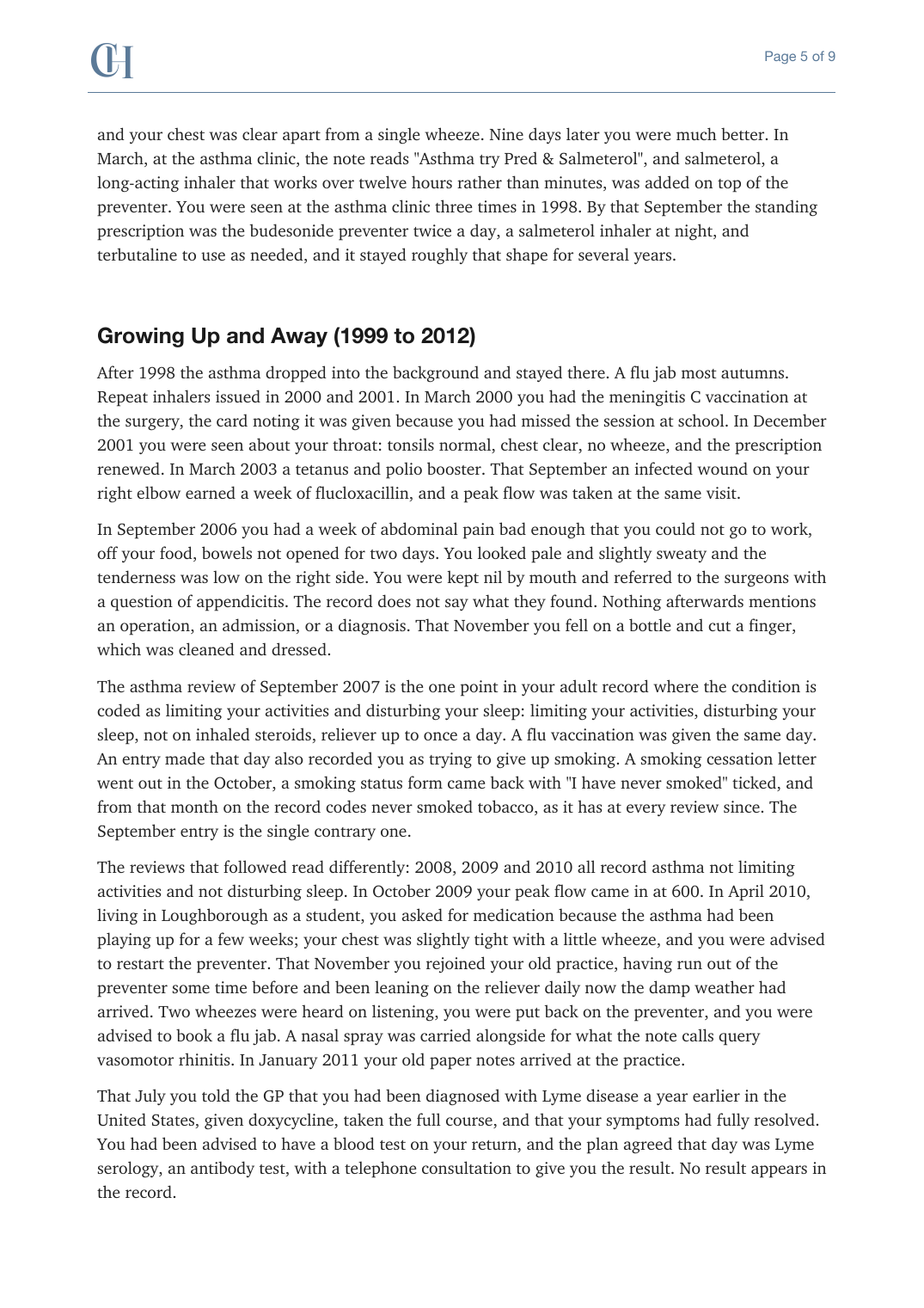
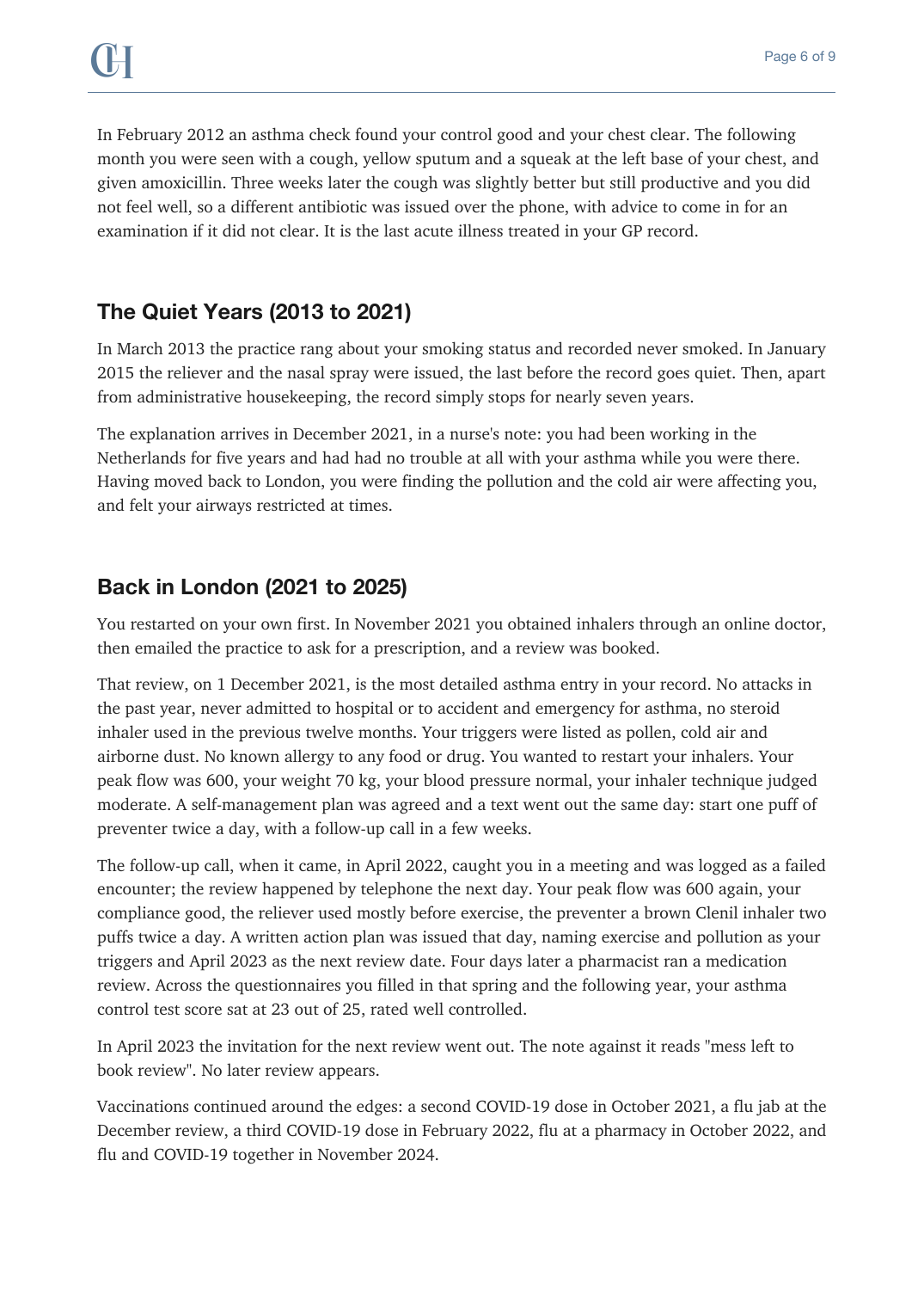
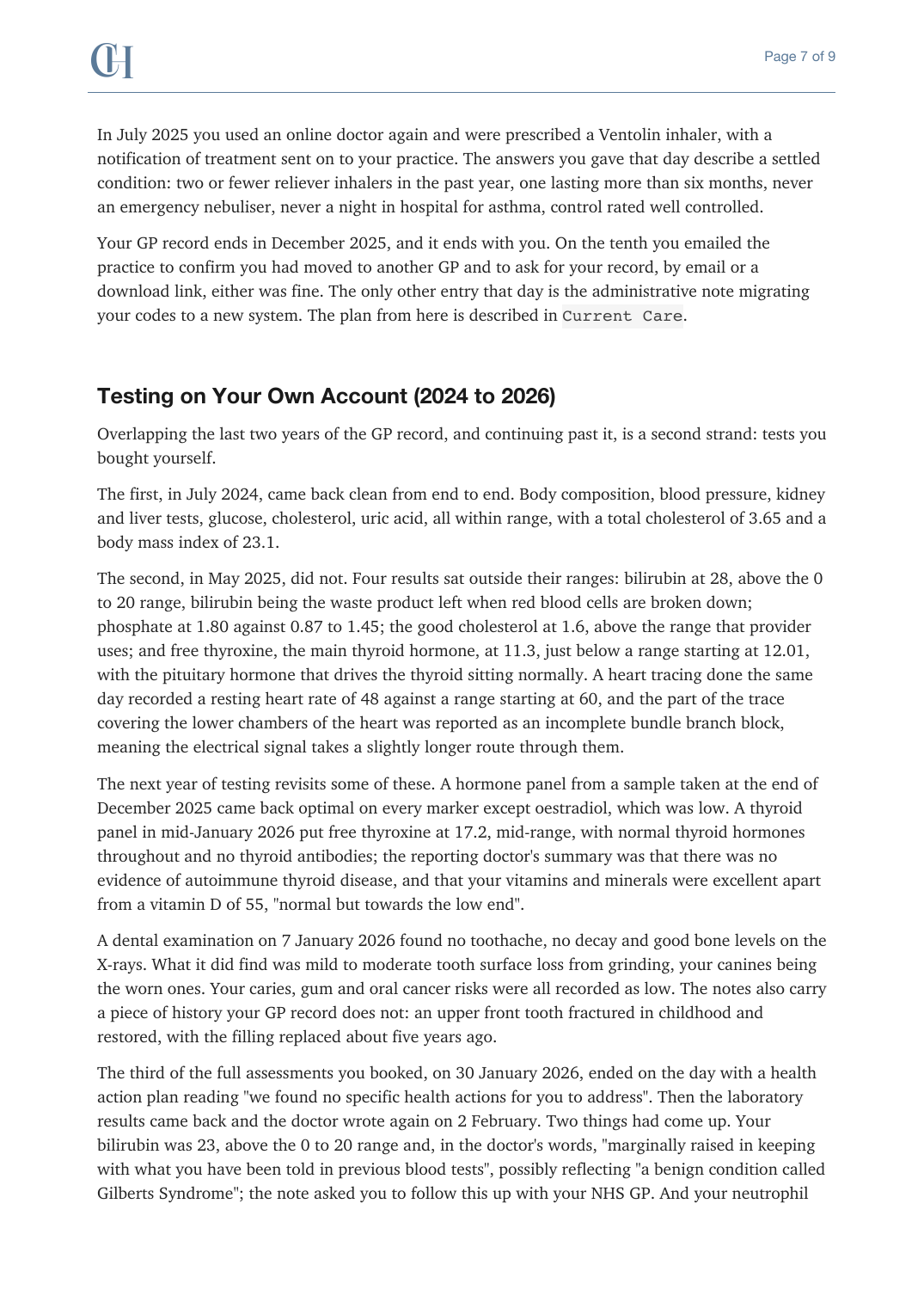

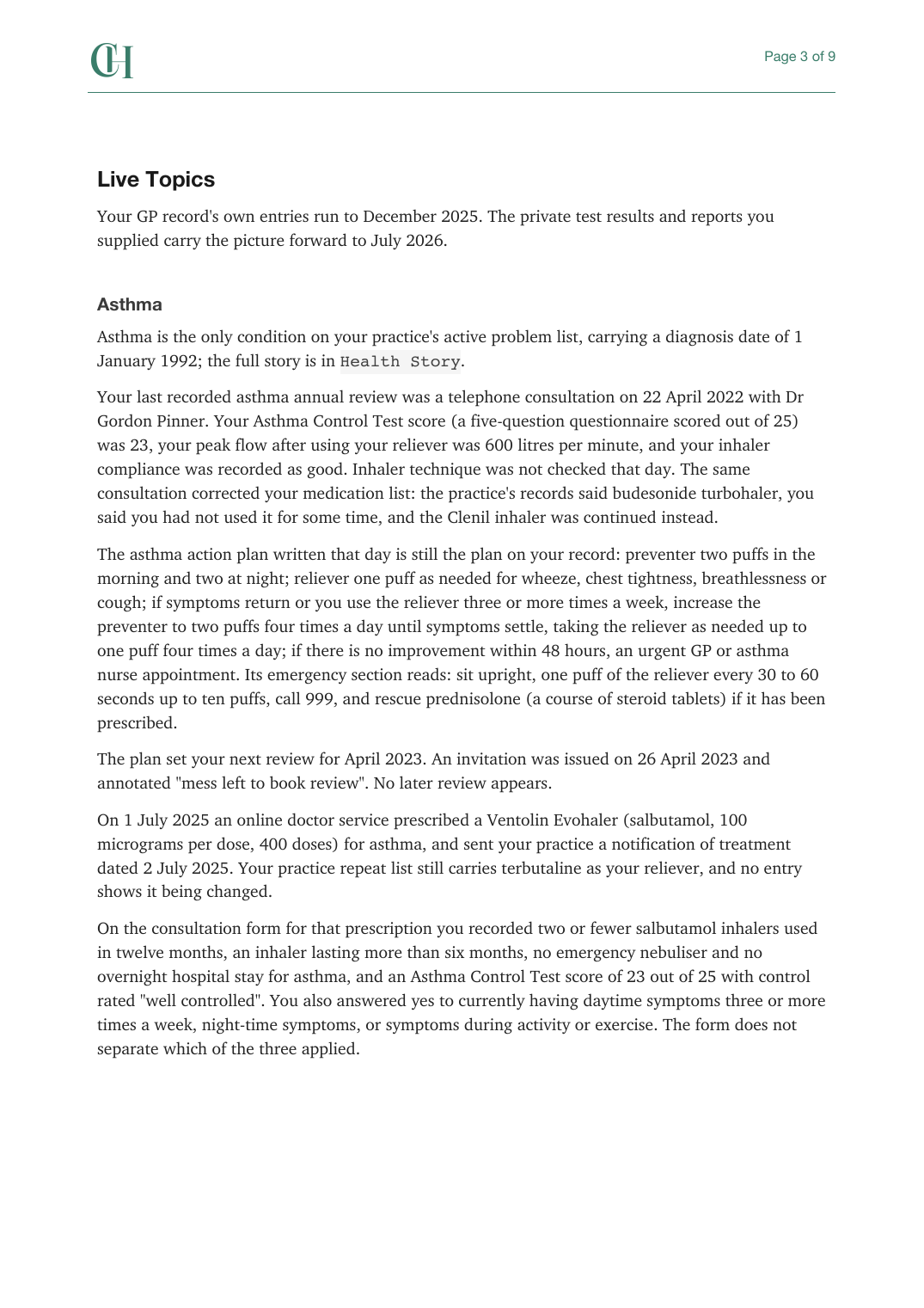
What is actively being managed now: live conditions, current medications, monitoring, and what's scheduled next.


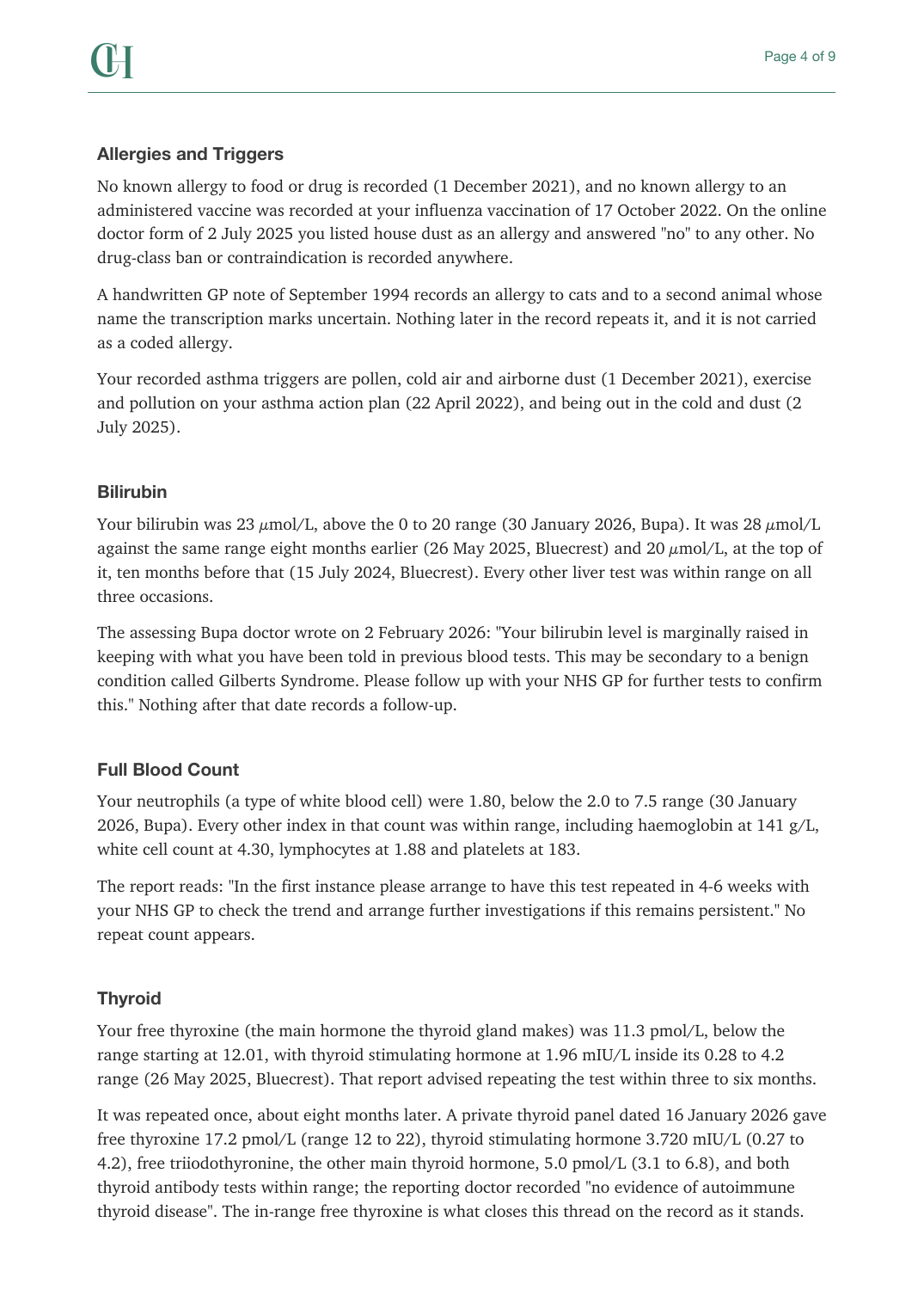
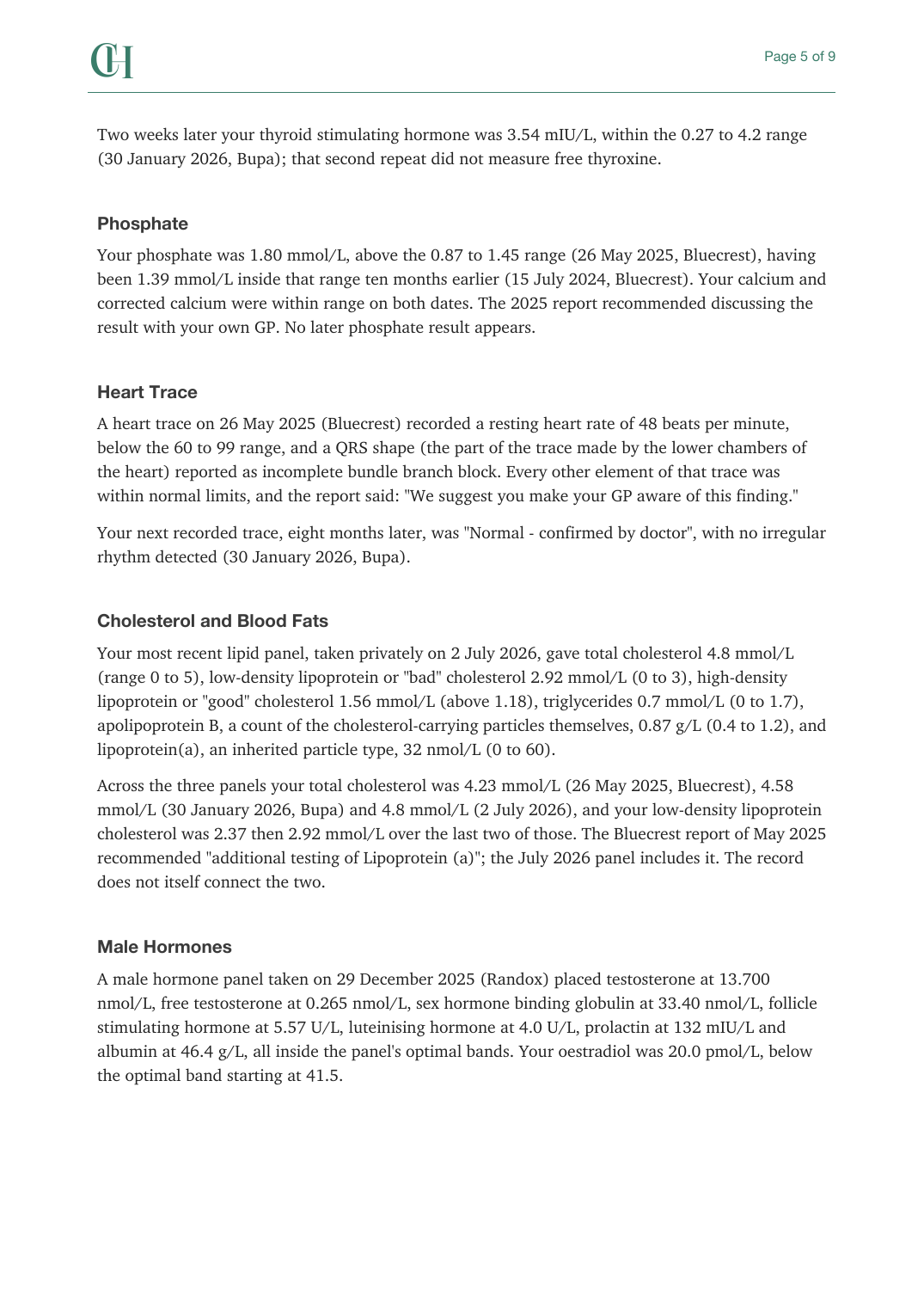
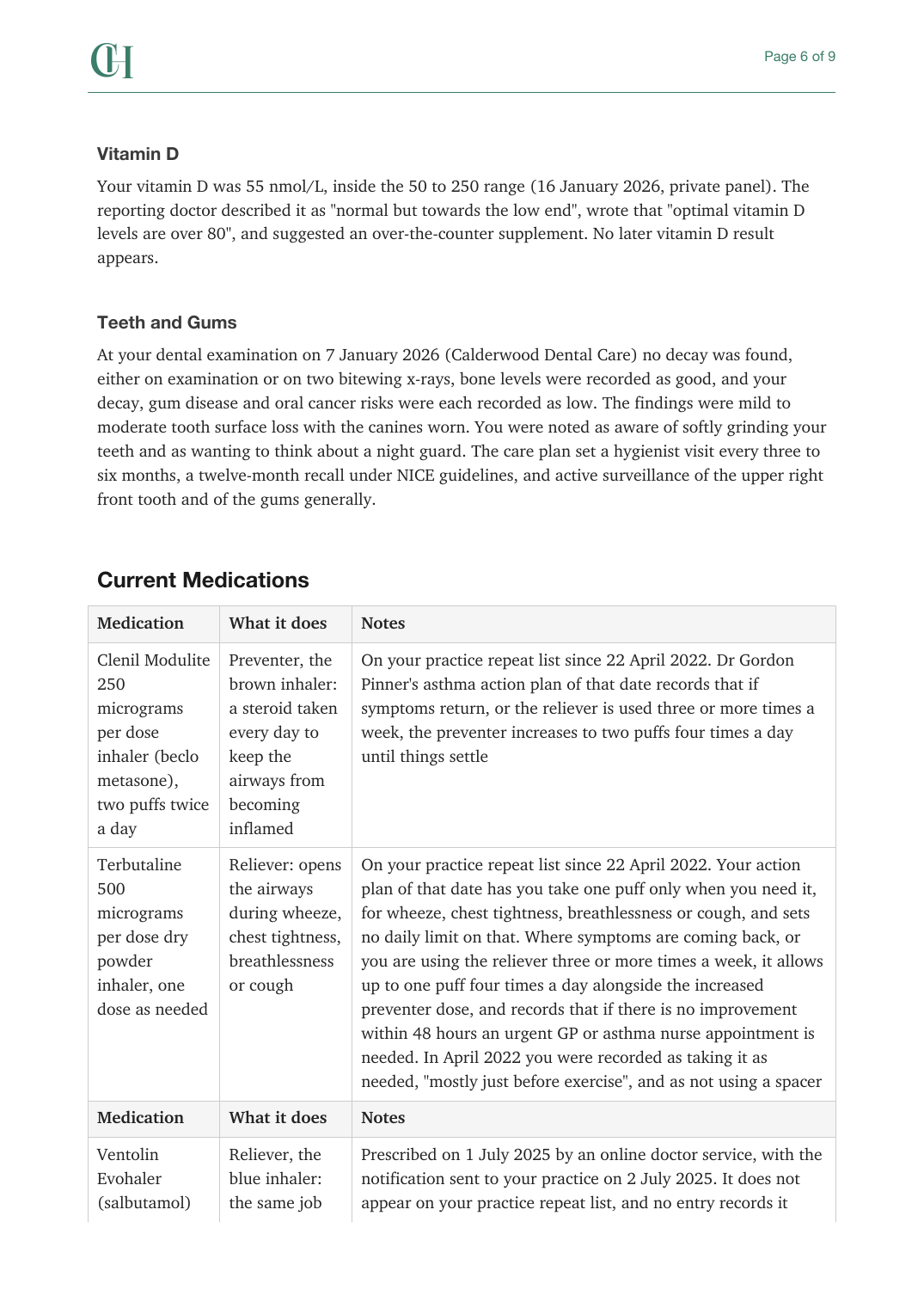
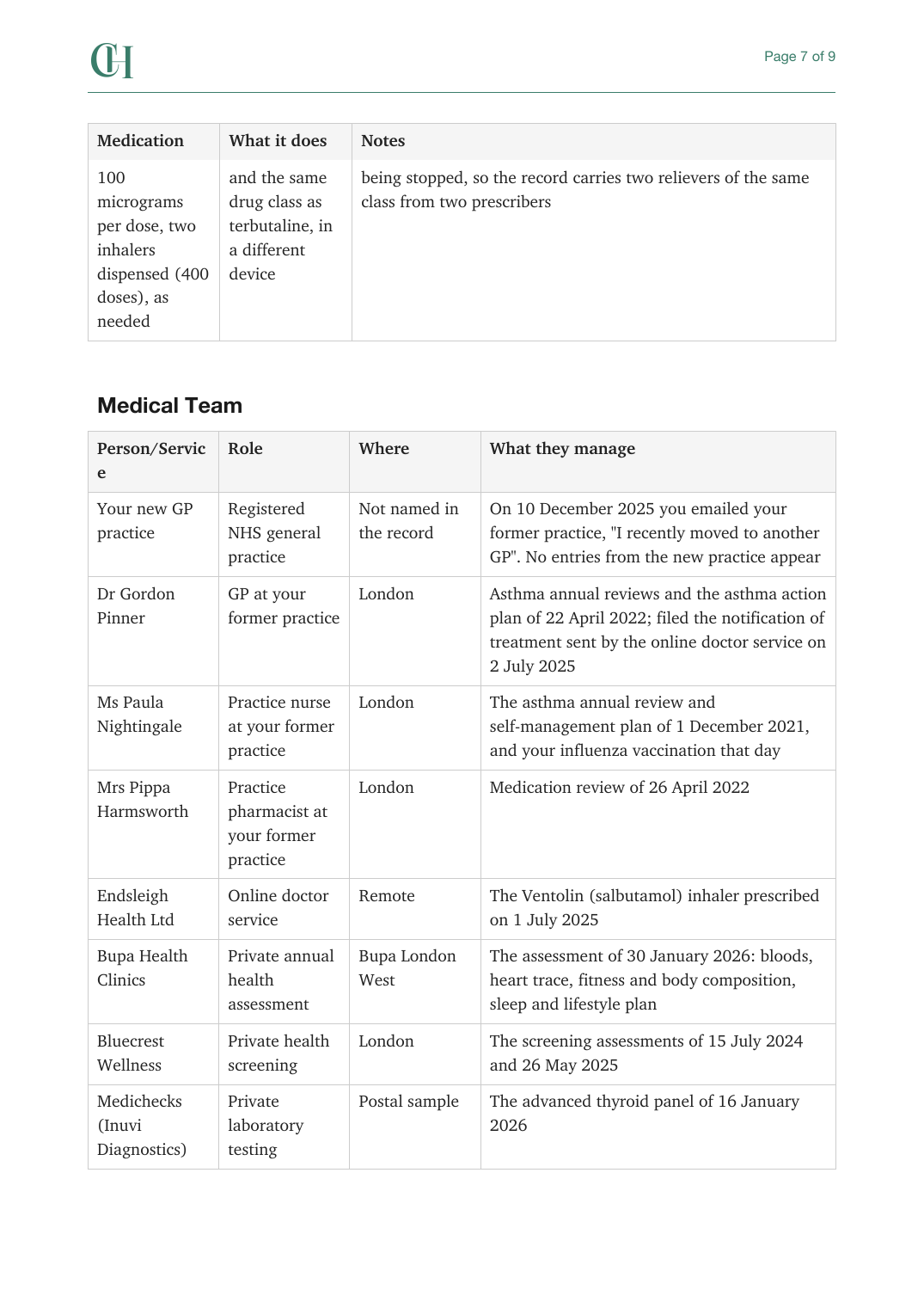
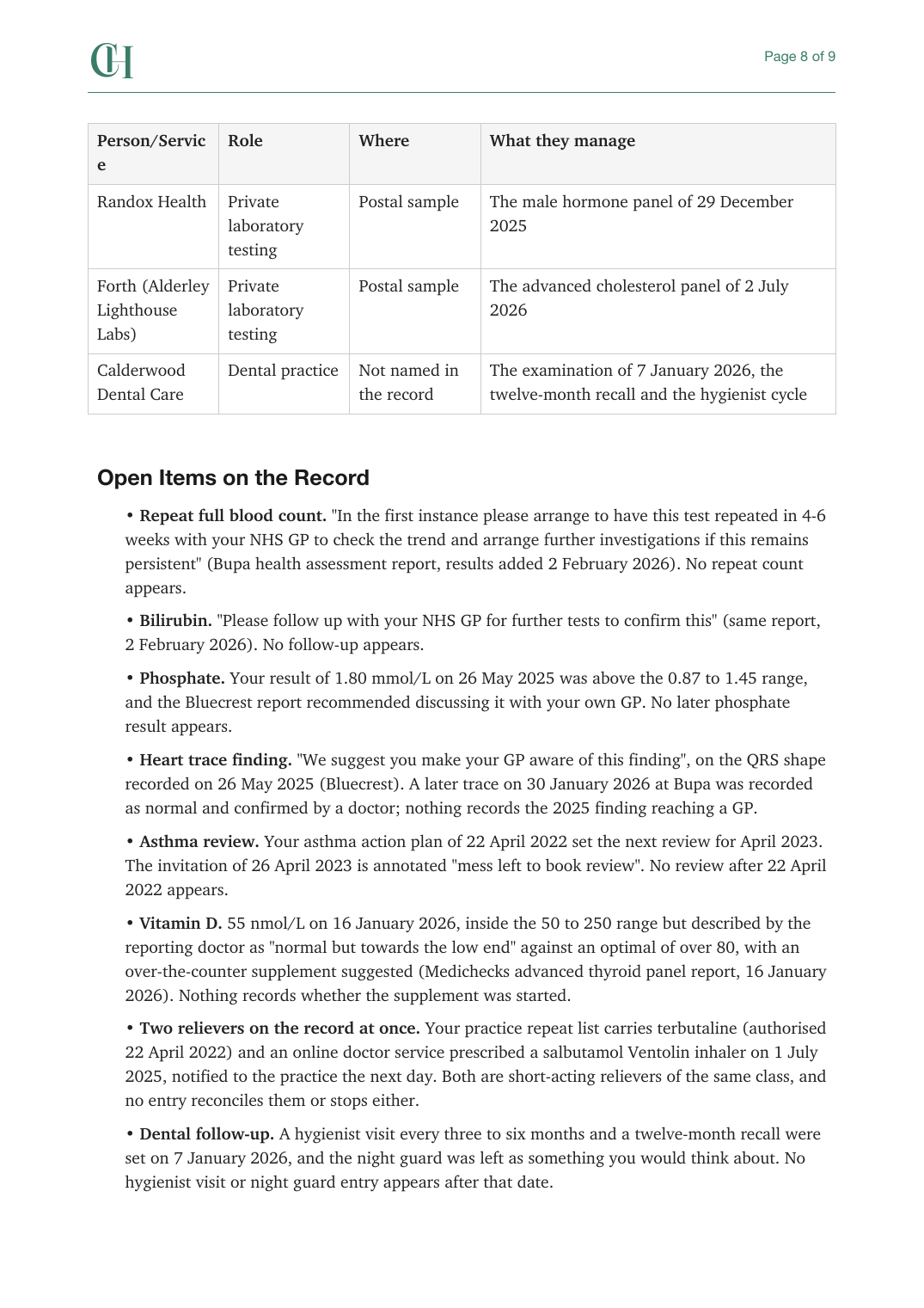
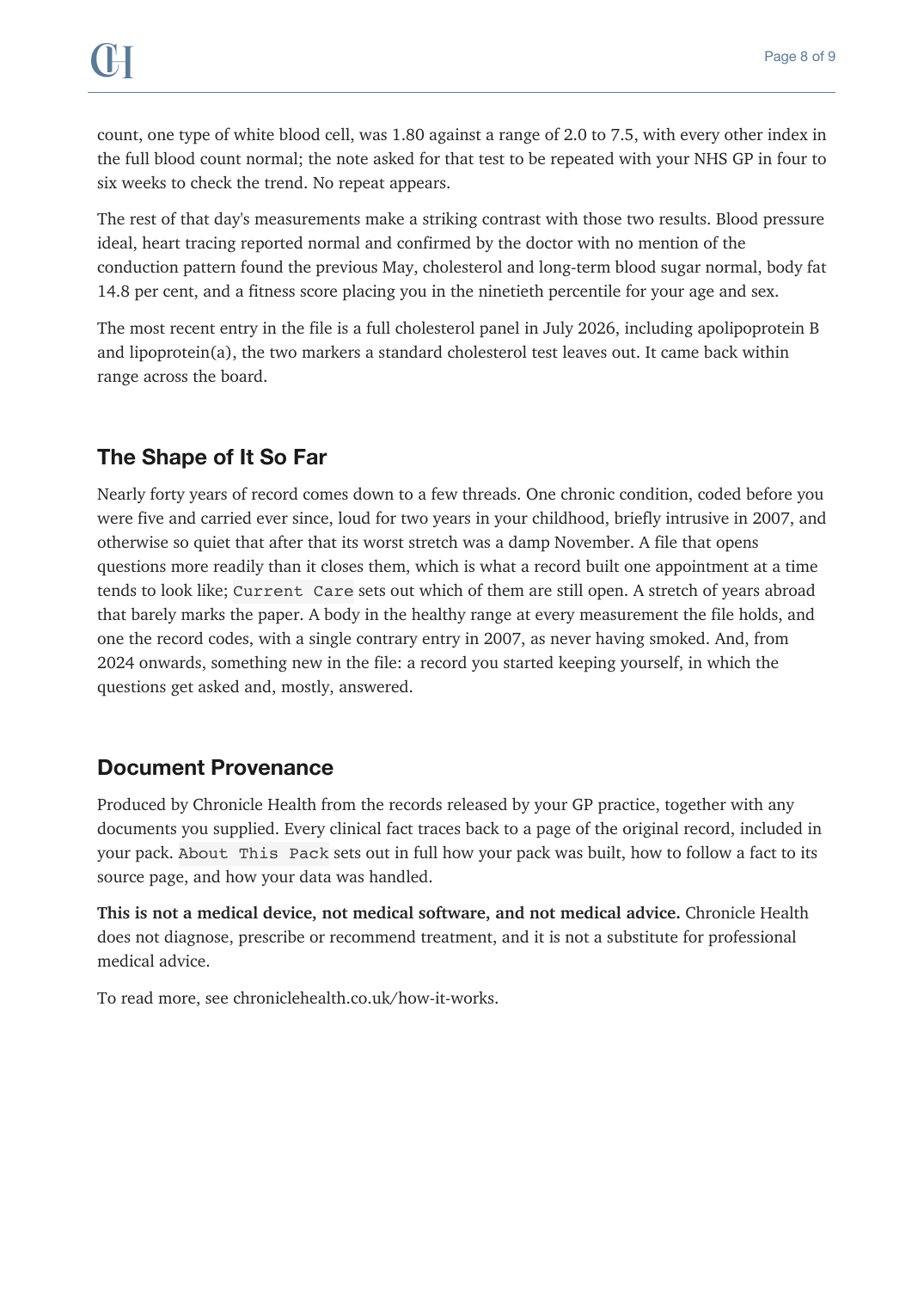
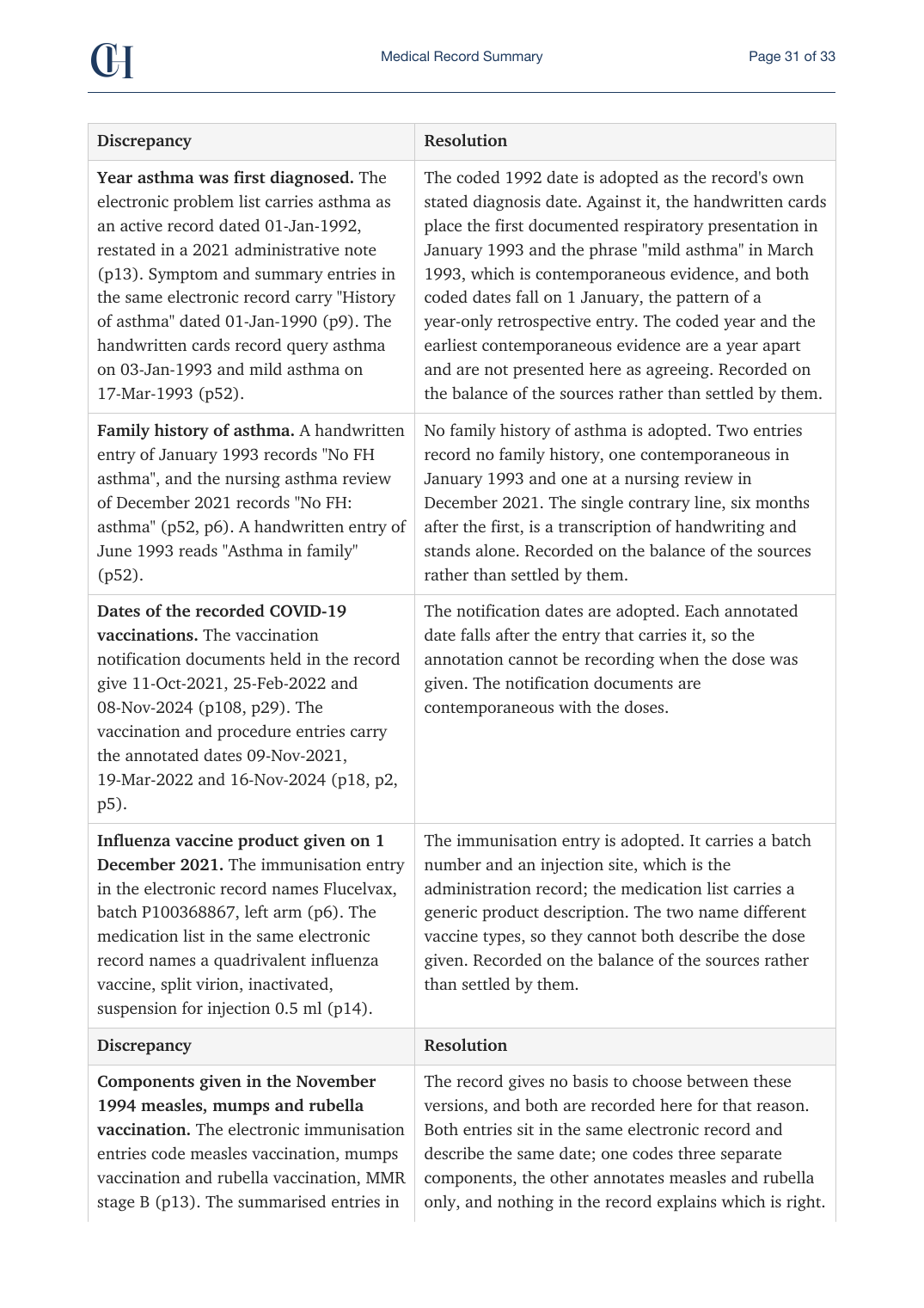
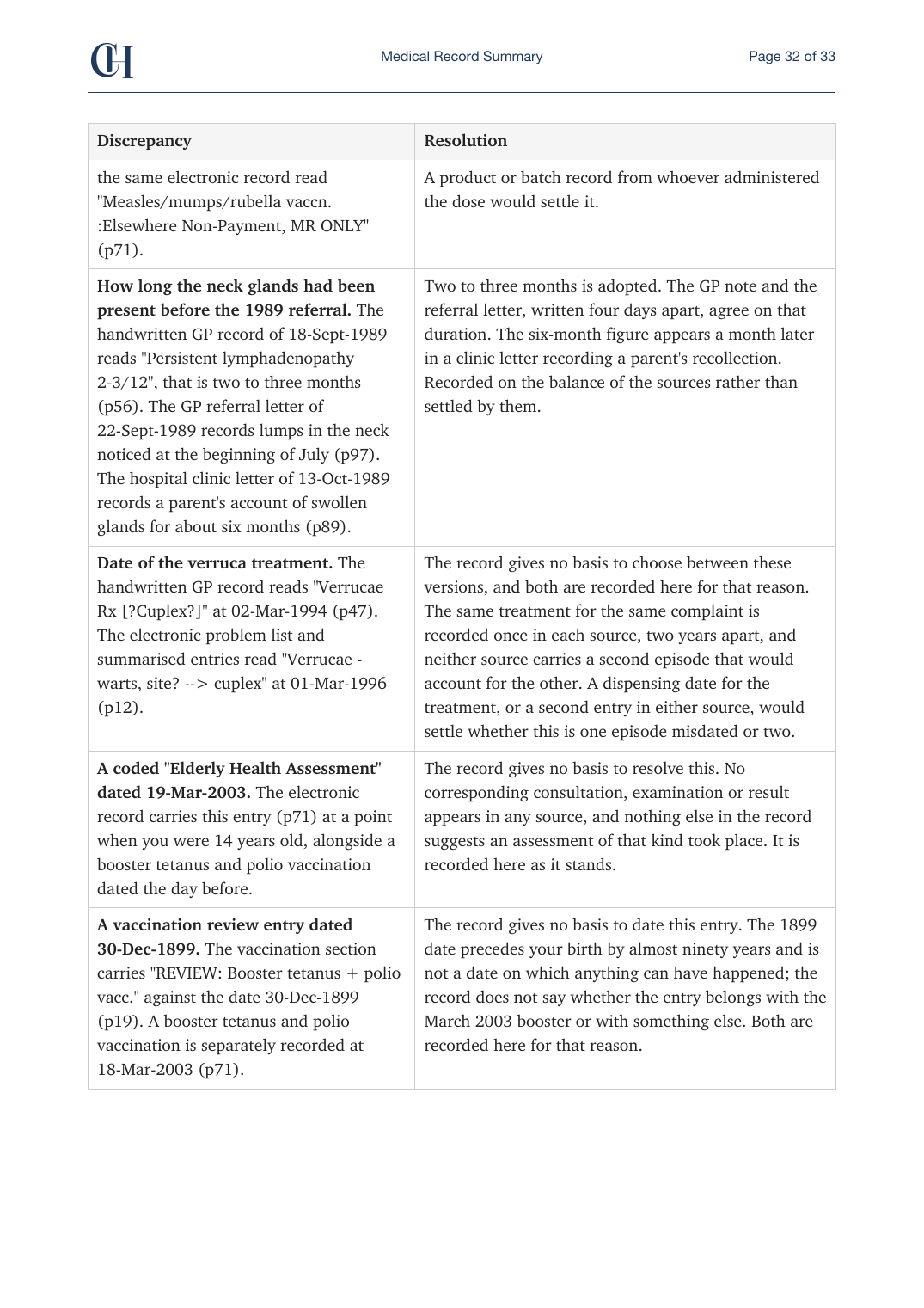
Your record restated by clinical topic, with every significant fact citing the page in your original GP record.


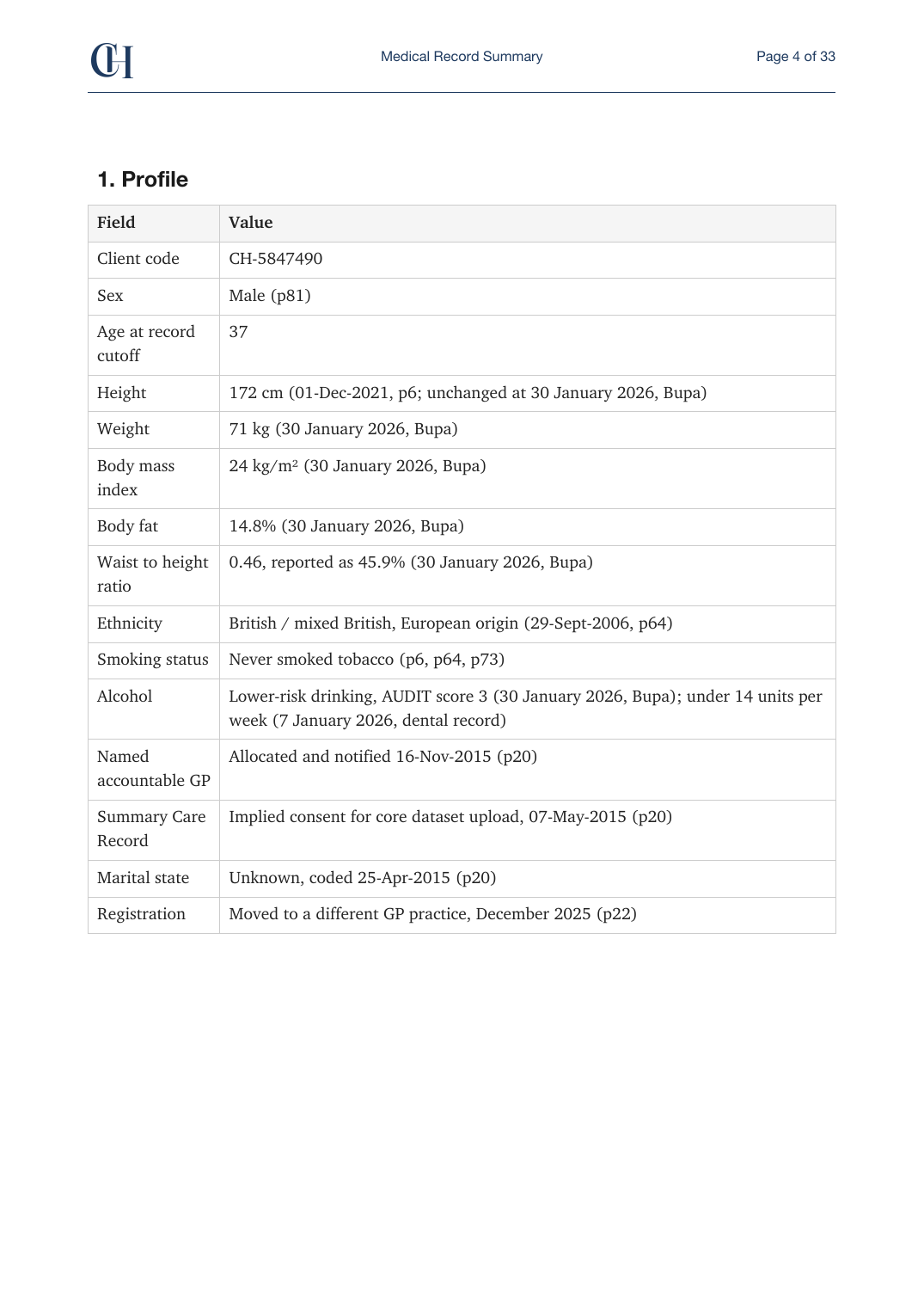
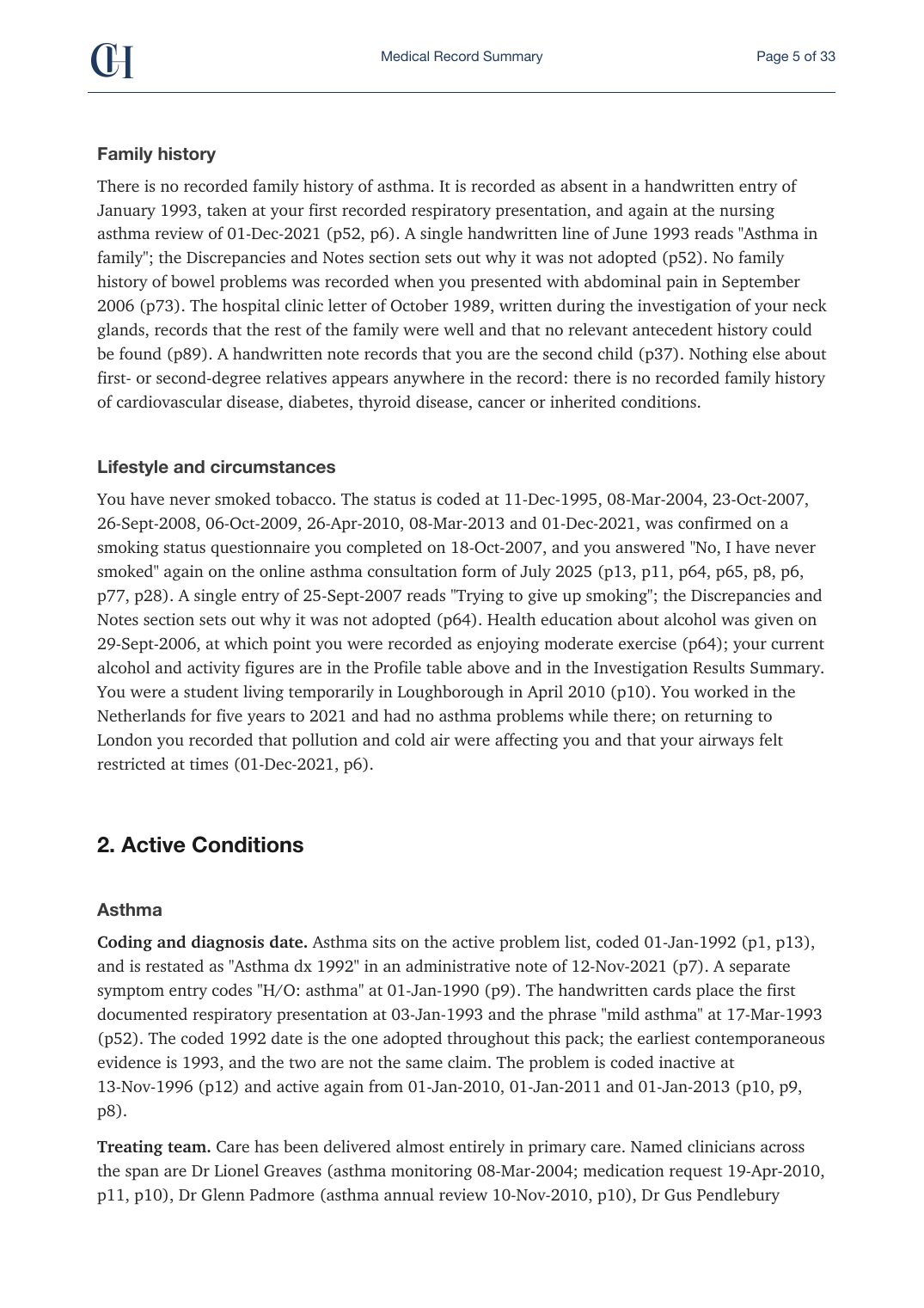
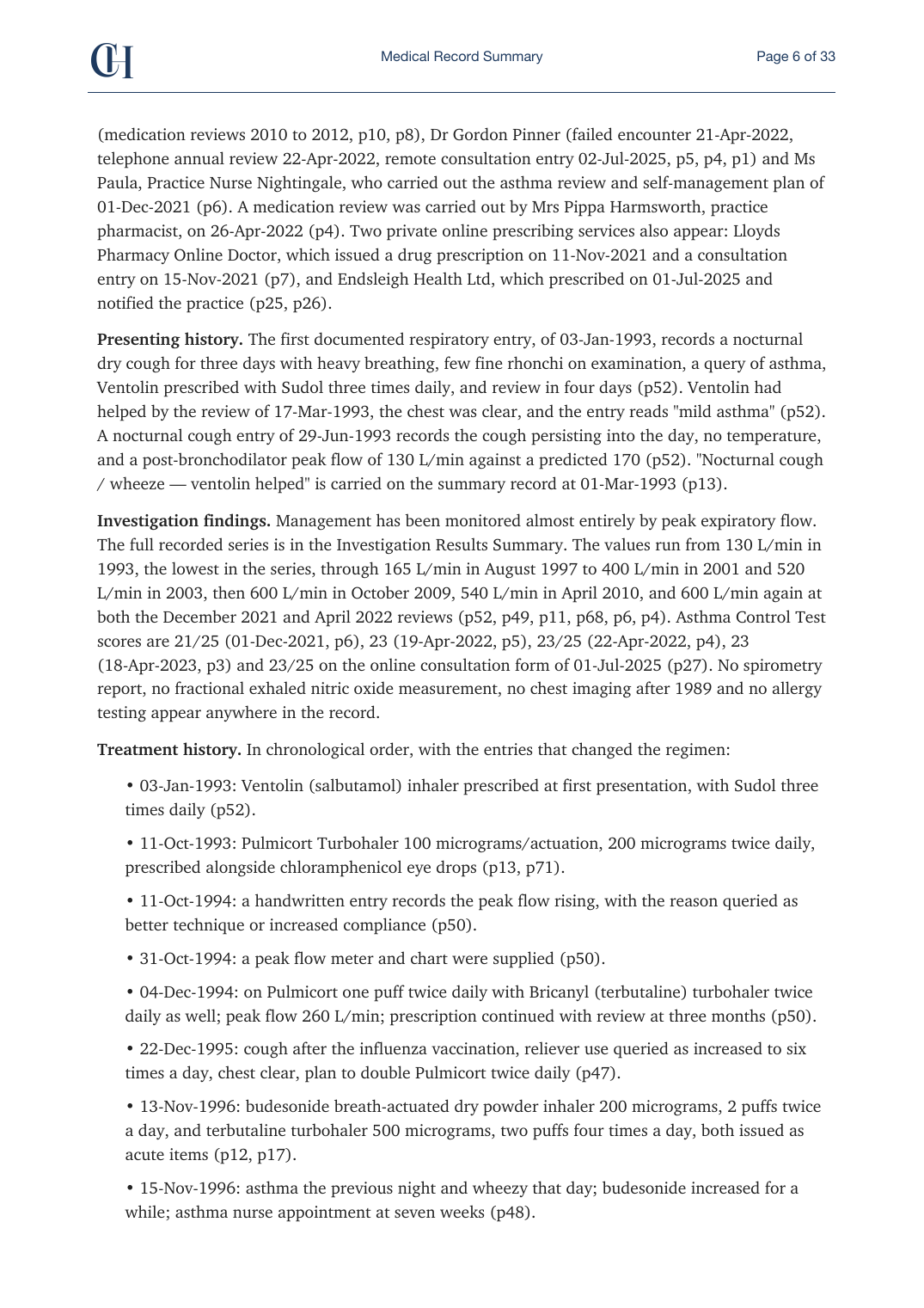
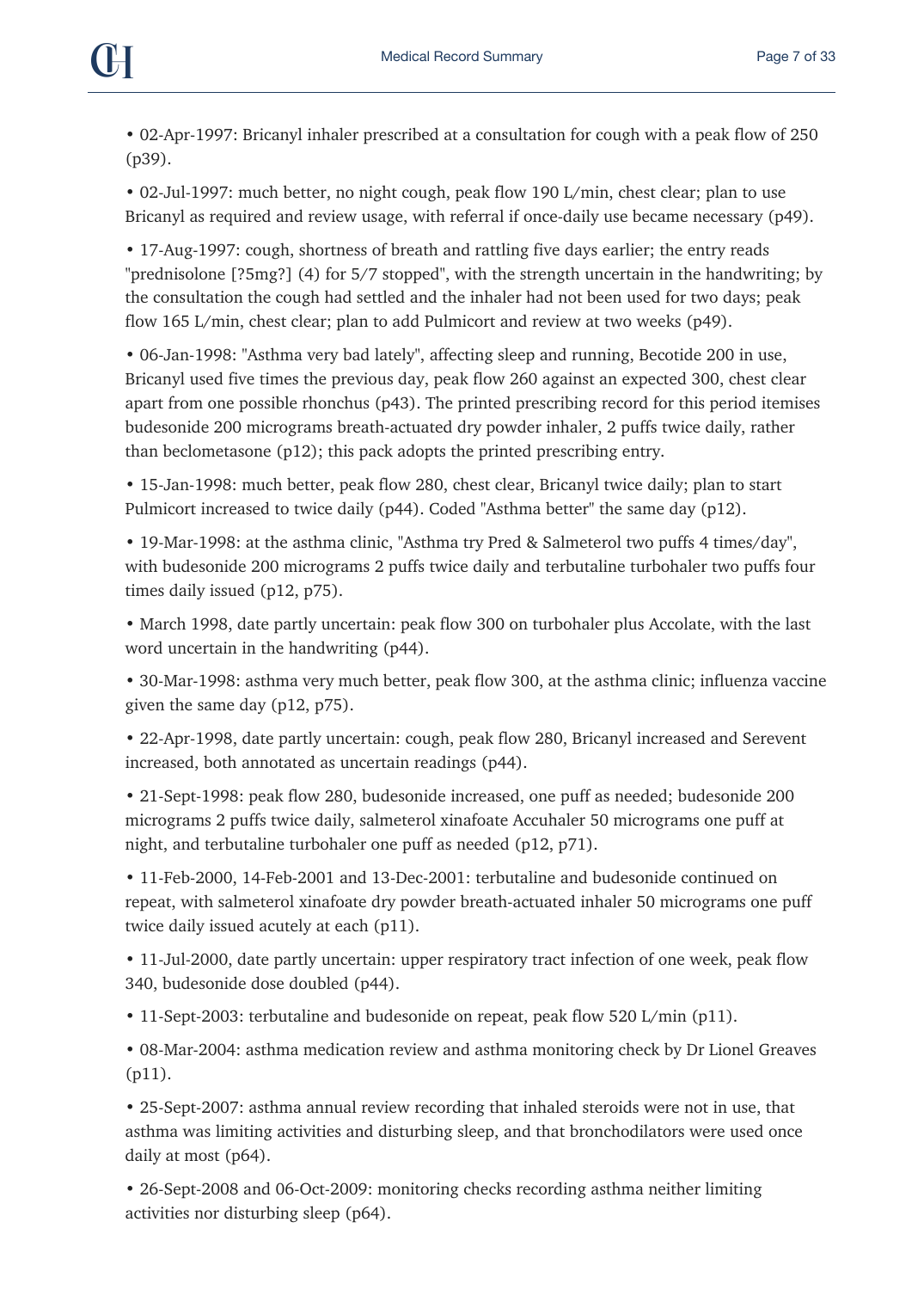
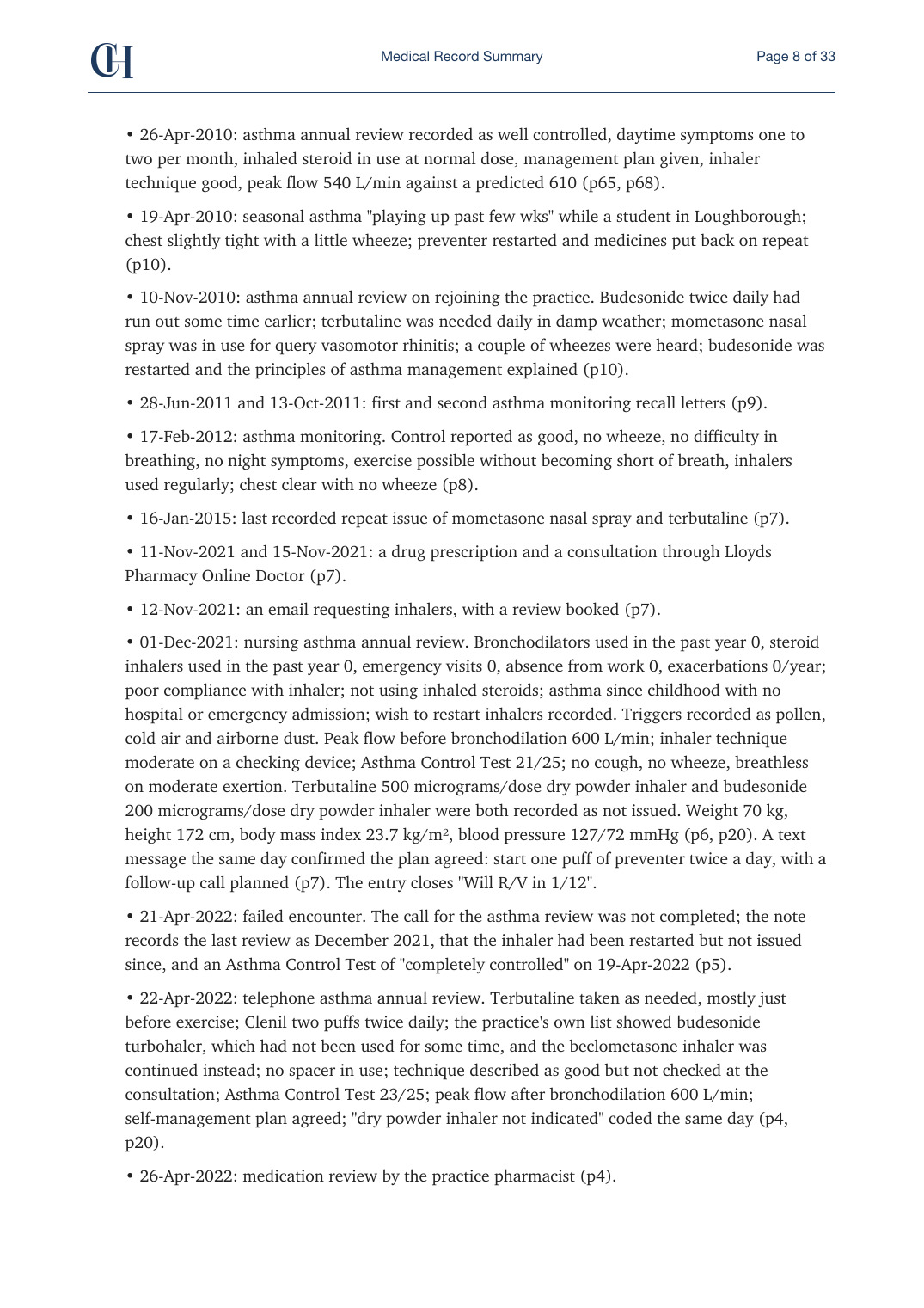
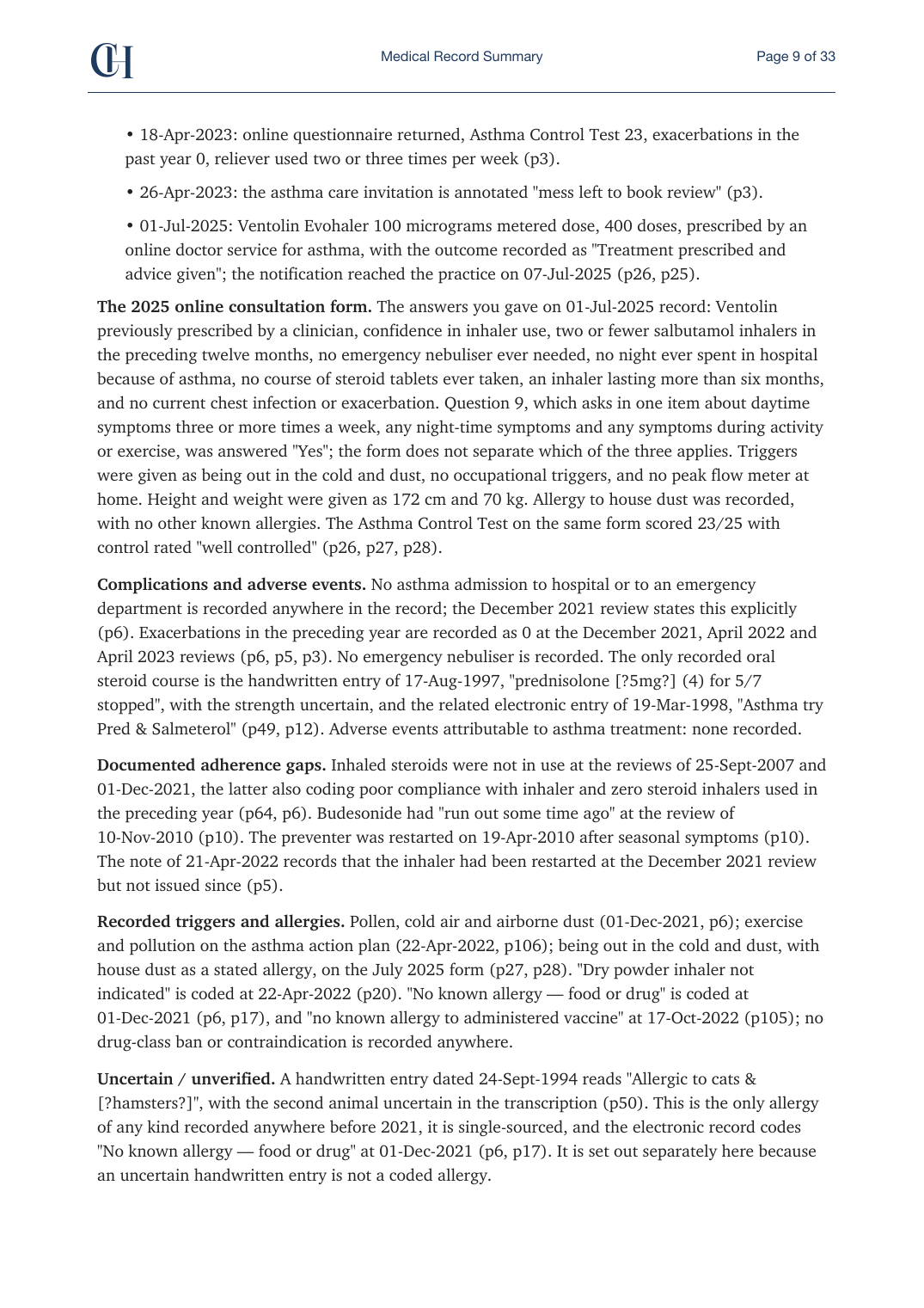
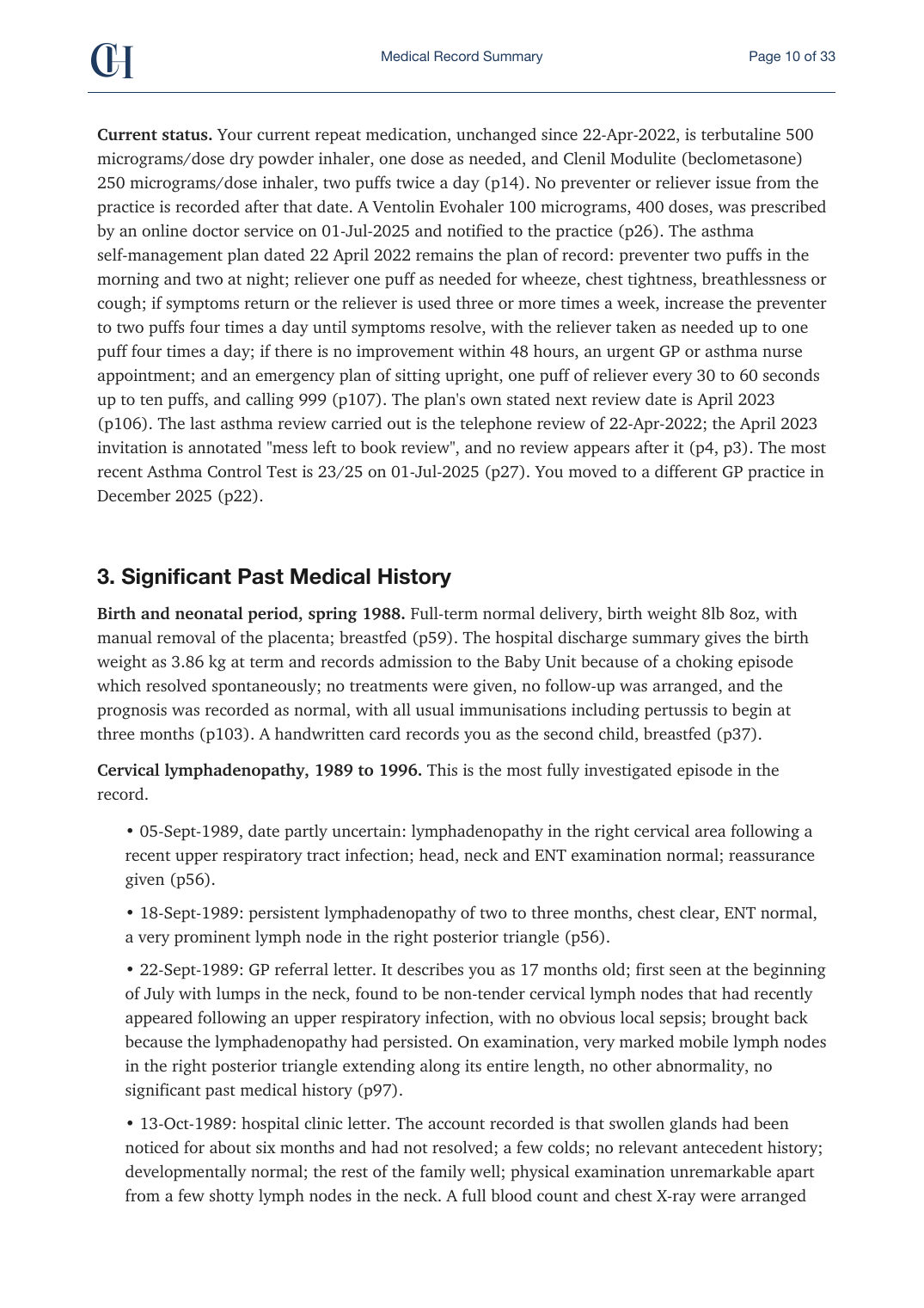
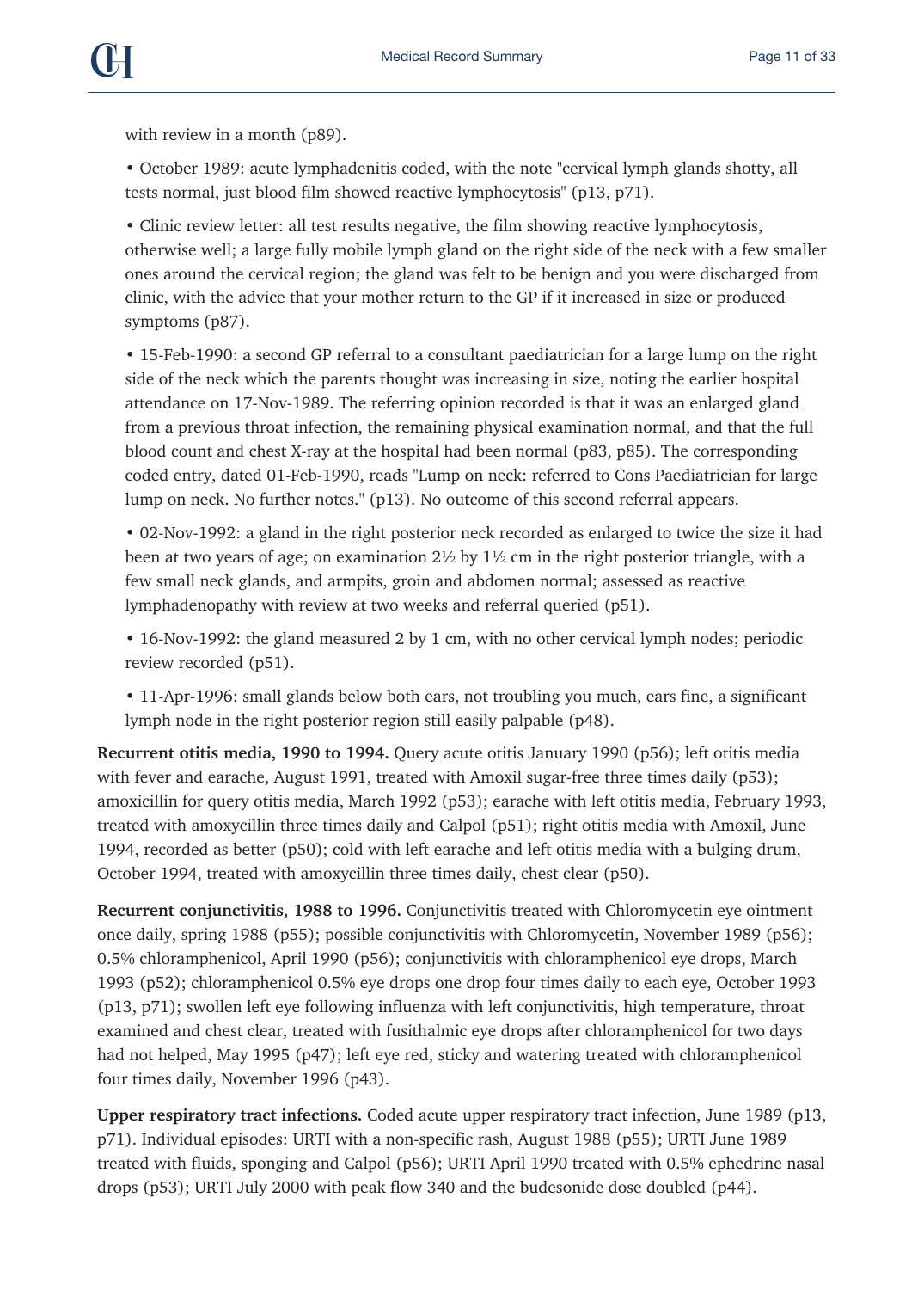
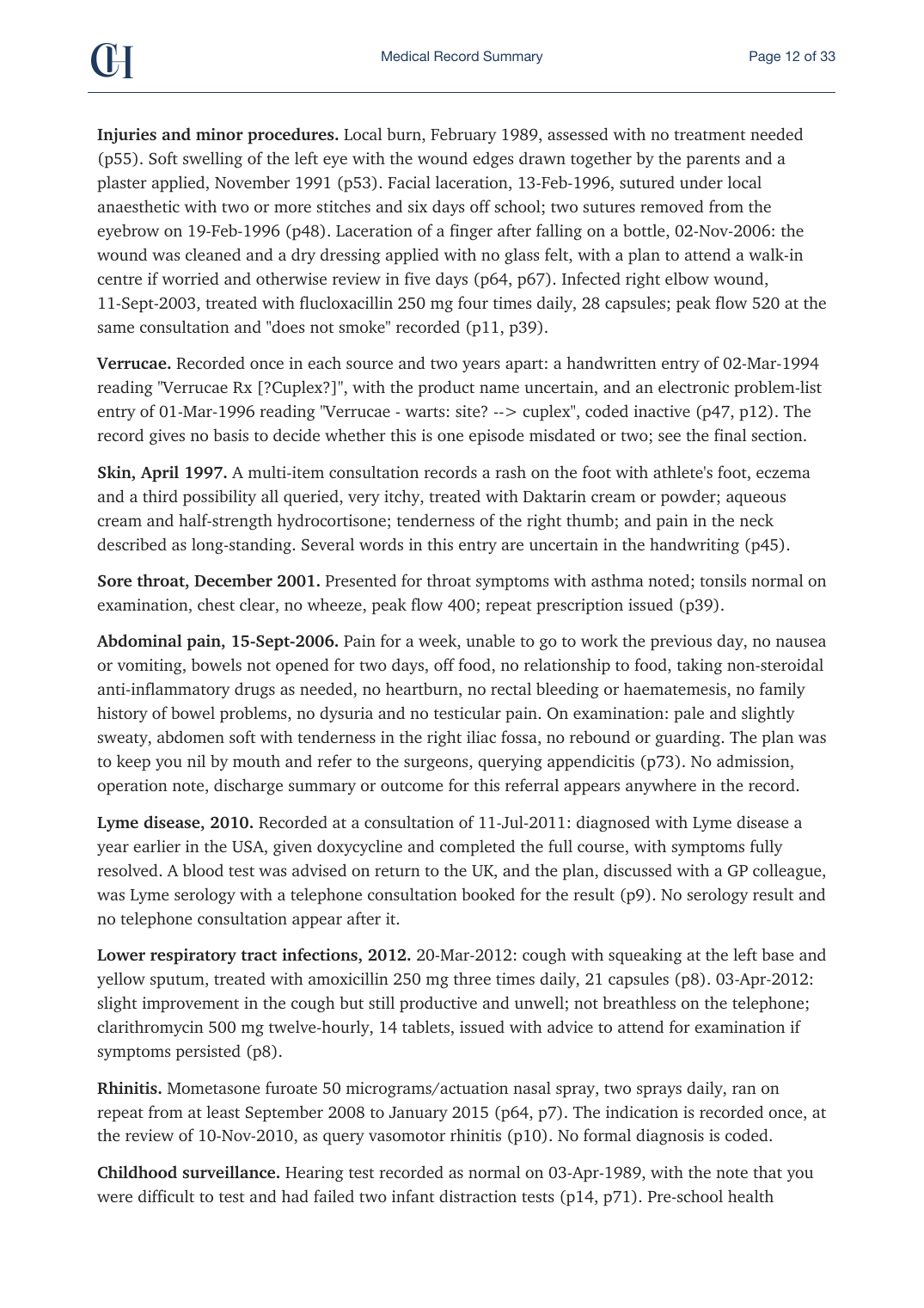
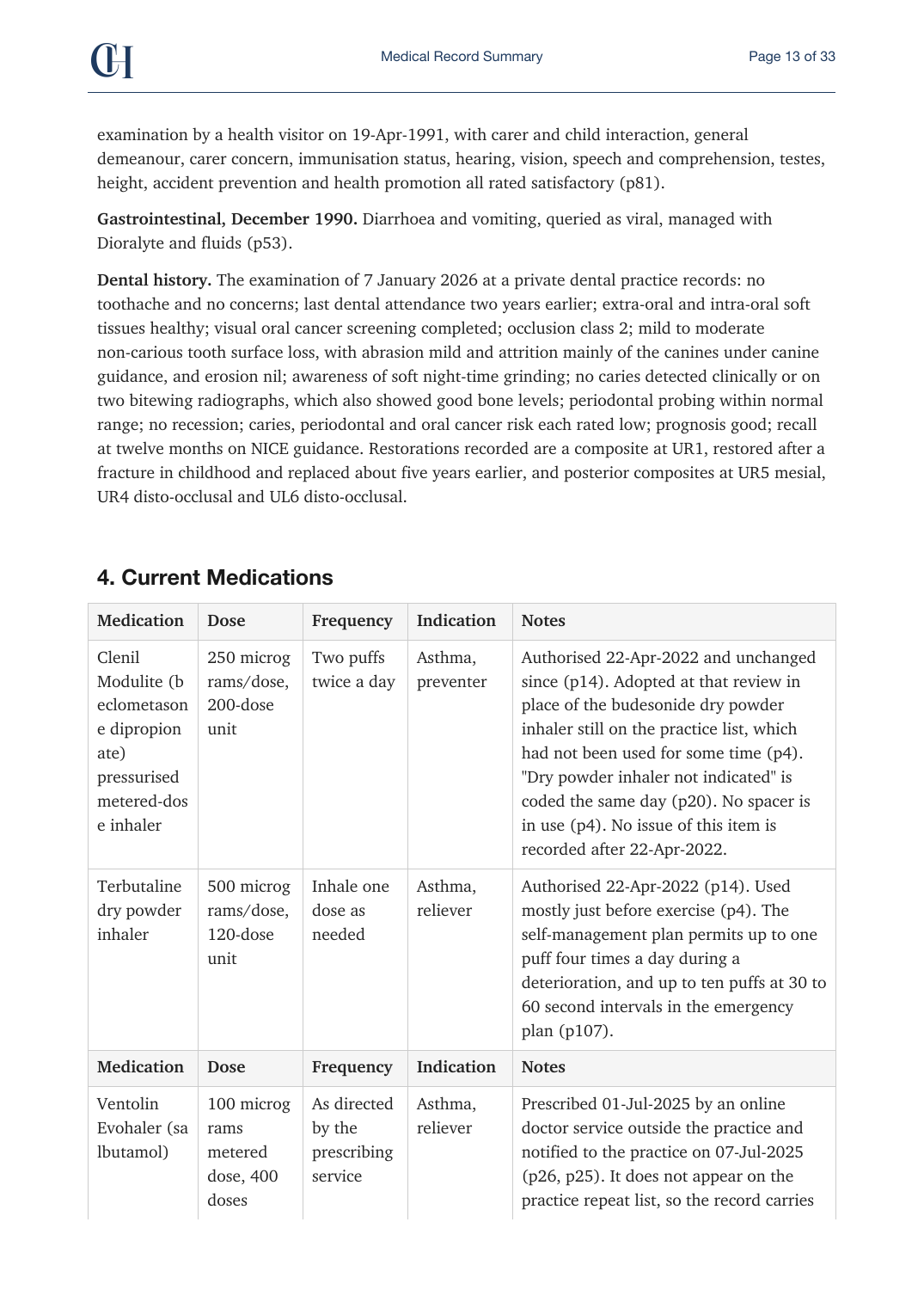
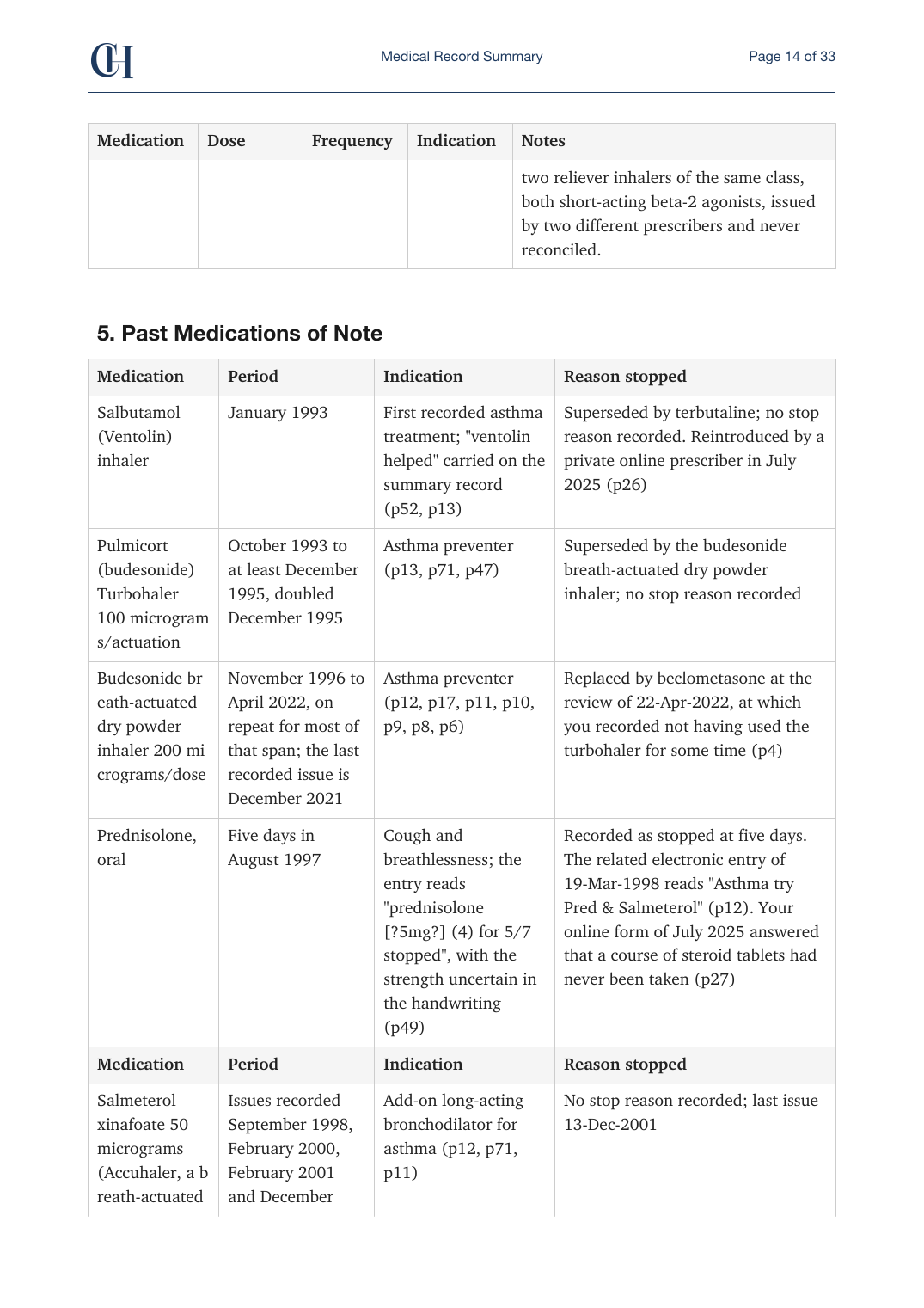
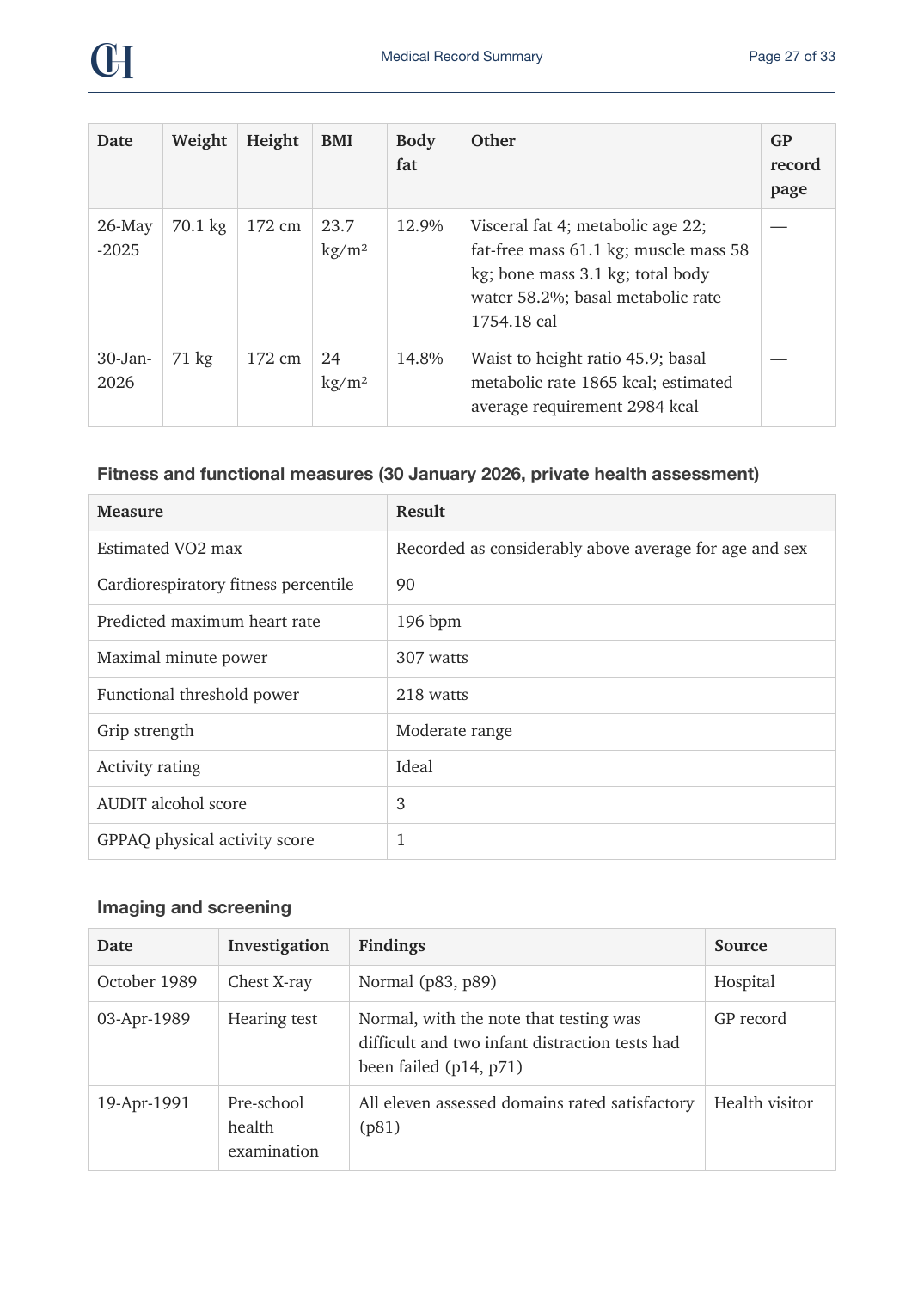
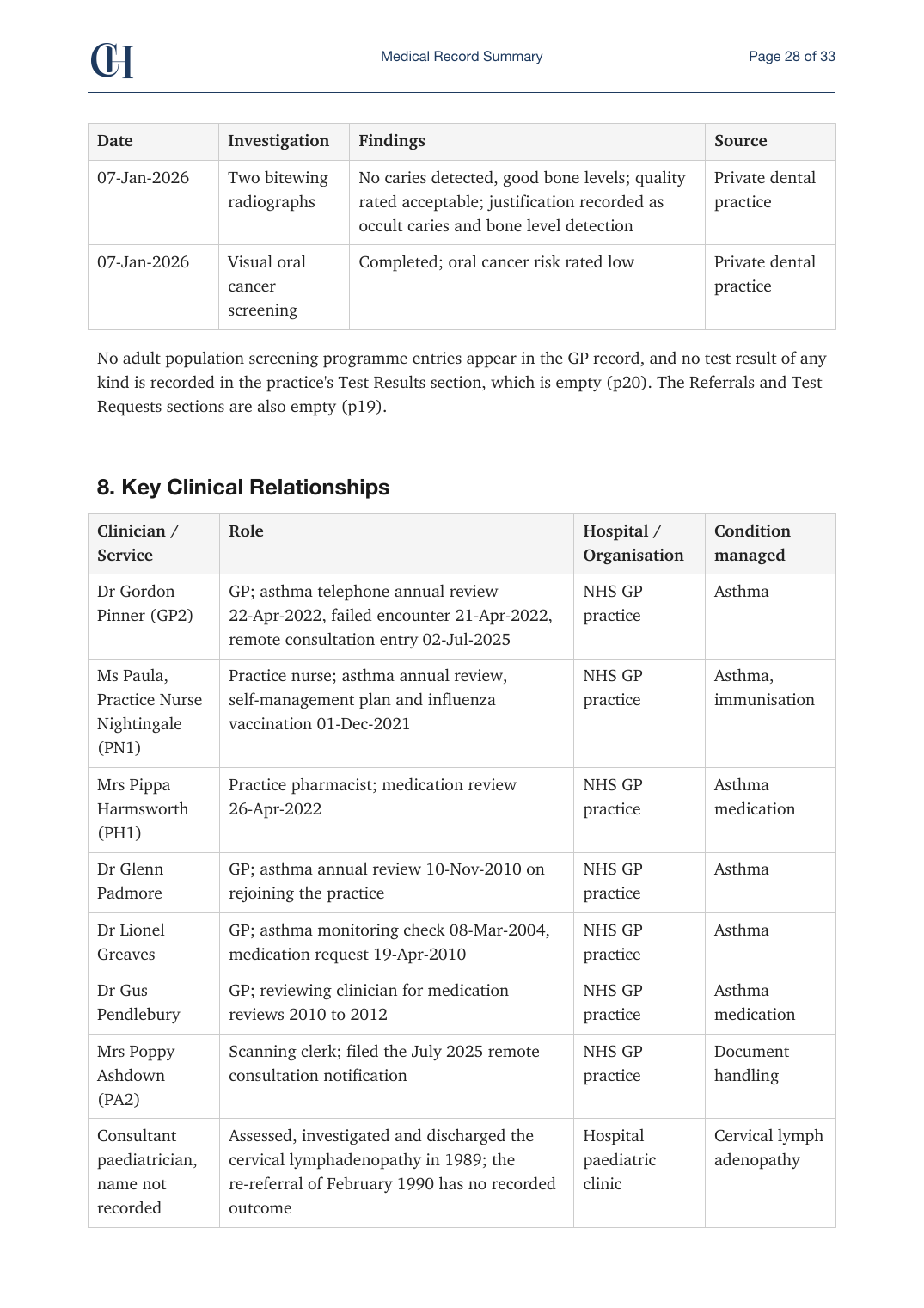
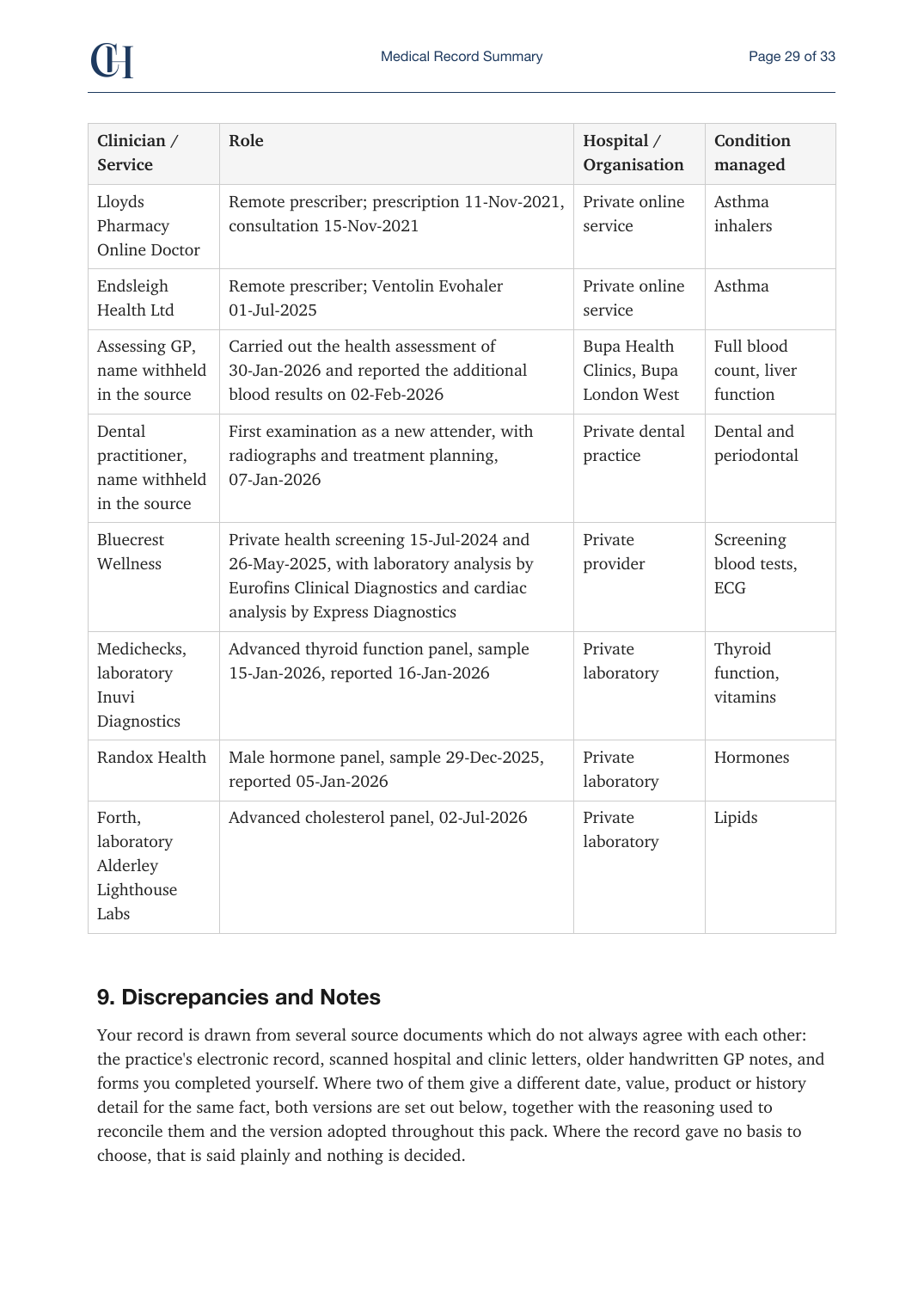
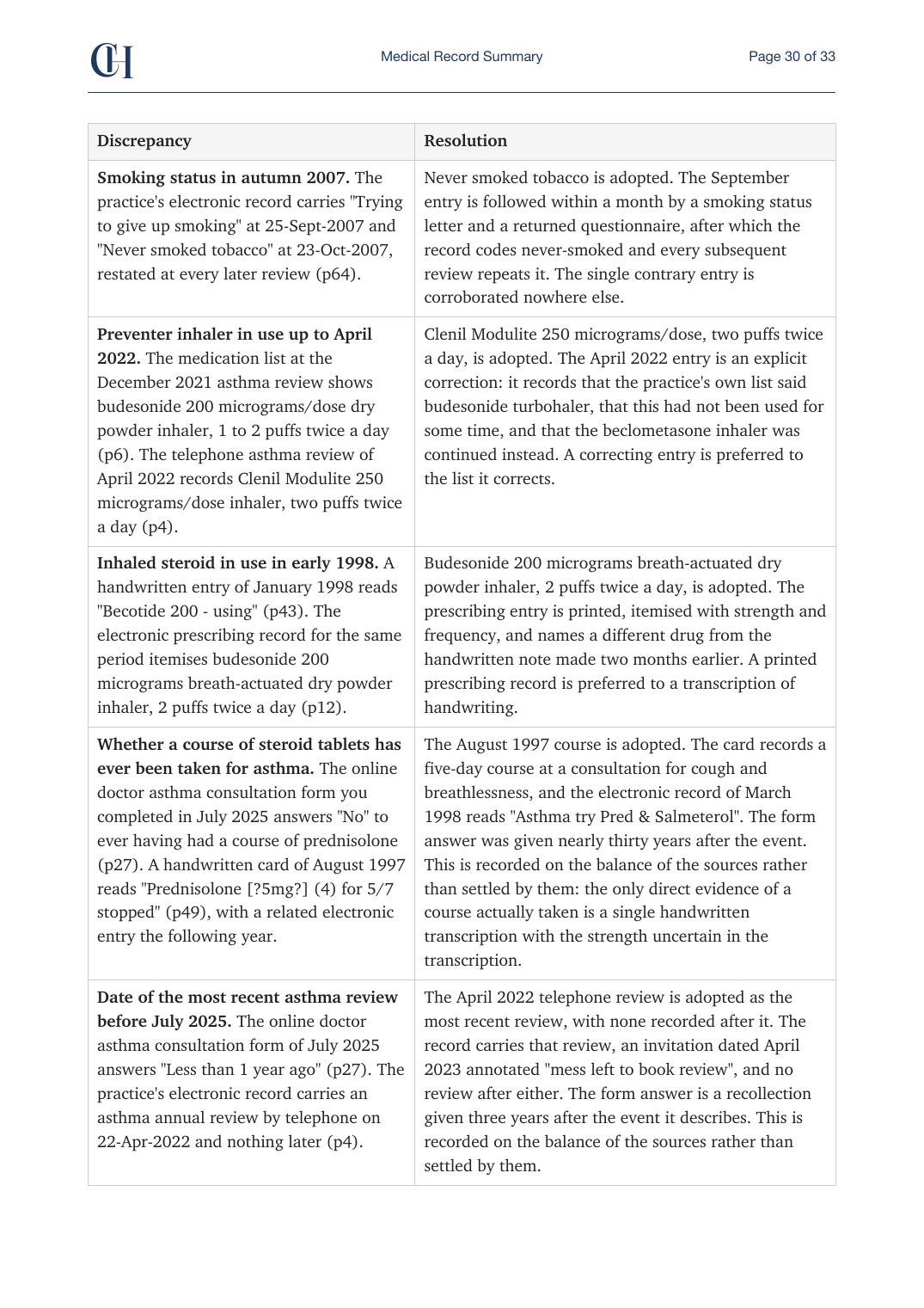

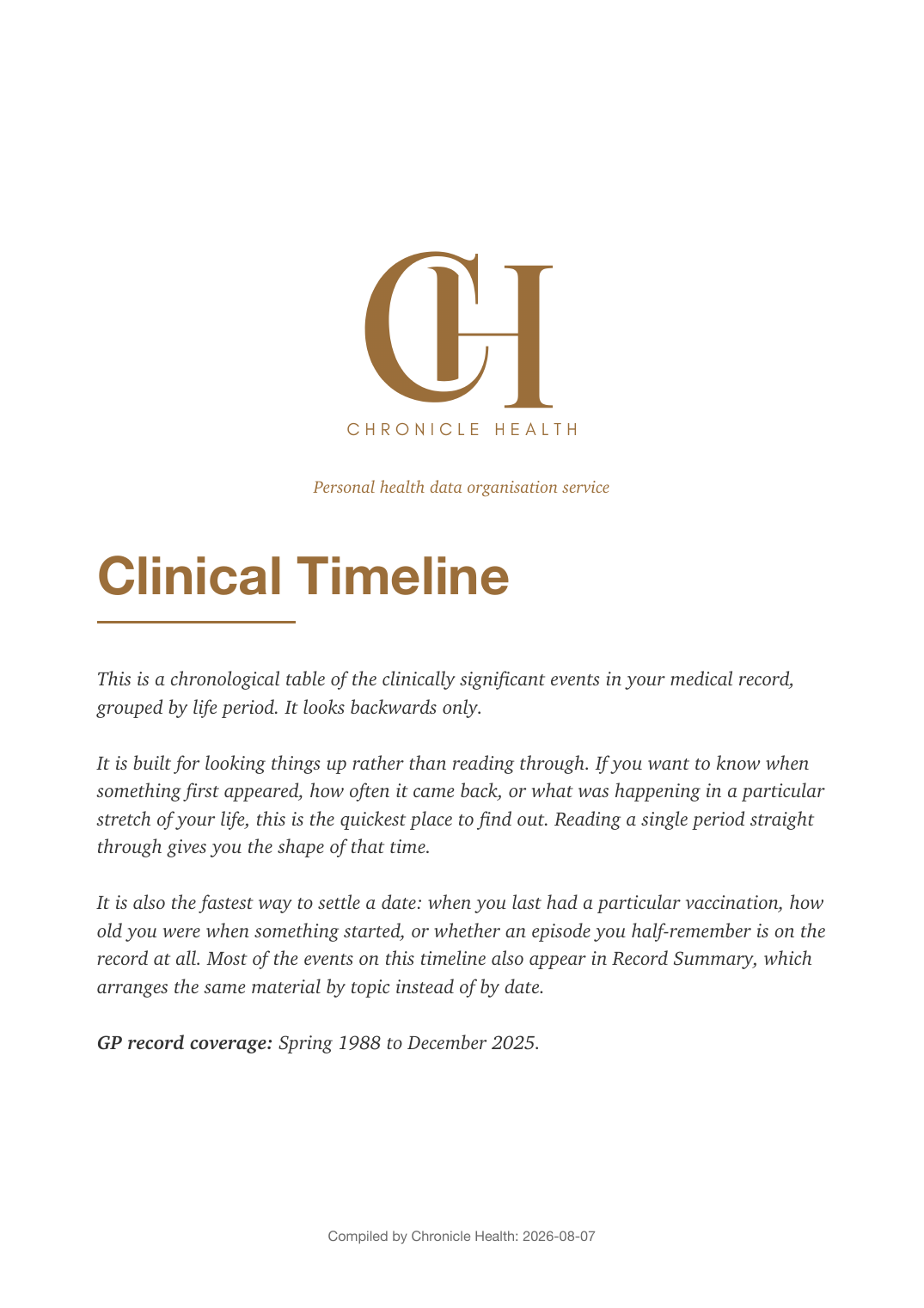
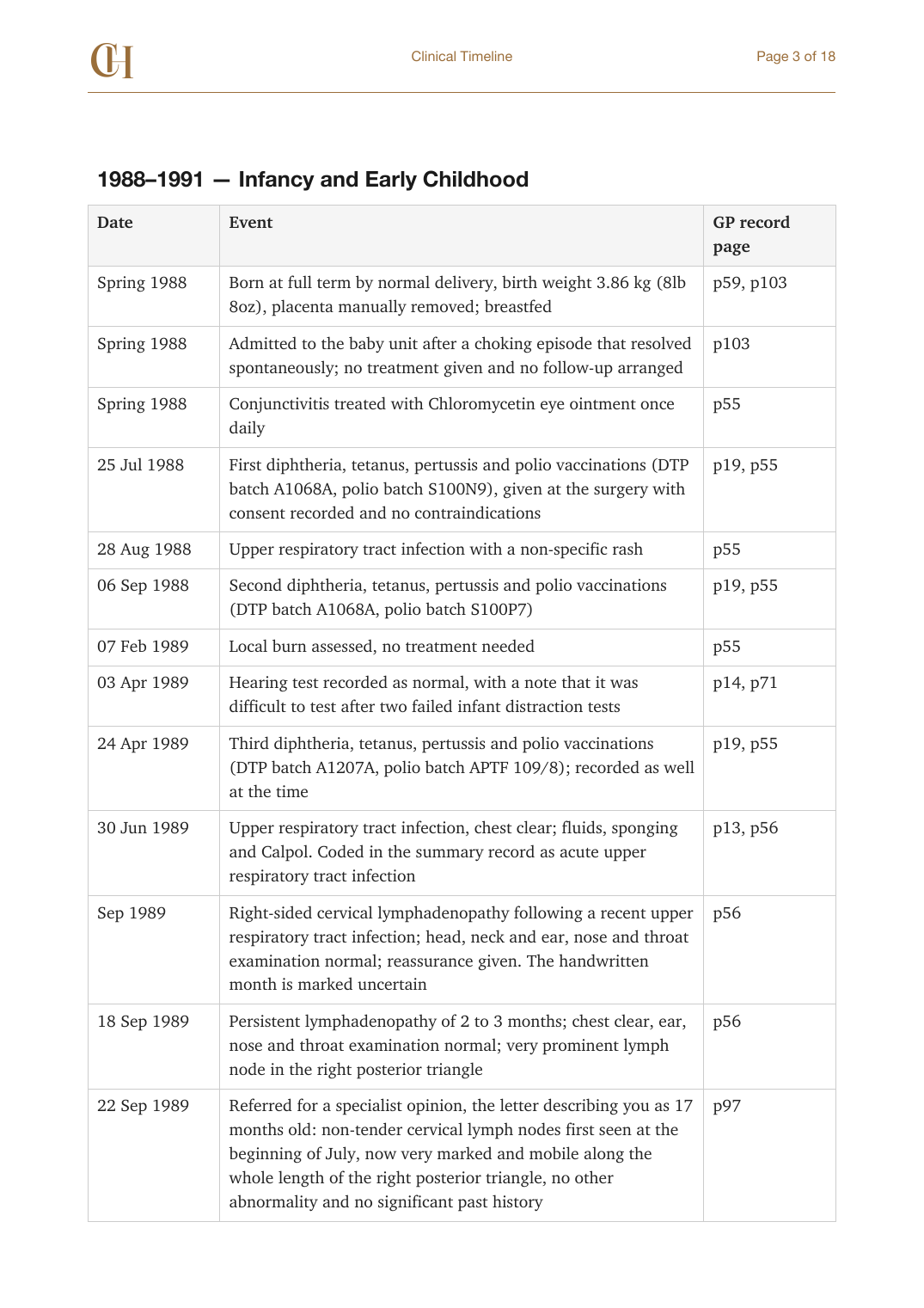
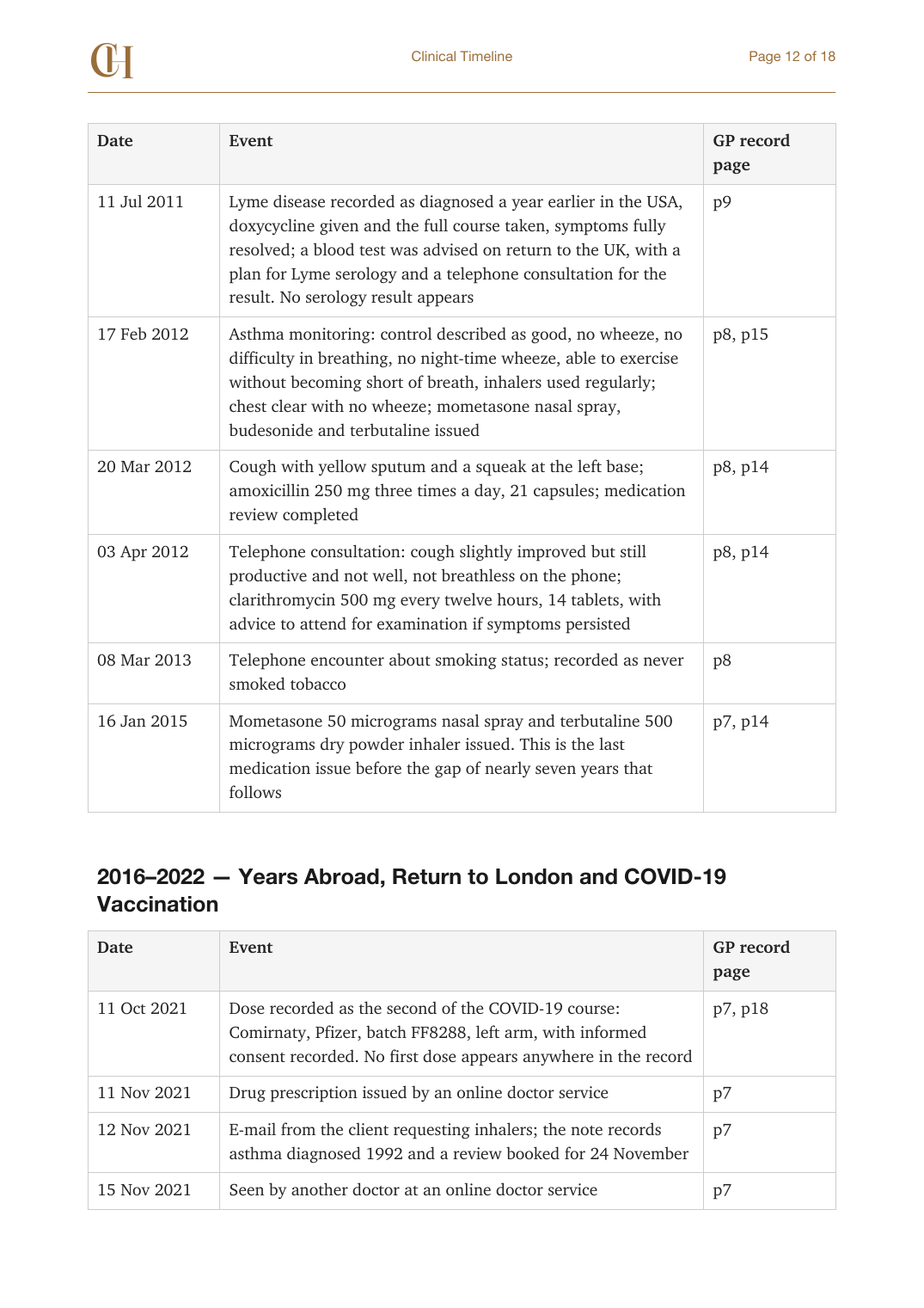
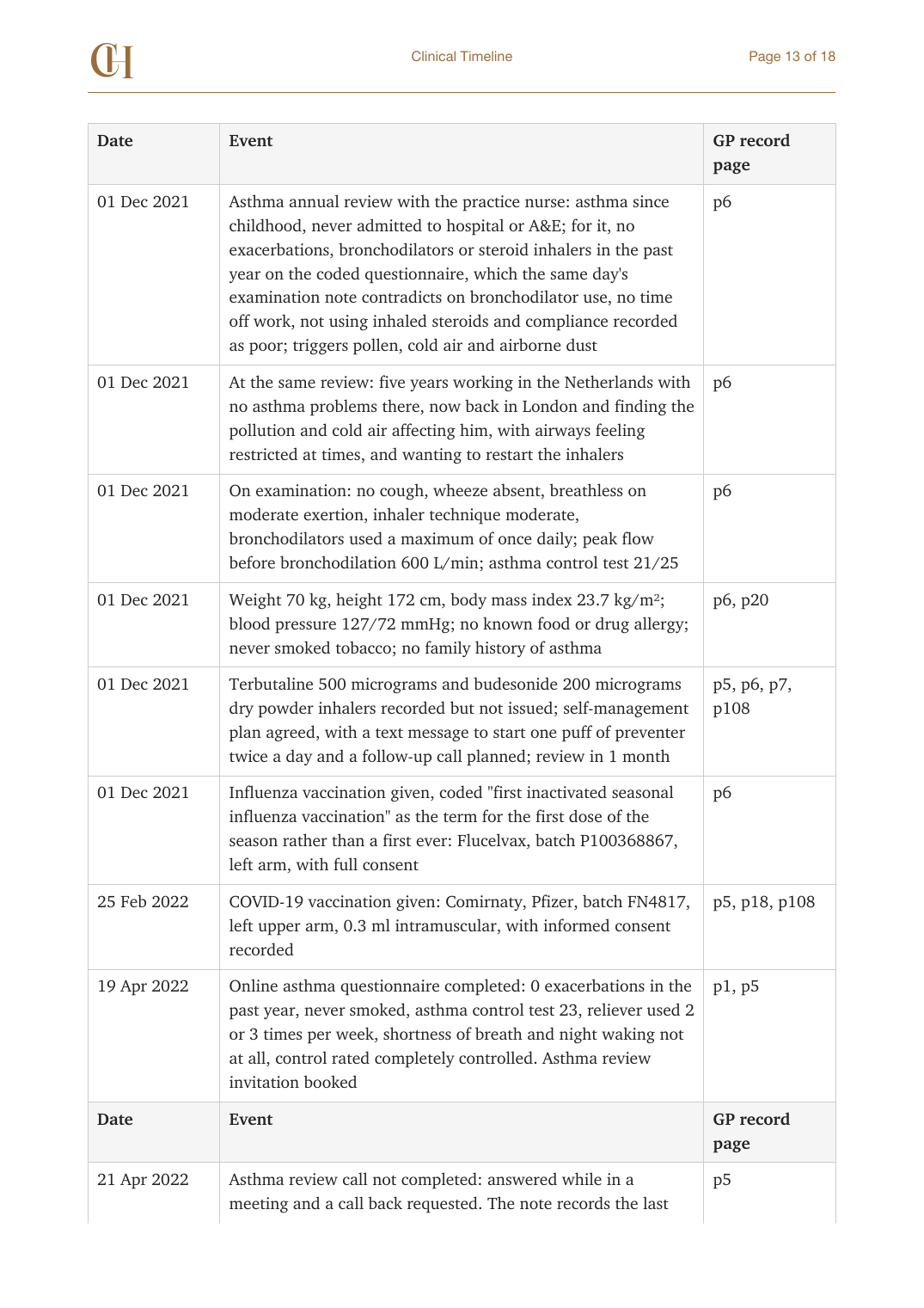
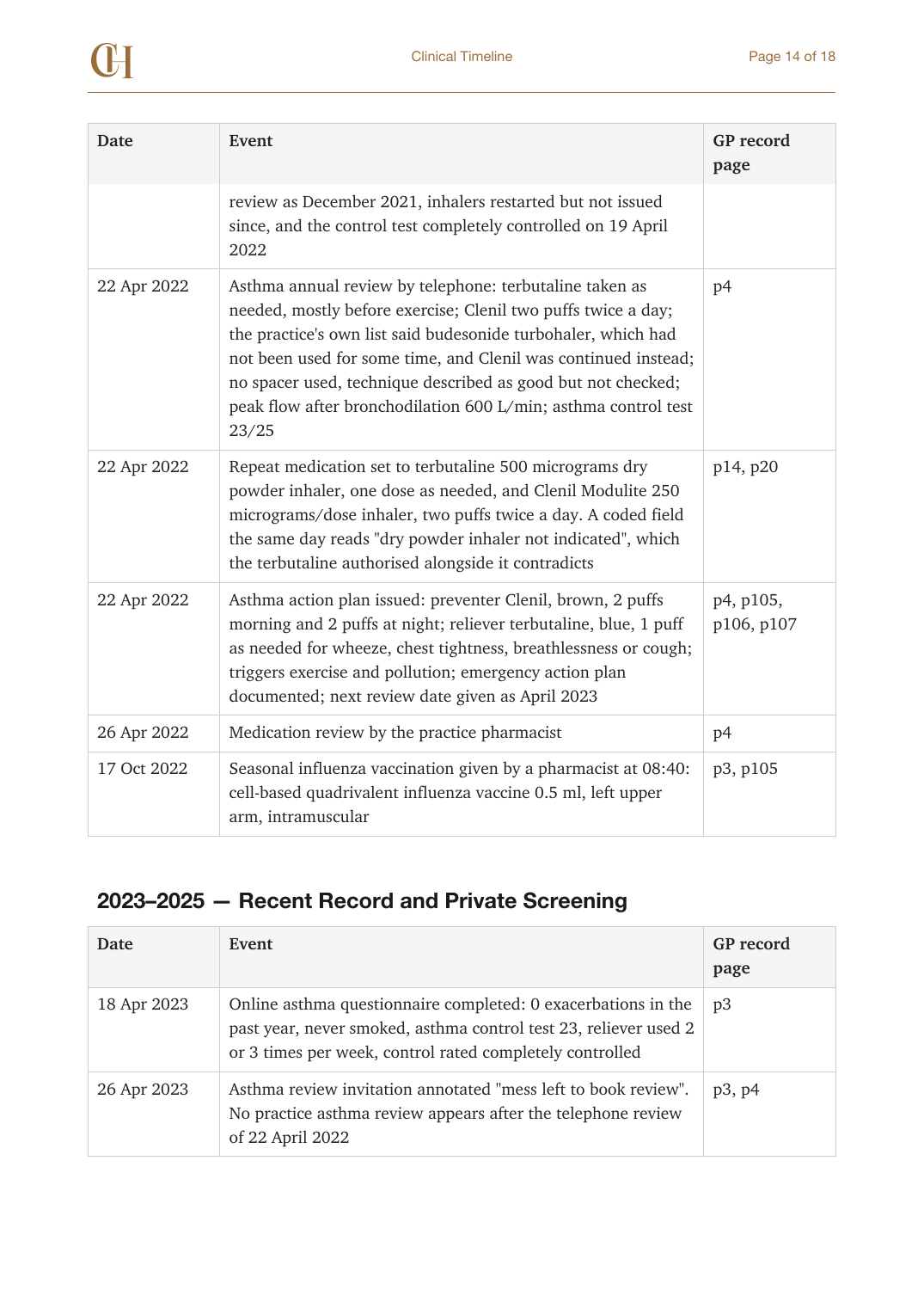
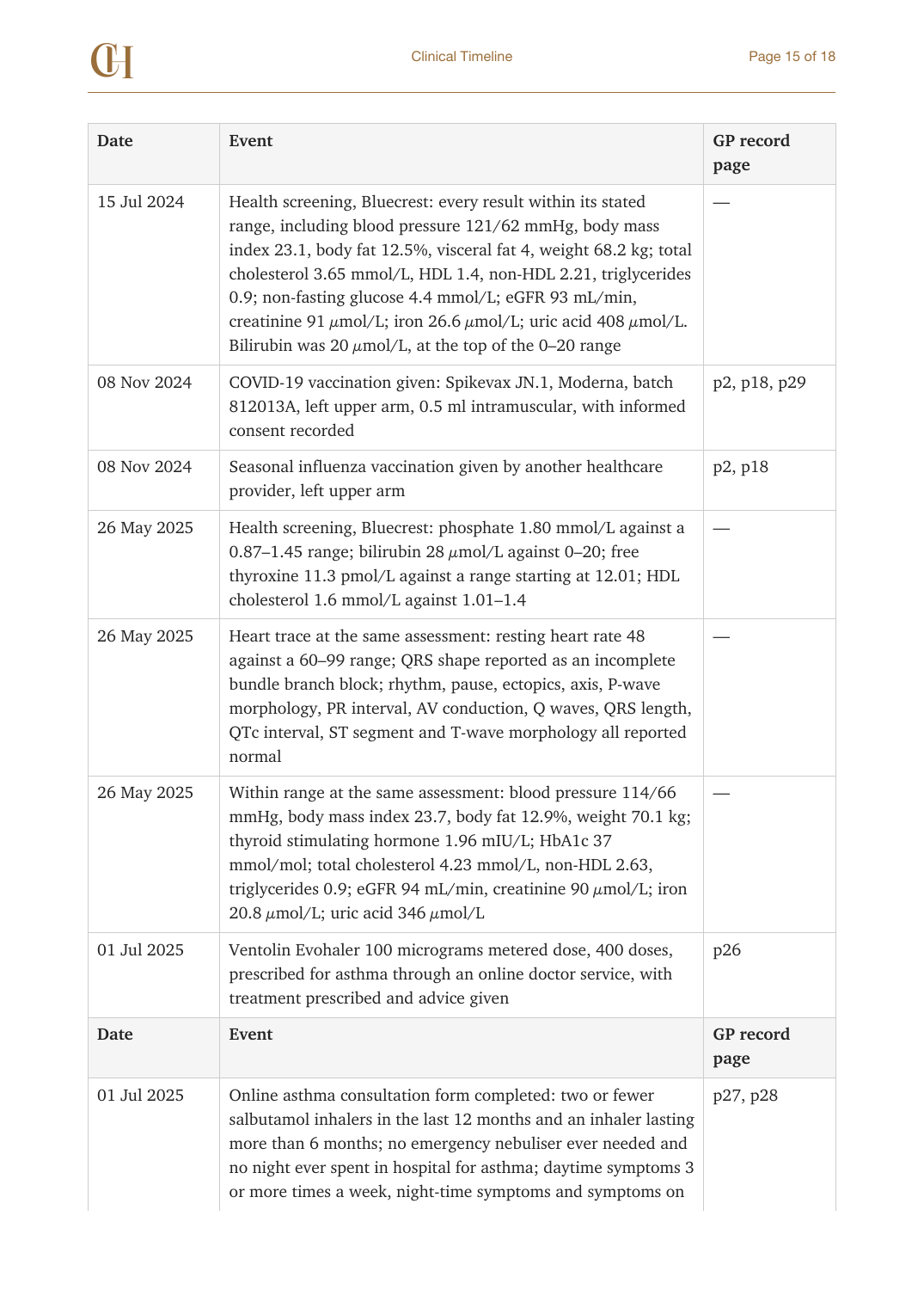
Every clinically significant event in date order, each row pointing back to the page in your record where it appears.

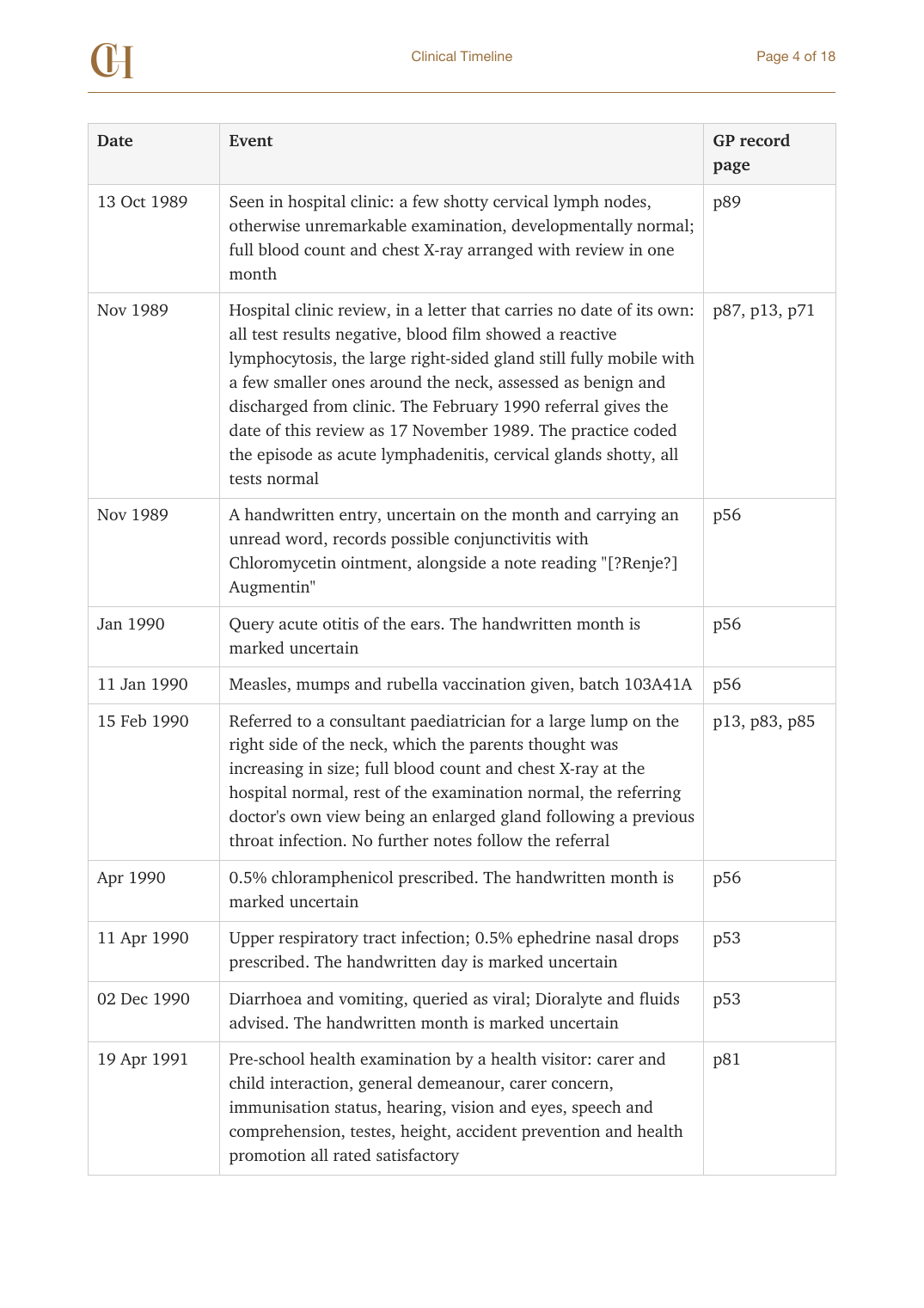
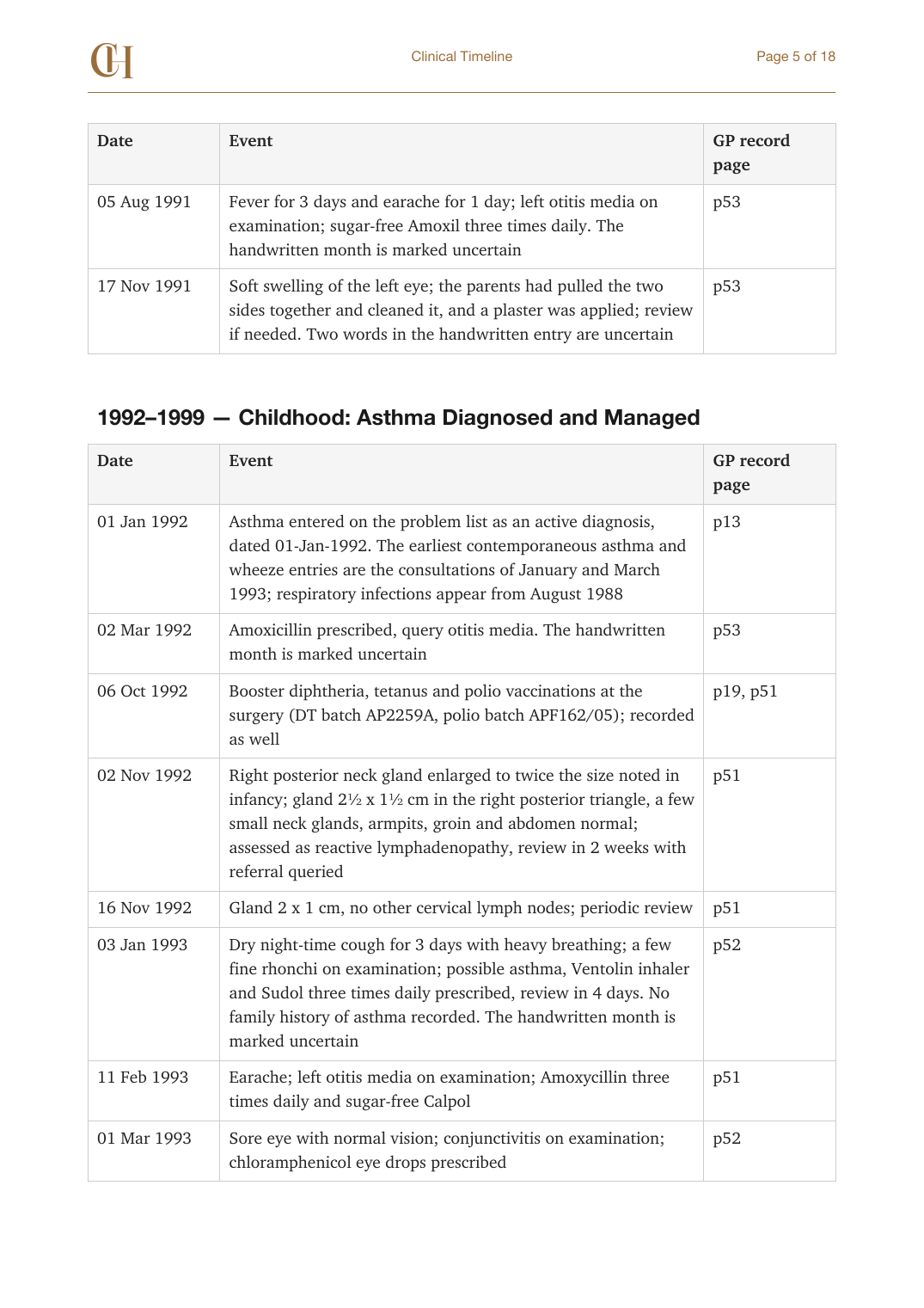
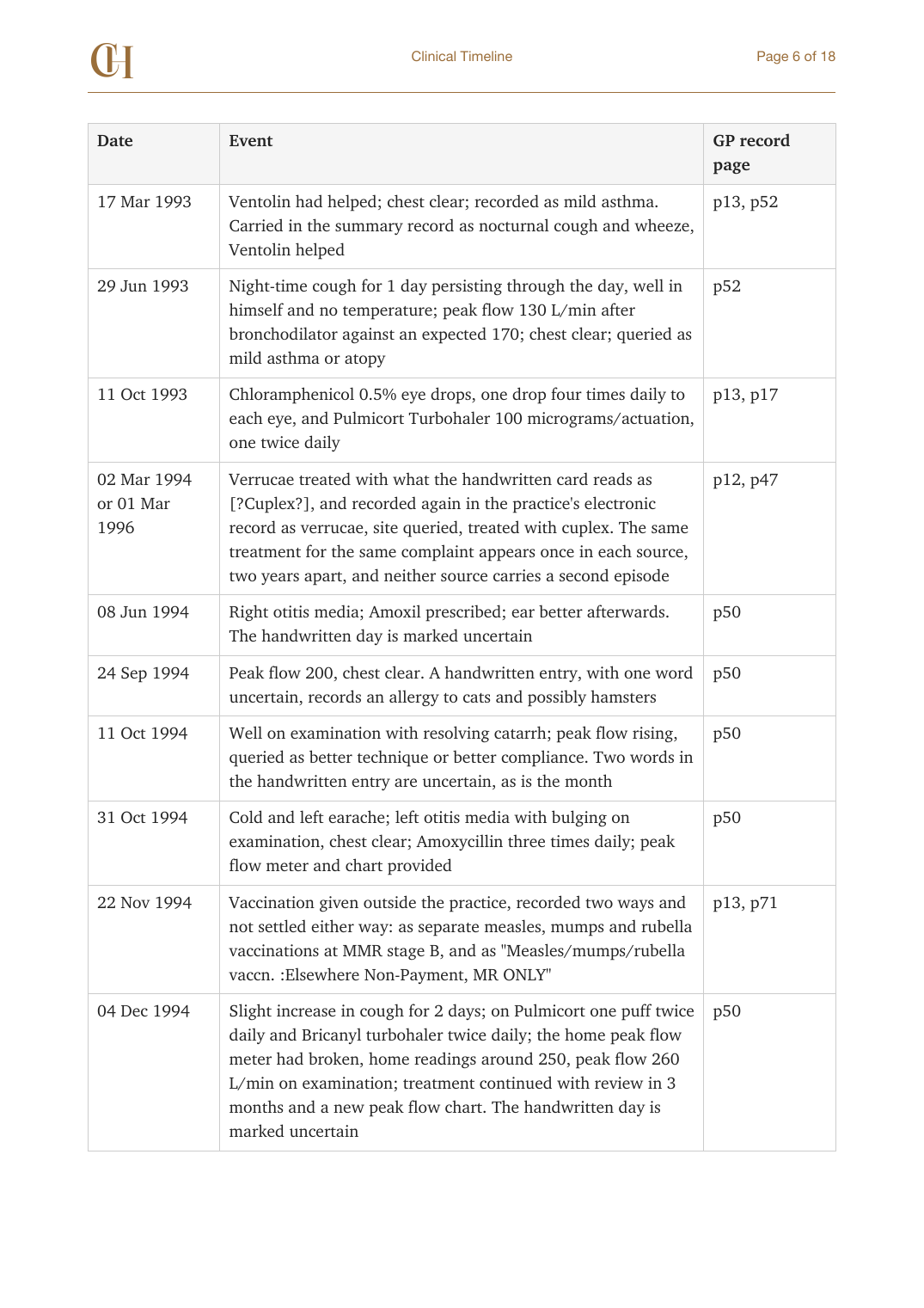
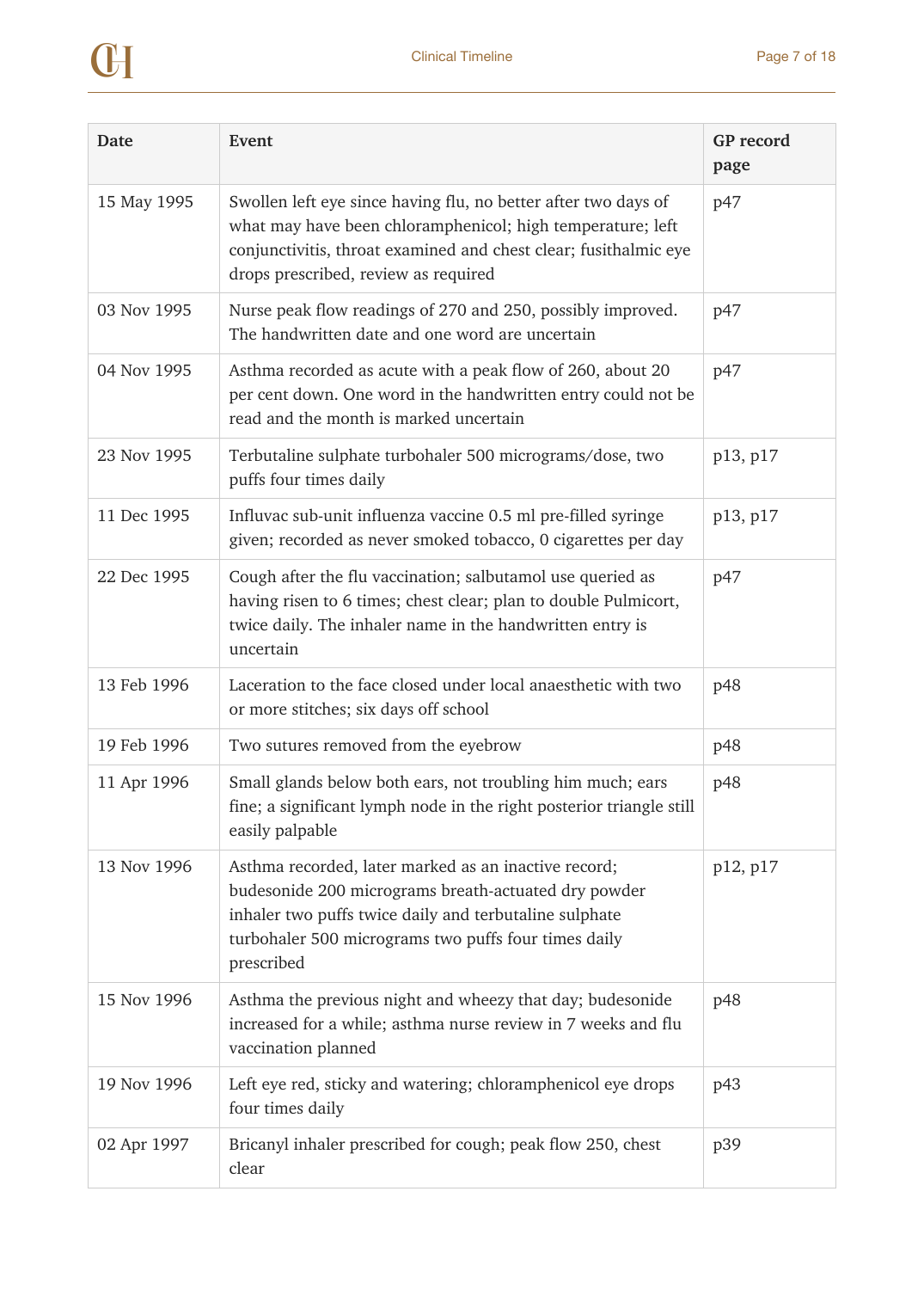
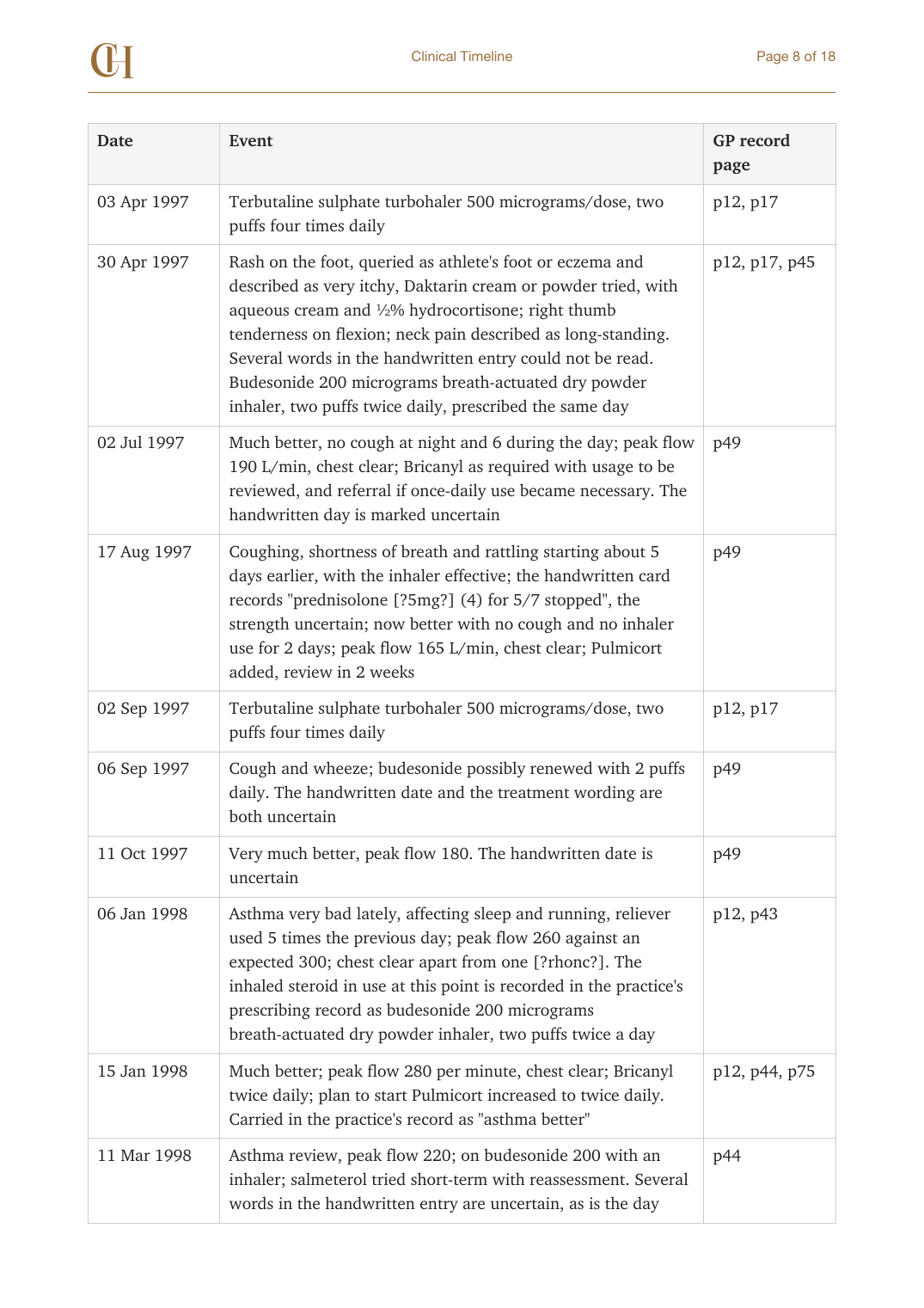
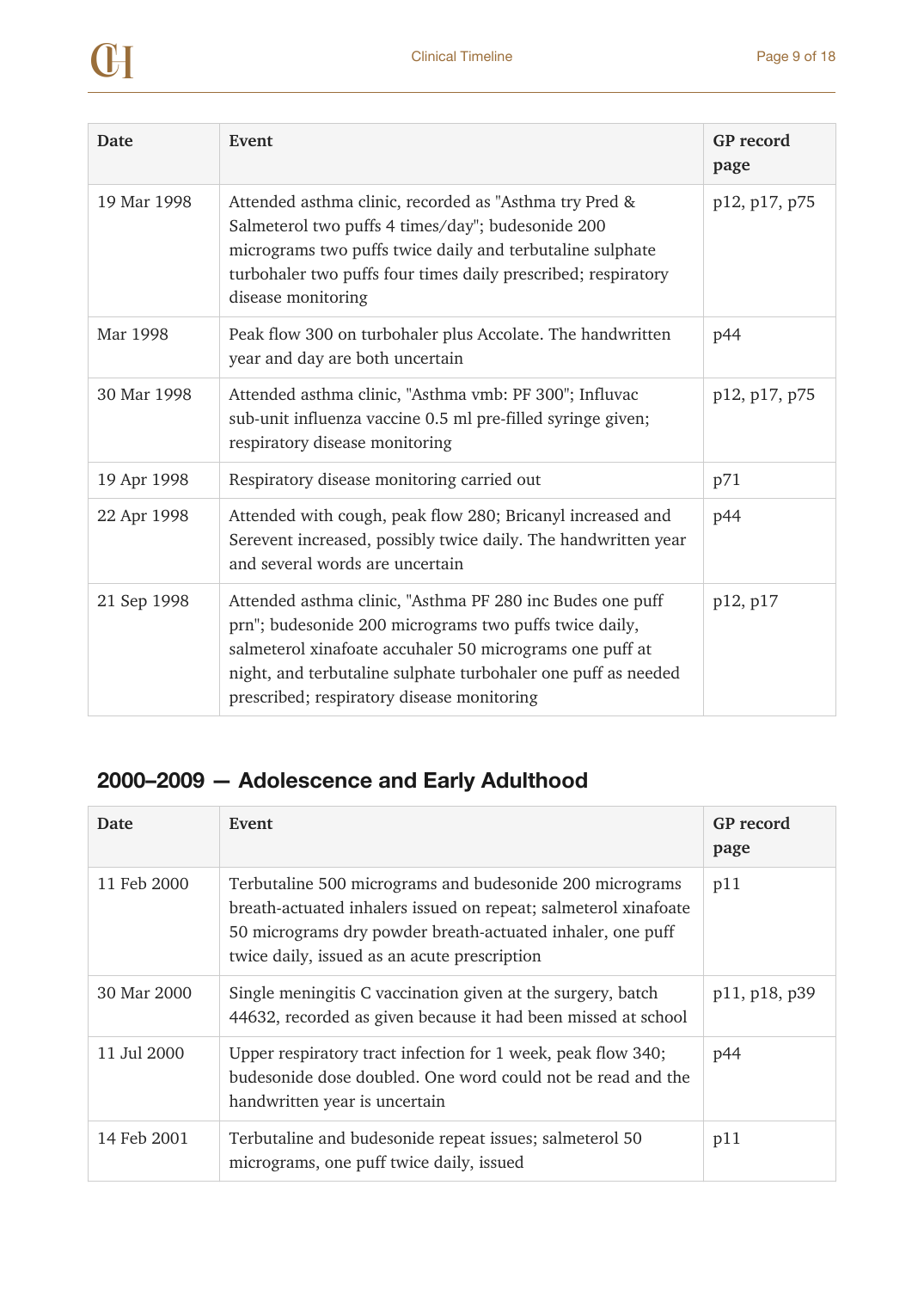
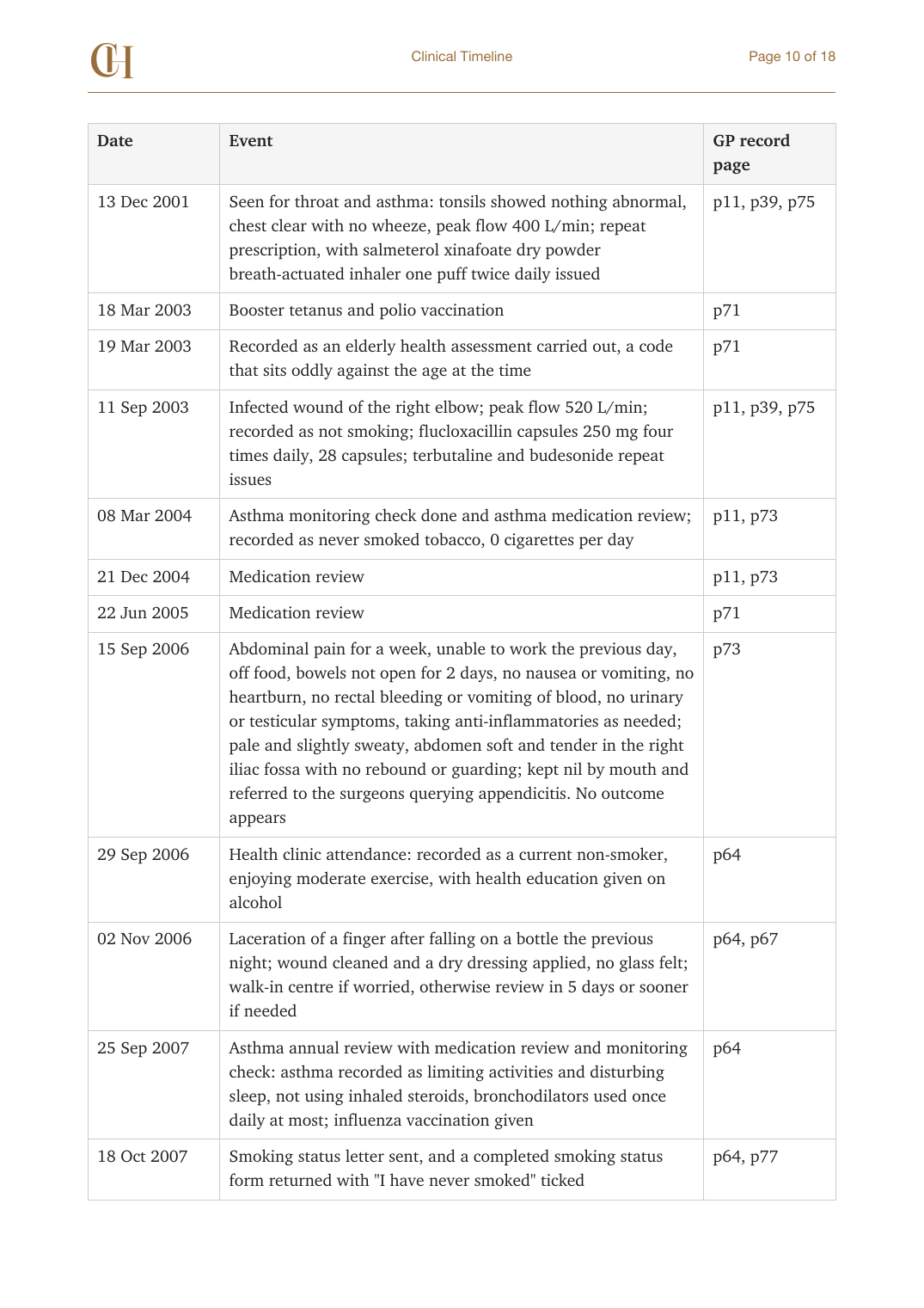
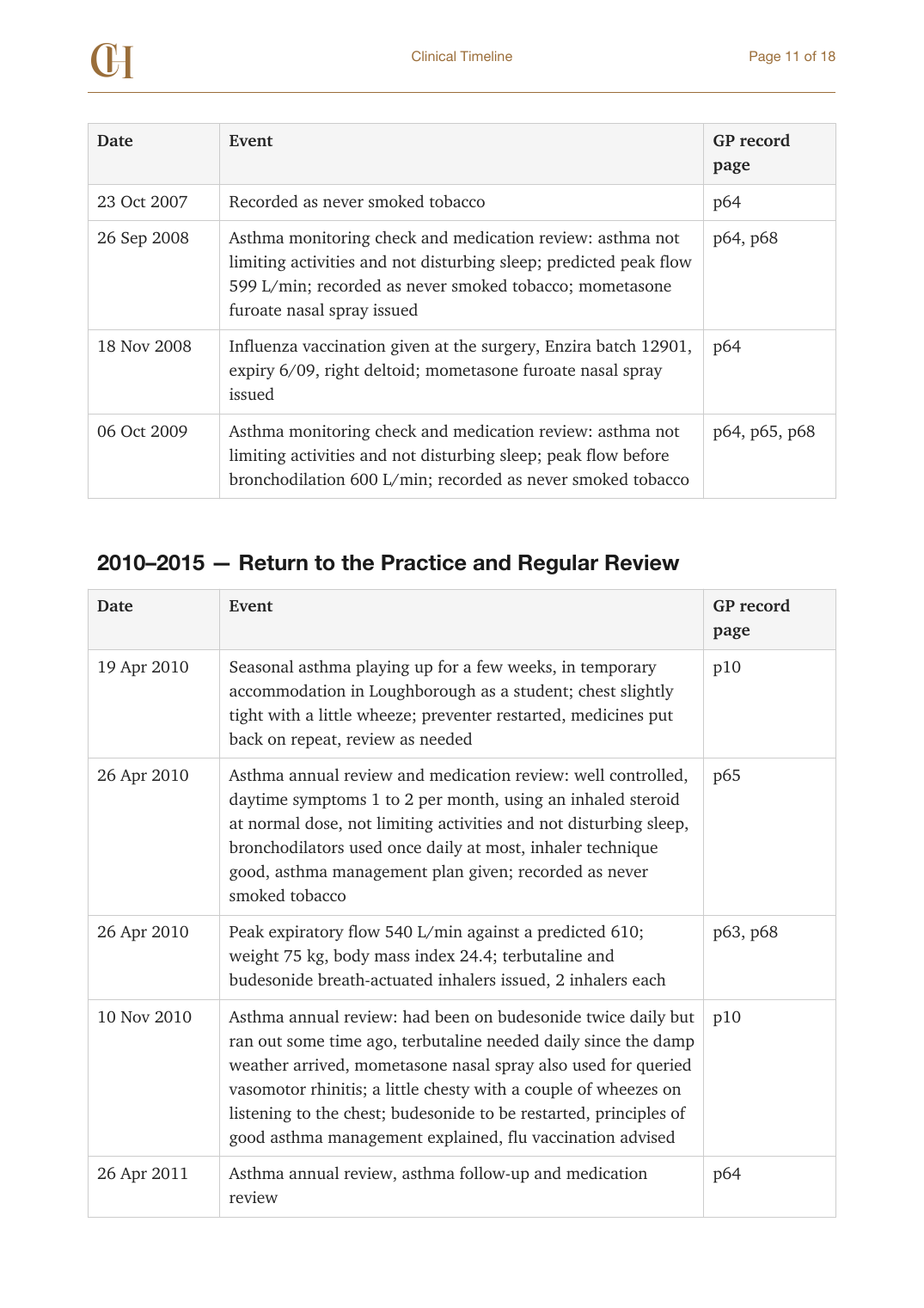
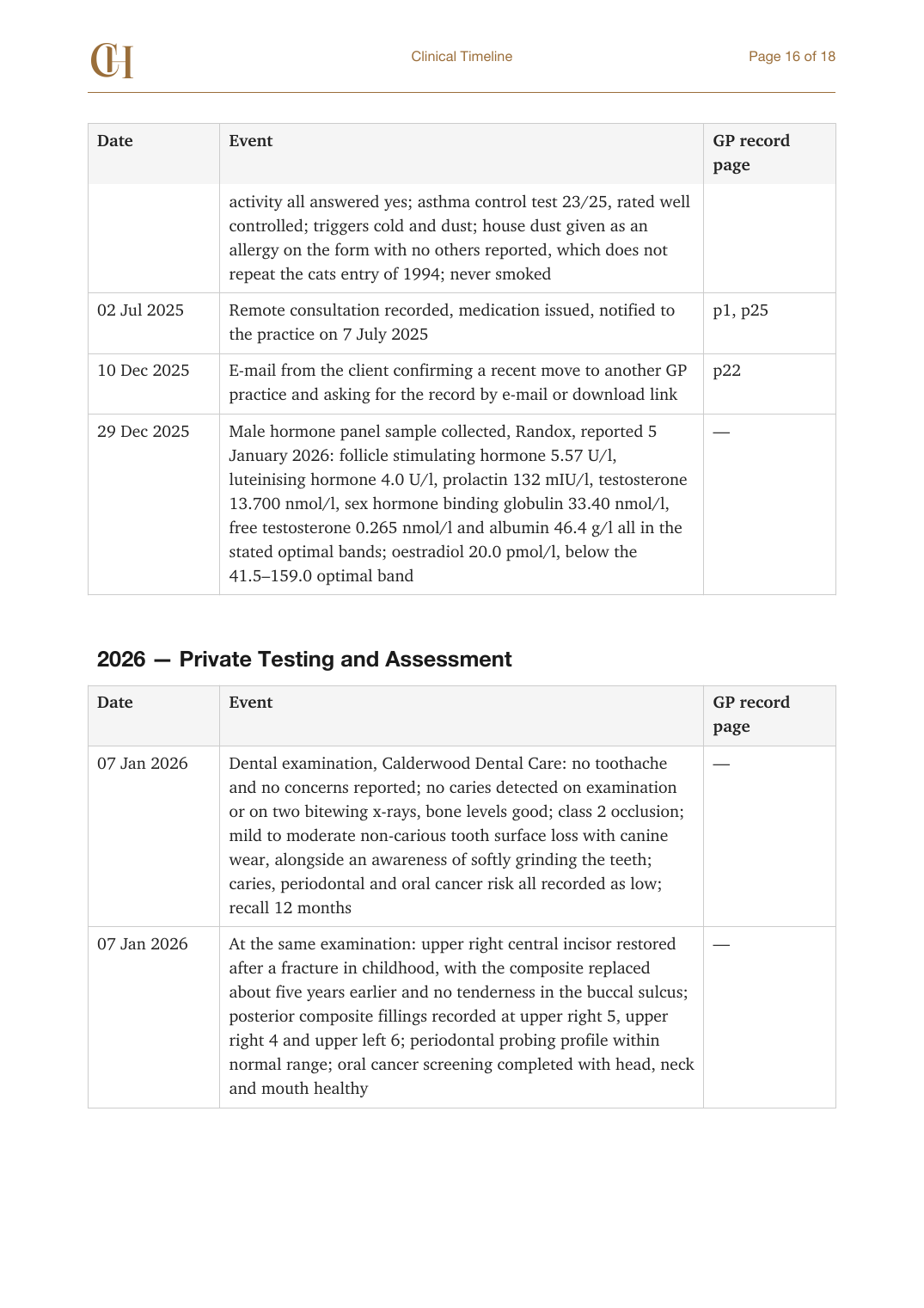
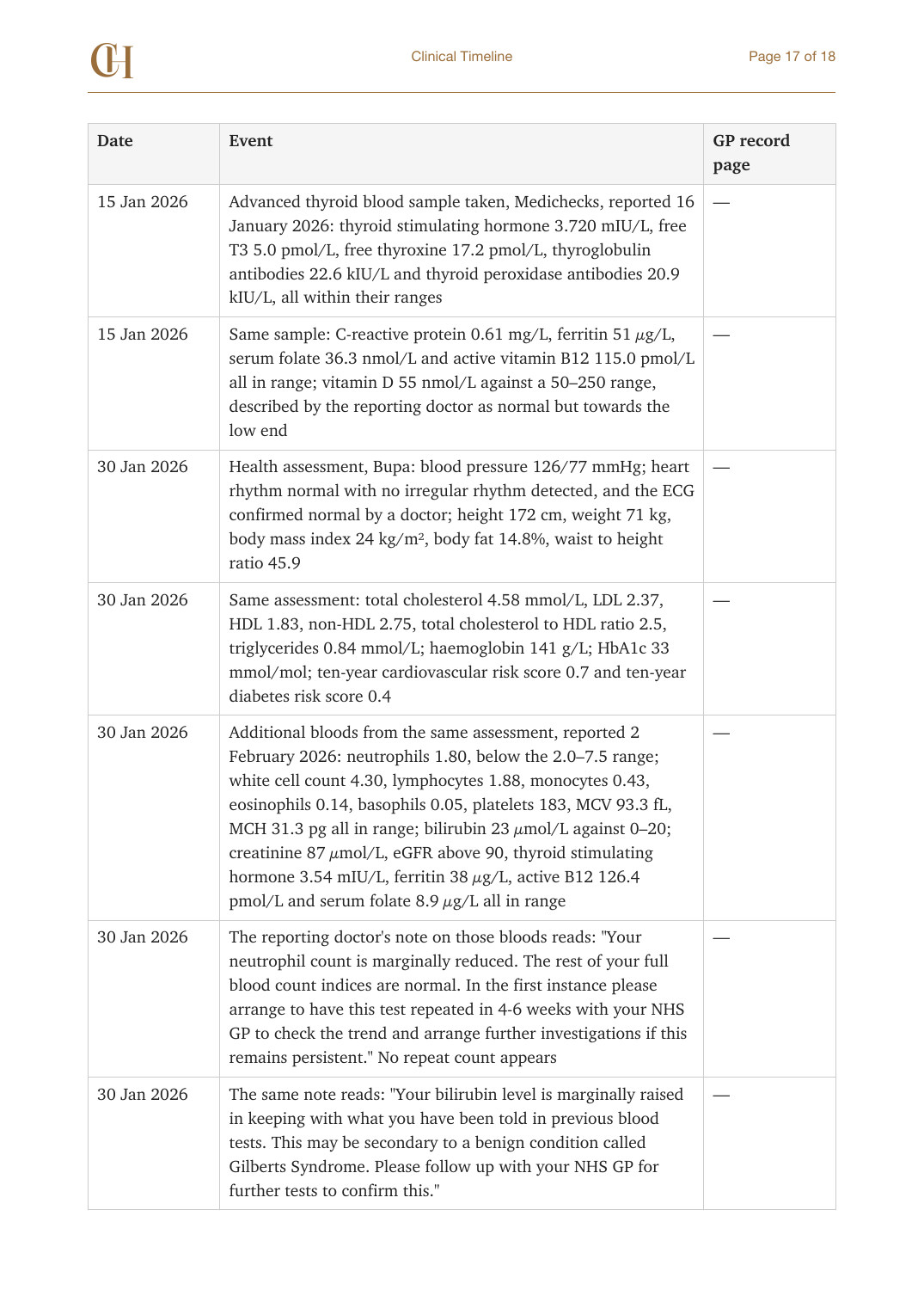
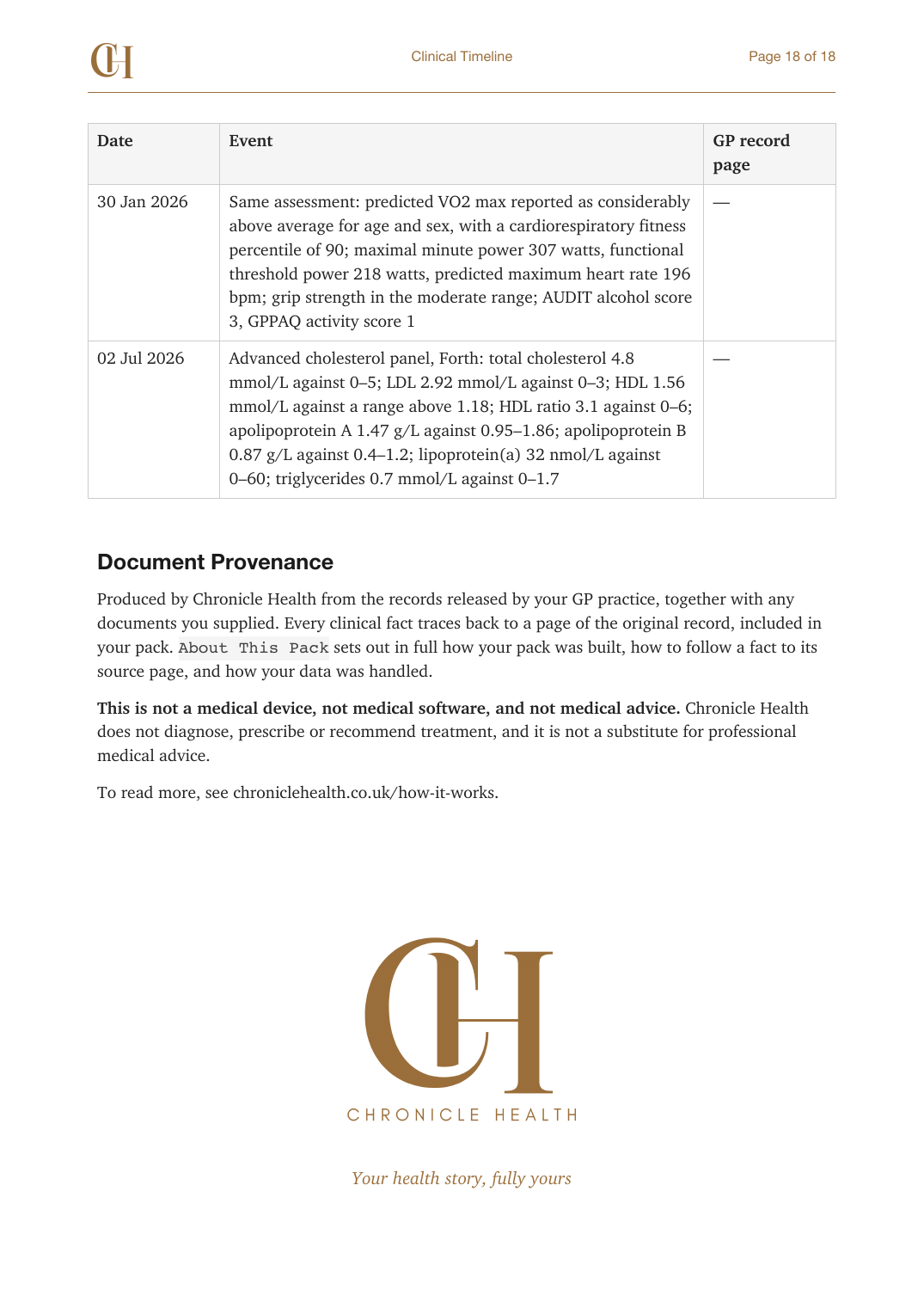
A domain-by-domain map of what your record holds across each area of your health, and where it is silent.


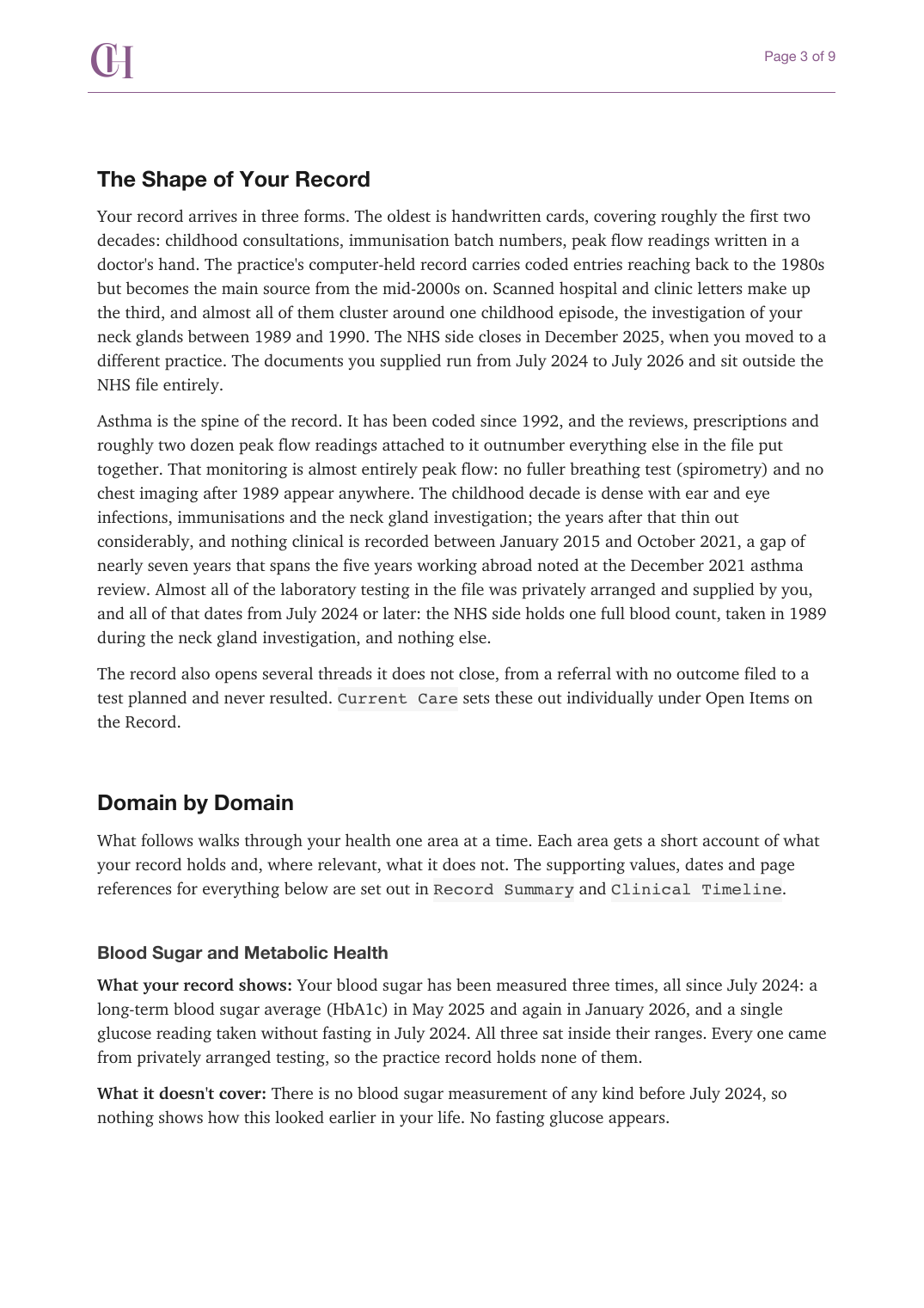
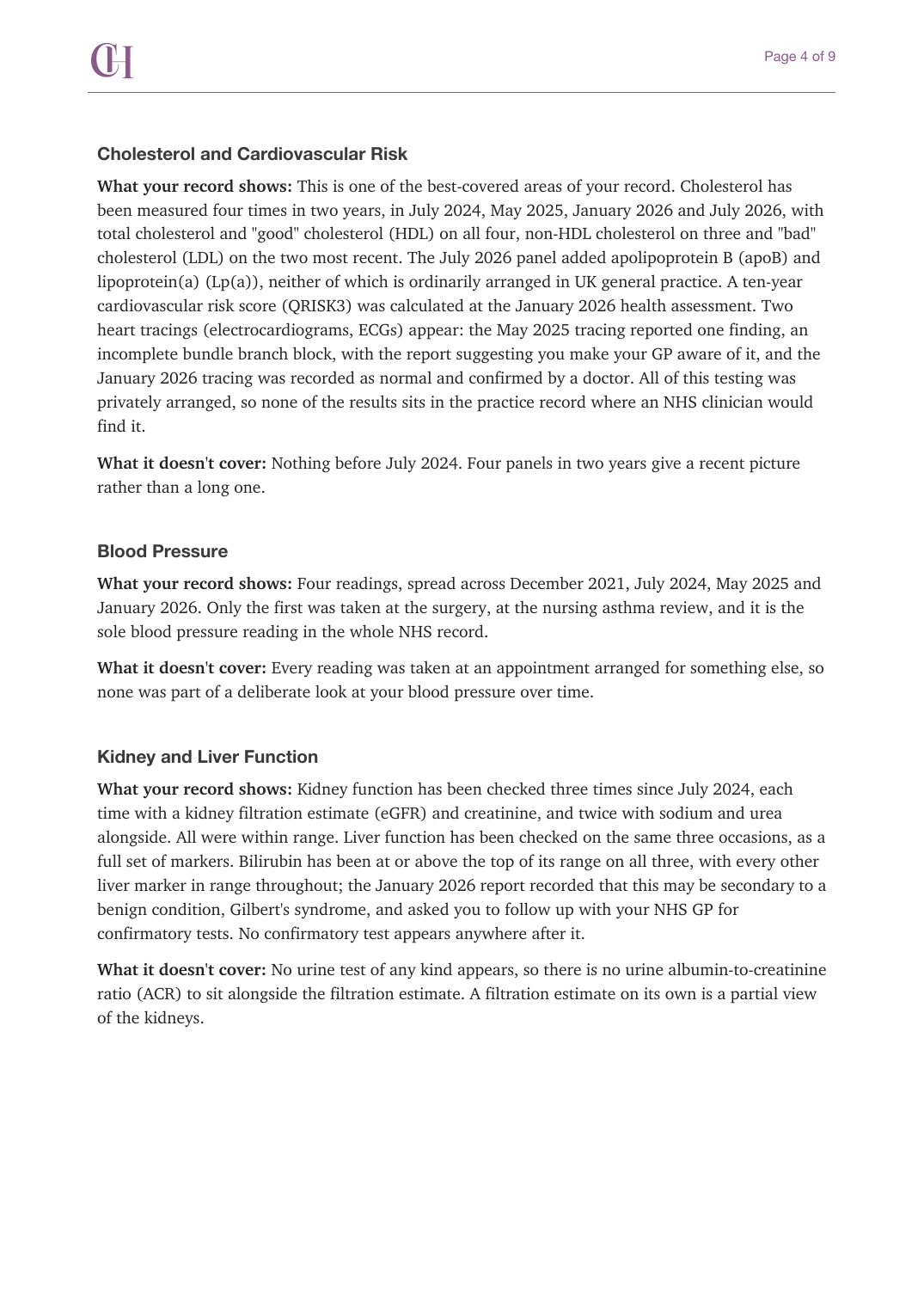
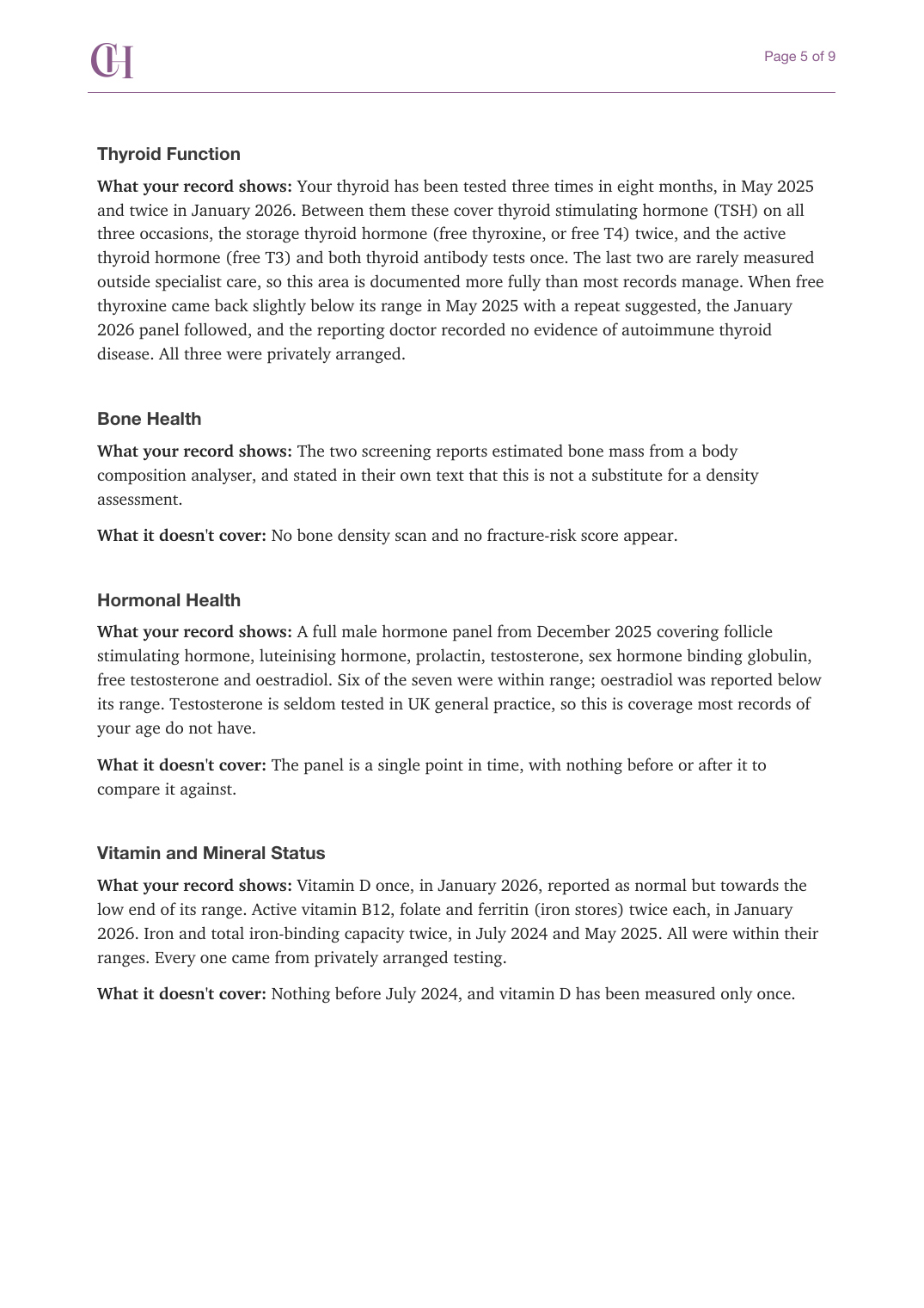
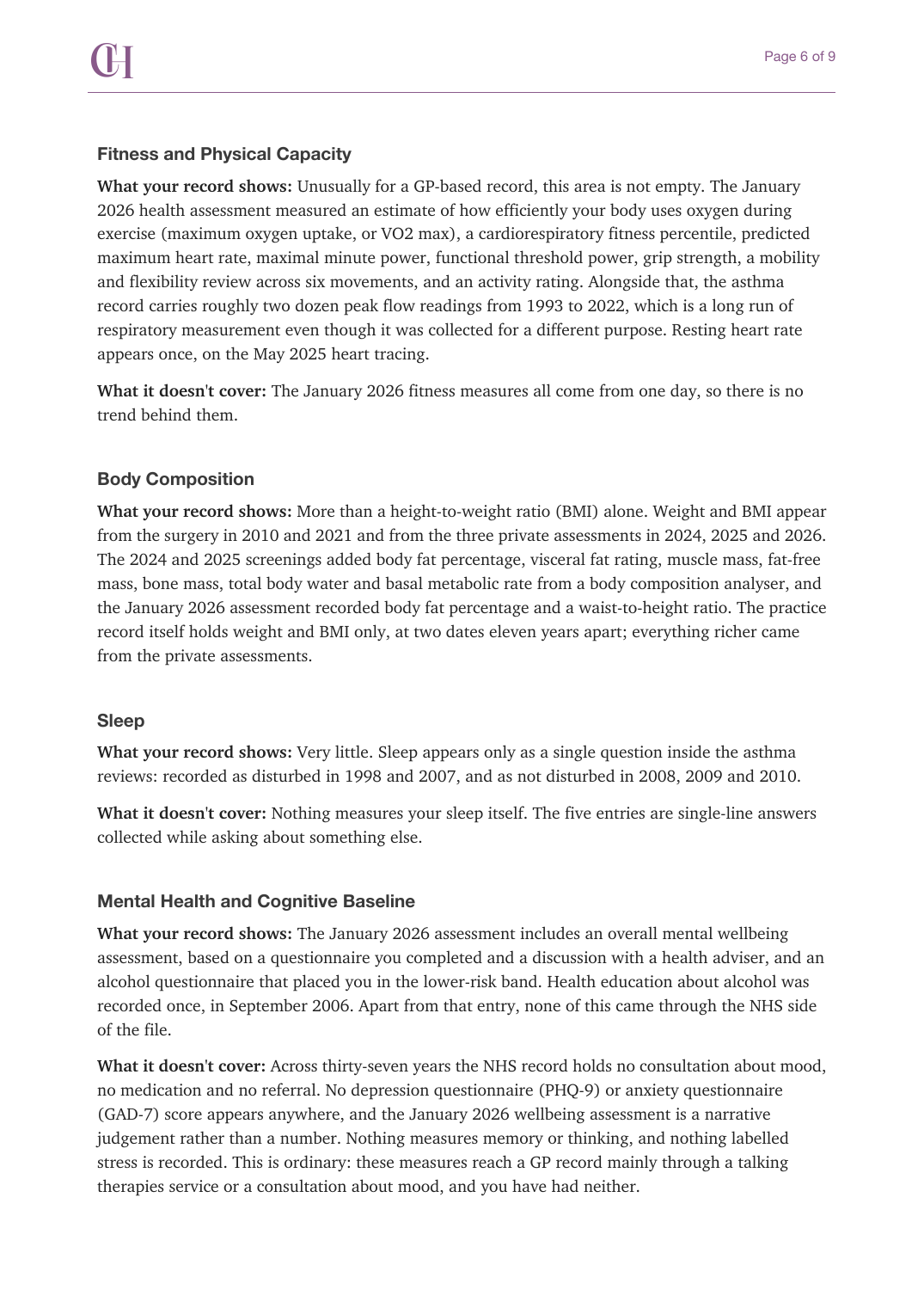
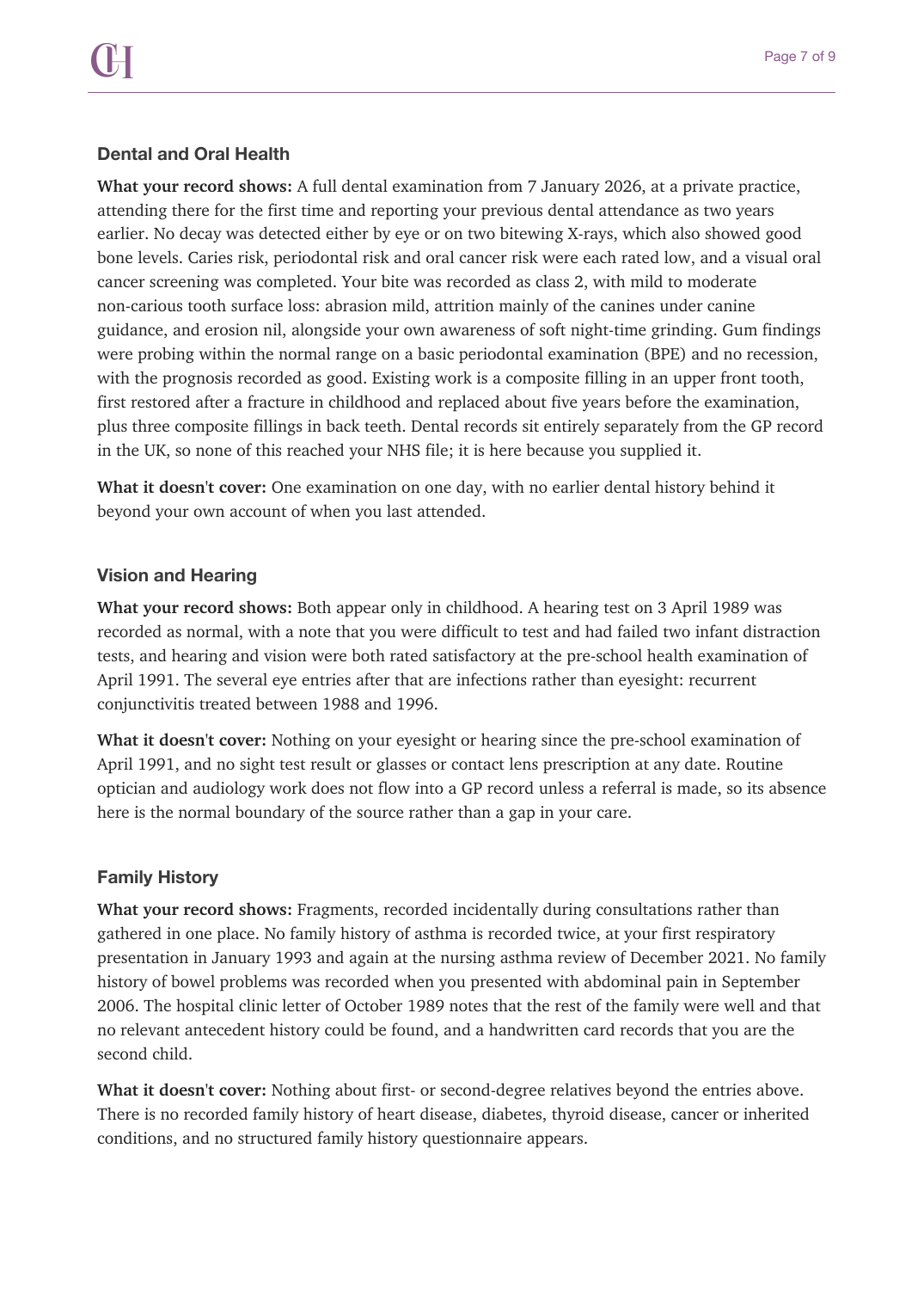
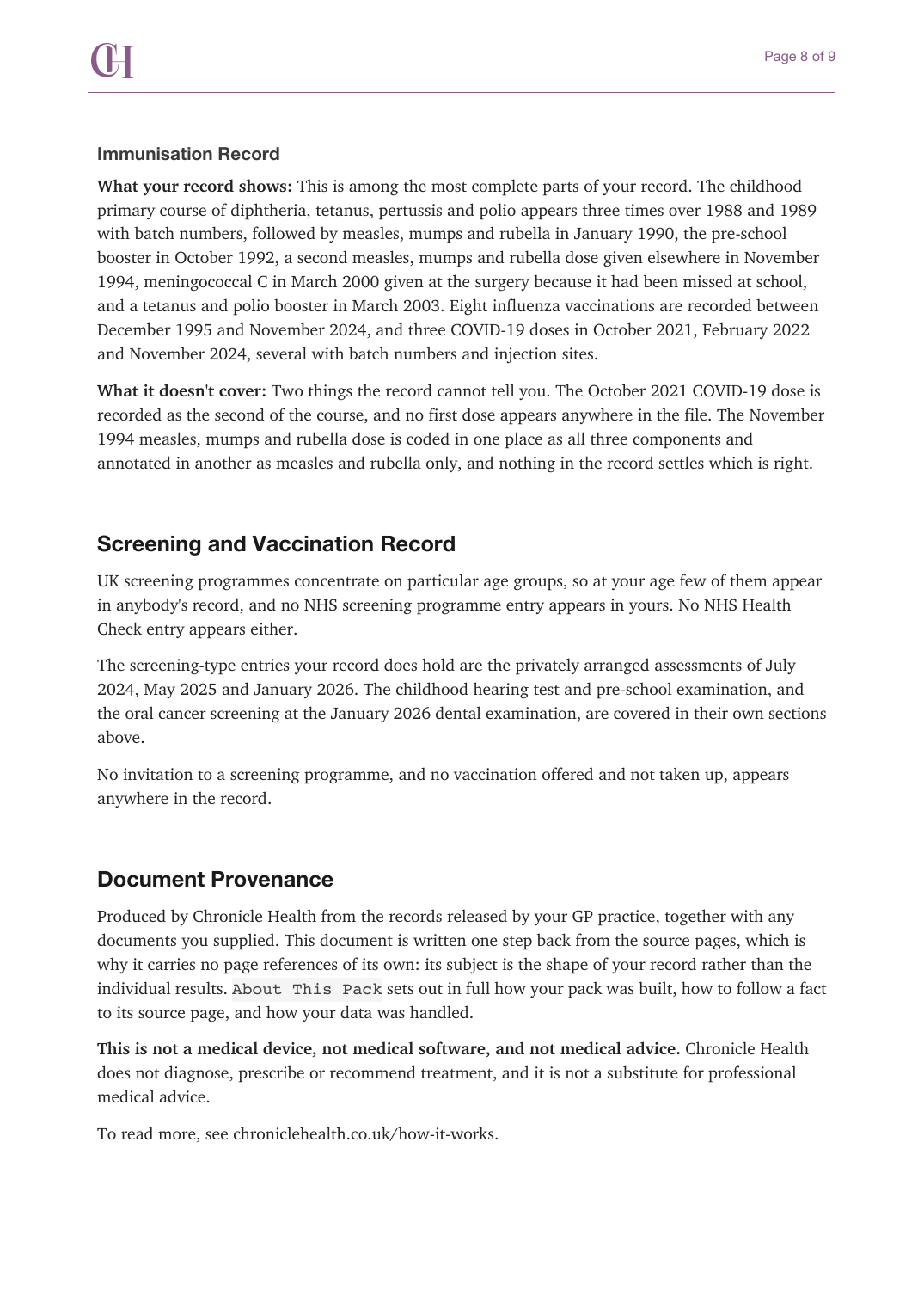

A personalised guide: what each document is, how they relate, and which one to open for which question. When it comes to reading your own pack, we recommend starting with this one, as it helps you to orientate.


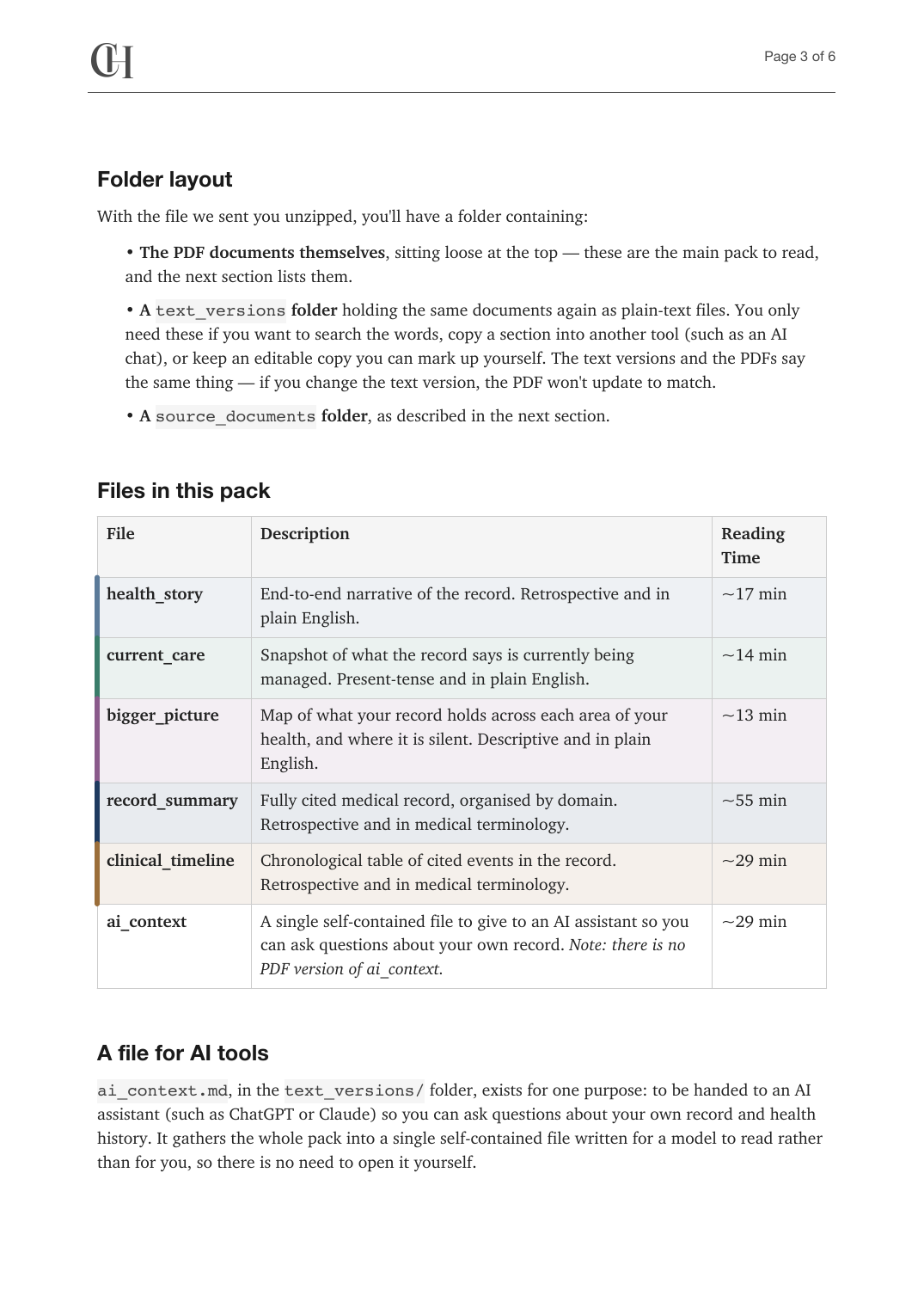
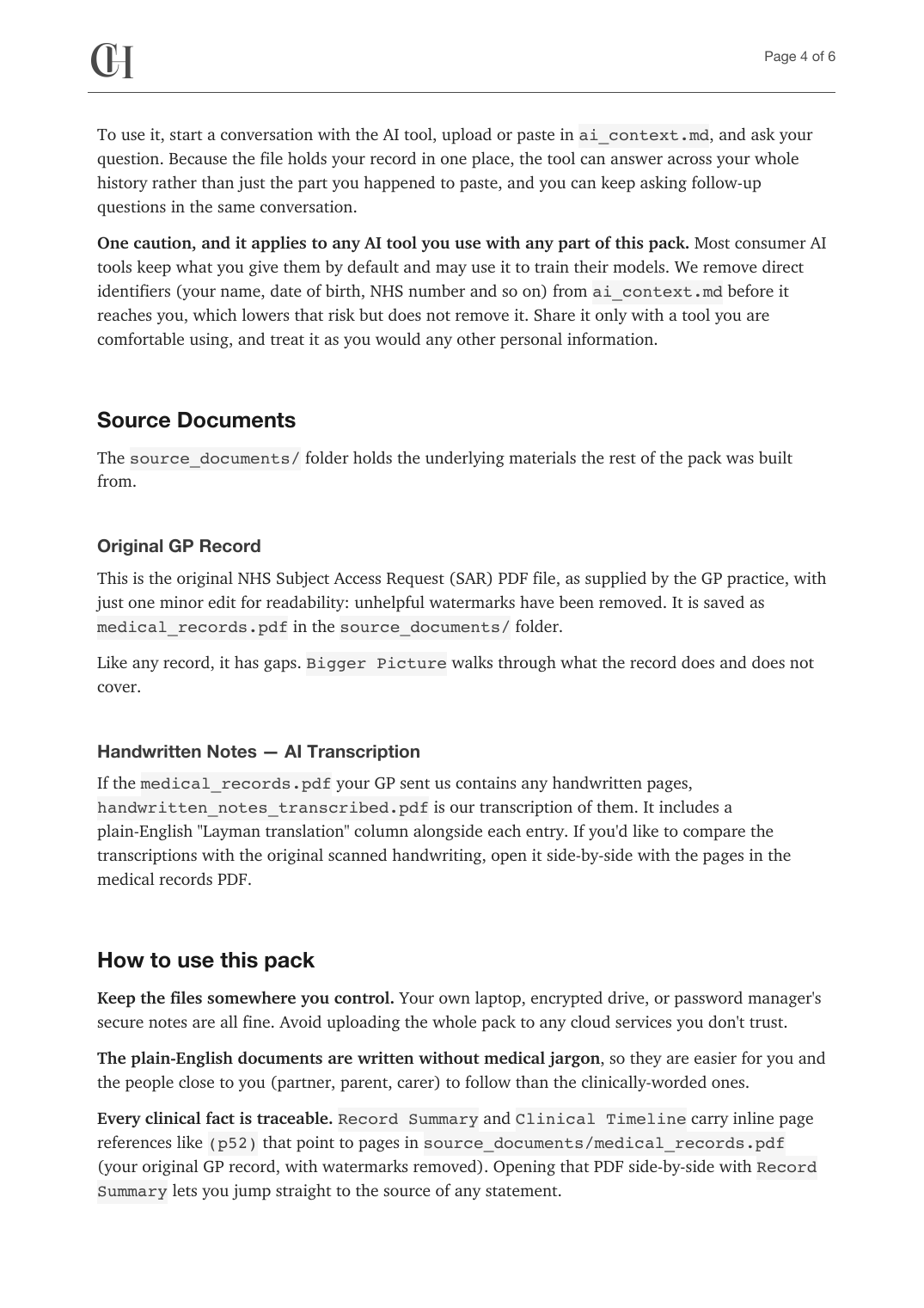
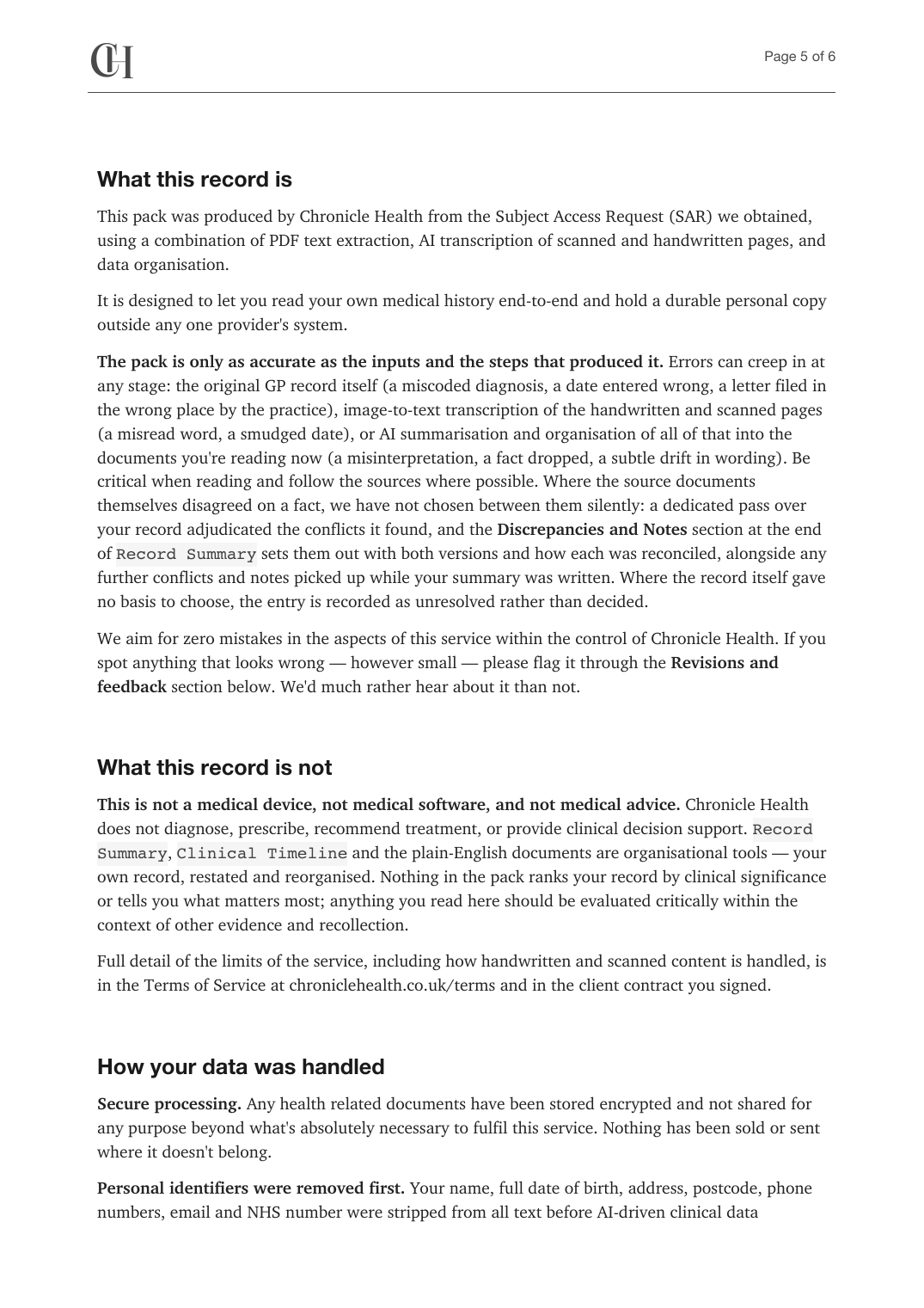
And One File That Is Not a Document
The seventh file in the pack has no cover, no page numbers and no design, because those exist for readers and this one is written for a machine. It is the whole record as plain text, to be used with an AI assistant, if you choose to, so you can ask questions of your own history and get answers drawn from it rather than from guesswork.
At roughly 8,700 tokens, all popular consumer models (e.g. ChatGPT / Claude / Gemini) can easily hold this summary of your health history all at once and answer questions for you. This provides a ground truth about your health, for any way you work with AI.
ai_context.md 34 KB · 5,813 words · ~8,700 tokens Read it ↓
Health Record: AI Context File
This is a single, self-contained file designed to be given to an AI assistant as context, so the owner of this record can ask questions about their own health history and conditions. It restates the contents of a personal health record pack in one place. It contains no personal identifiers.
How to use this file (instructions for the AI assistant)
You are helping the person whose health record this is understand their own medical history. Follow these rules:
- Answer using both this document and your general medical knowledge. This document is the authoritative source for facts about this specific person: their history, test results, medications, and findings. Draw freely on general medical knowledge to explain what conditions, terms, and results mean, to give context, and to answer the person’s questions.
- If asked about something specific to them that the record does not cover, say so plainly (“your record does not mention that”), then, if useful, give relevant general information separately and clearly labelled as general rather than personal.
- This is the person’s own record, so you may freely explain, summarise, group, and contextualise what it contains.
- The “Open items on the record” section lists threads left unresolved: findings a clinician flagged for follow-up, tests advised but not recorded as done, and reviews not recorded as having taken place.
- Keep separate what the record states from what it does not. Where the record holds no measurement for an area, do not infer a result or finding for it.
- Quote dates and values exactly as written. Where the record itself marks a finding as uncertain, transient, single-occurrence, or unconfirmed, carry that caveat into your answer.
- The GP record in this file runs to around December 2025. Privately arranged reports may carry later dates, so treat that as the end of the GP record rather than the end of the file. If recency matters, reason from the dates written against each finding and state them.
Profile
| Field | Value |
|---|---|
| Sex | Male |
| Age at record cutoff | 37 |
| Height | 172 cm (January 2026) |
| Weight | 71 kg (January 2026) |
| Body mass index | 24 kg/m² (January 2026) |
| Body fat | 14.8% (January 2026) |
| Blood pressure | 126/77 mmHg (January 2026) |
| Resting heart rate | 48 bpm (May 2025) |
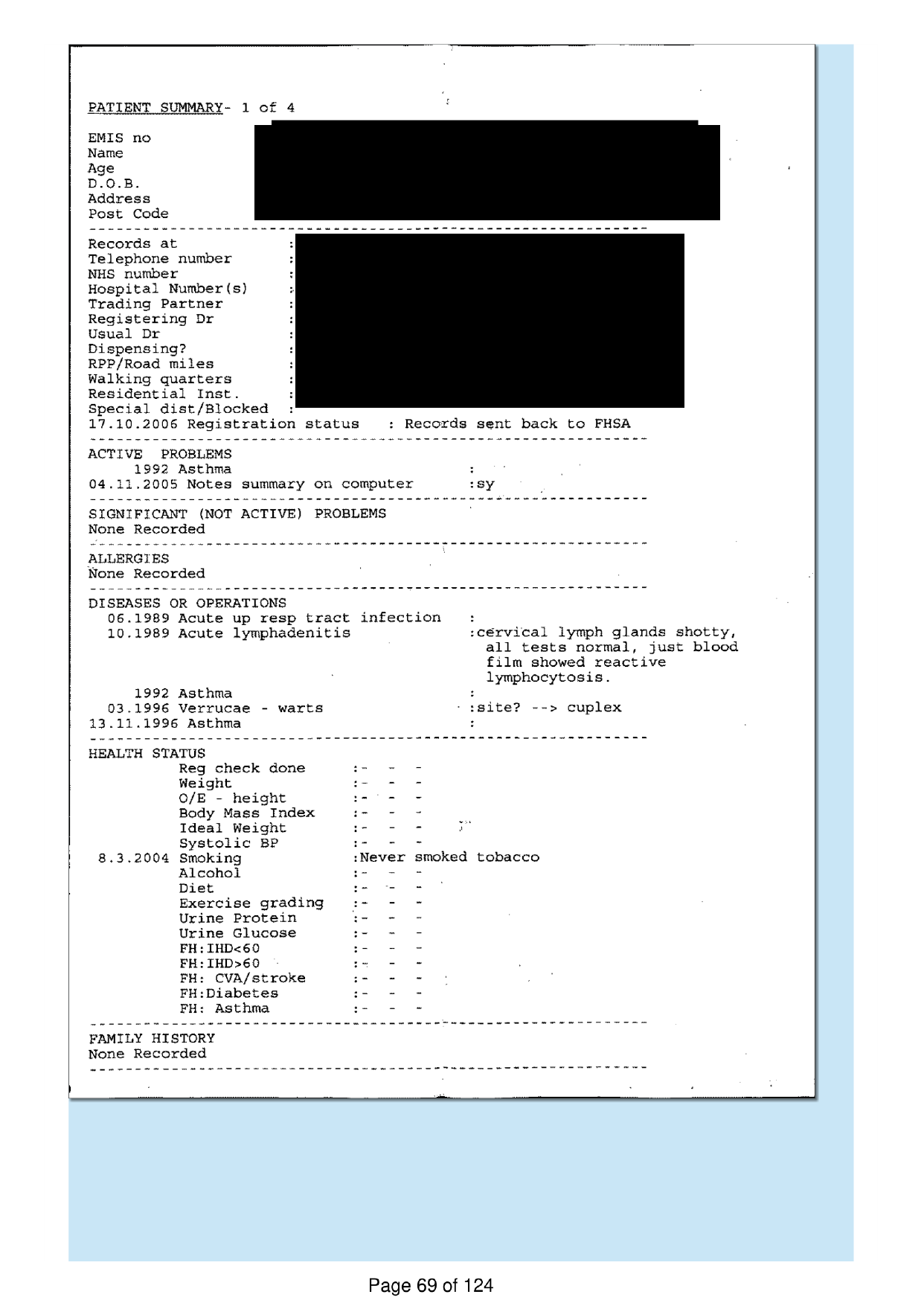
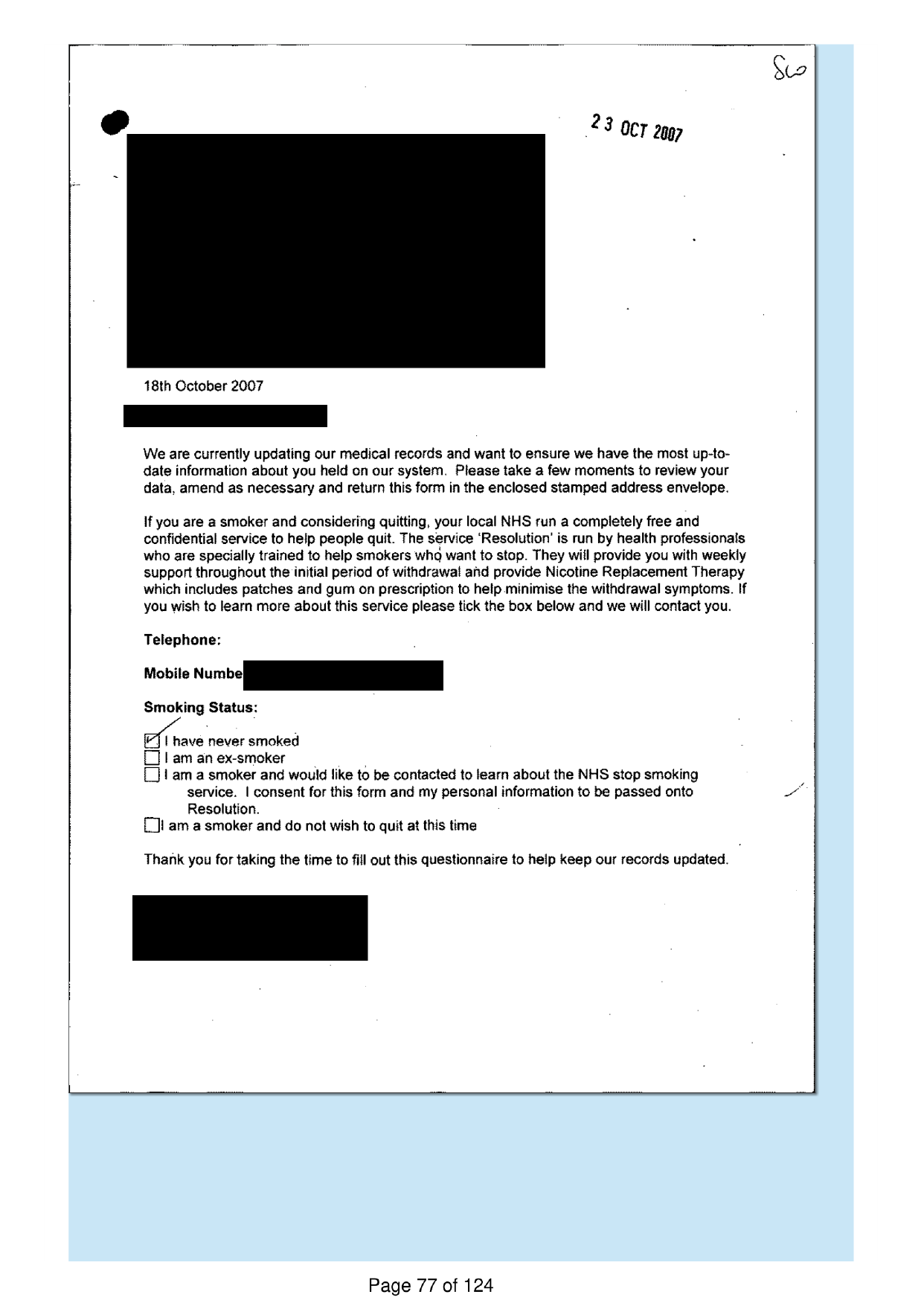
Smoking. Never smoked tobacco. The status is coded repeatedly between December 1995 and December 2021, confirmed on a smoking status questionnaire returned in October 2007, and repeated on the online asthma questionnaires of 2022, 2023 and July 2025. A single entry of September 2007 reading “Trying to give up smoking” is uncorroborated, and the pack adopts never-smoked.
Alcohol. Lower-risk drinking. The AUDIT score was 3 at the Bupa health assessment of 30 January 2026, and intake was recorded as under 14 units a week at a dental examination earlier the same month. Health education about alcohol was given once, in September 2006.
Exercise. Activity level was rated ideal at the January 2026 Bupa assessment, with a GPPAQ score of 1; the measured fitness values from that assessment are in Investigation results summary. The only earlier note is from September 2006, when moderate exercise was recorded as enjoyed.
Sleep. Sleep appears only as a single question inside asthma reviews, recorded as disturbed in 1998 and 2007 and as undisturbed in 2008, 2009 and 2010. Nothing in the pack measures sleep itself.
Active conditions and current findings
Asthma
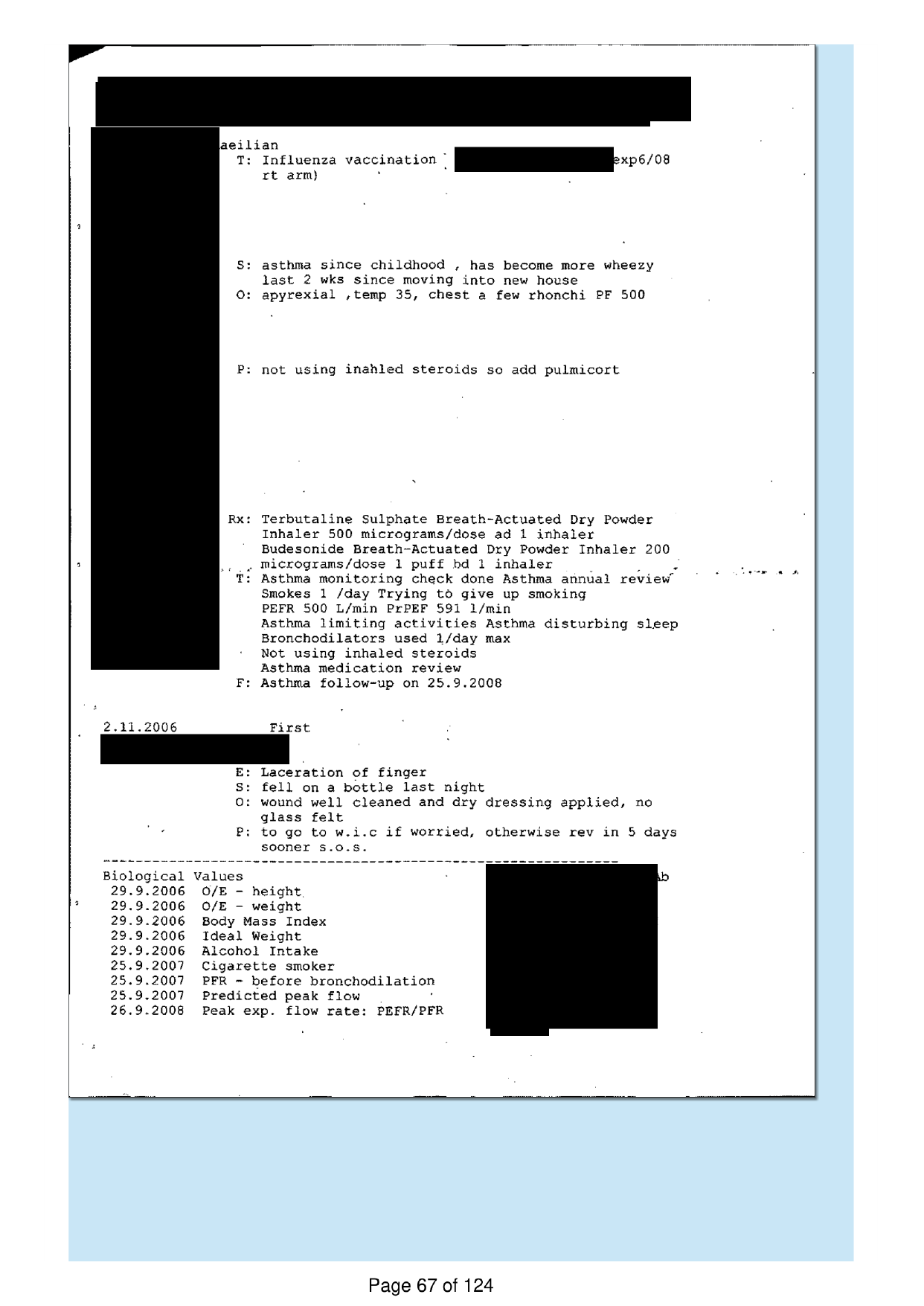
Asthma is the only condition on the GP practice’s active problem list. It is coded with a diagnosis date of 1 January 1992, and that is the date the pack adopts; the earliest contemporaneous respiratory entries are a “query asthma” consultation of 3 January 1993 and “mild asthma” on 17 March 1993, so the coded year and the earliest documented presentation are a year apart. The problem was coded inactive in November 1996 and active again from 2010. No family history of asthma is recorded at the first respiratory presentation in January 1993 or at the nursing review of December 2021; a single handwritten line of June 1993 reading “Asthma in family” stands alone, and the pack adopts no family history of asthma.
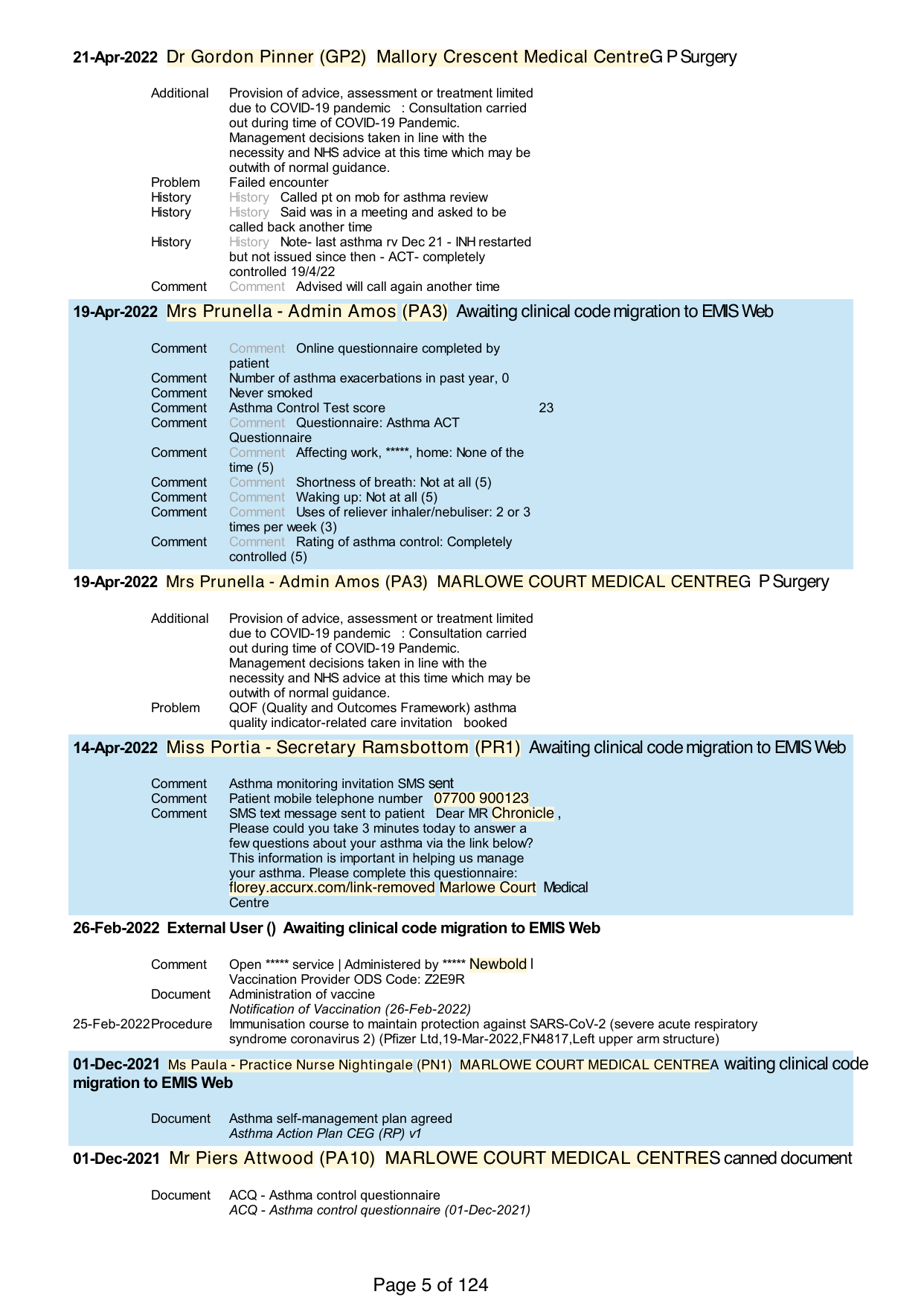
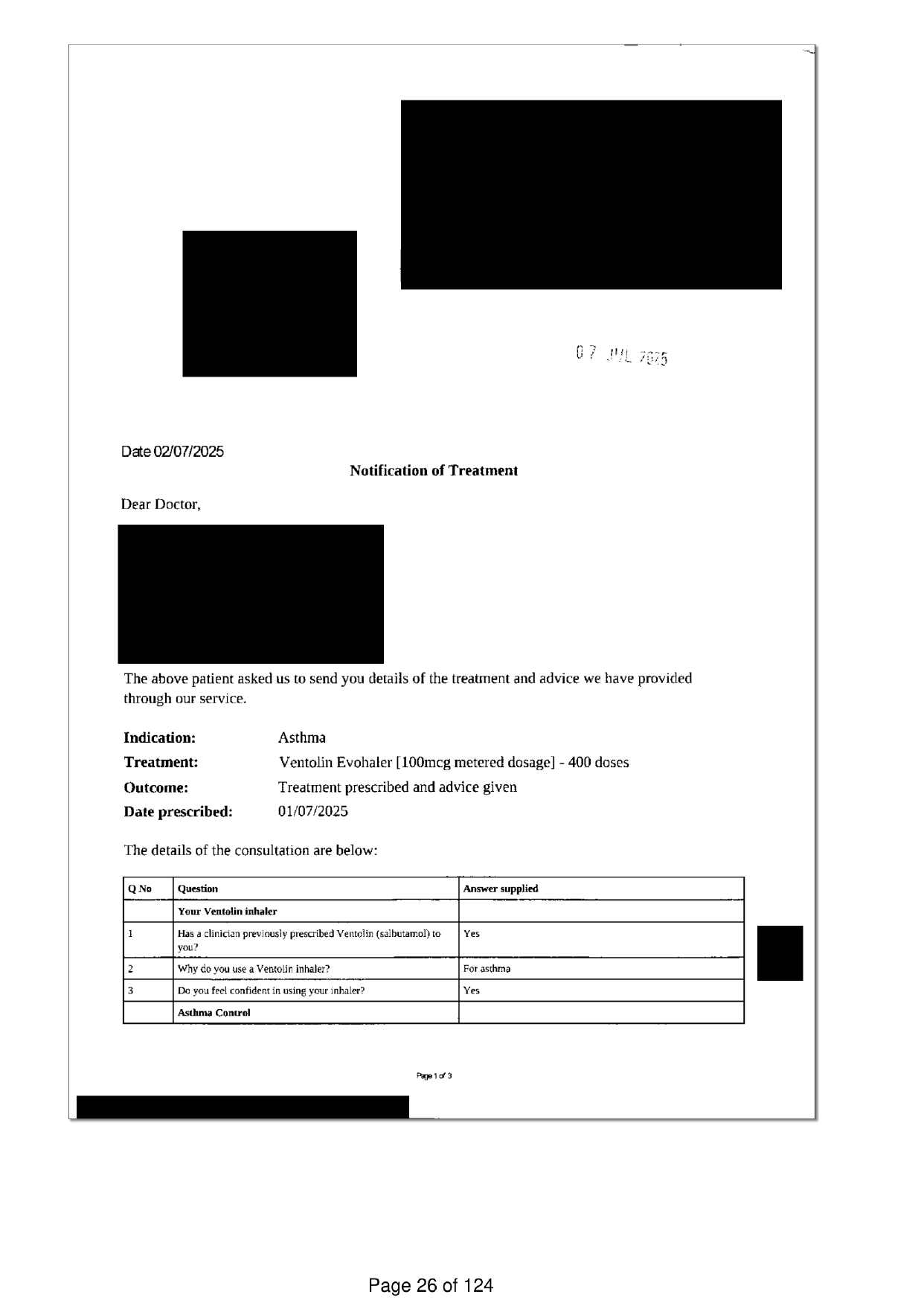
Current treatment is an inhaled beclometasone preventer and a terbutaline dry powder reliever, both authorised at the telephone annual review of 22 April 2022, with a salbutamol metered-dose reliever prescribed by an online doctor service on 1 July 2025 that does not appear on the practice repeat list. Doses are in Current medications. That April 2022 review also corrected the medication list: the practice’s own record showed a budesonide turbohaler, which had not been used for some time, and the beclometasone inhaler was continued in its place. No spacer is recorded. A coded field the same day reads “dry powder inhaler not indicated”, which the terbutaline dry powder reliever authorised at the same review contradicts; the record does not resolve it.
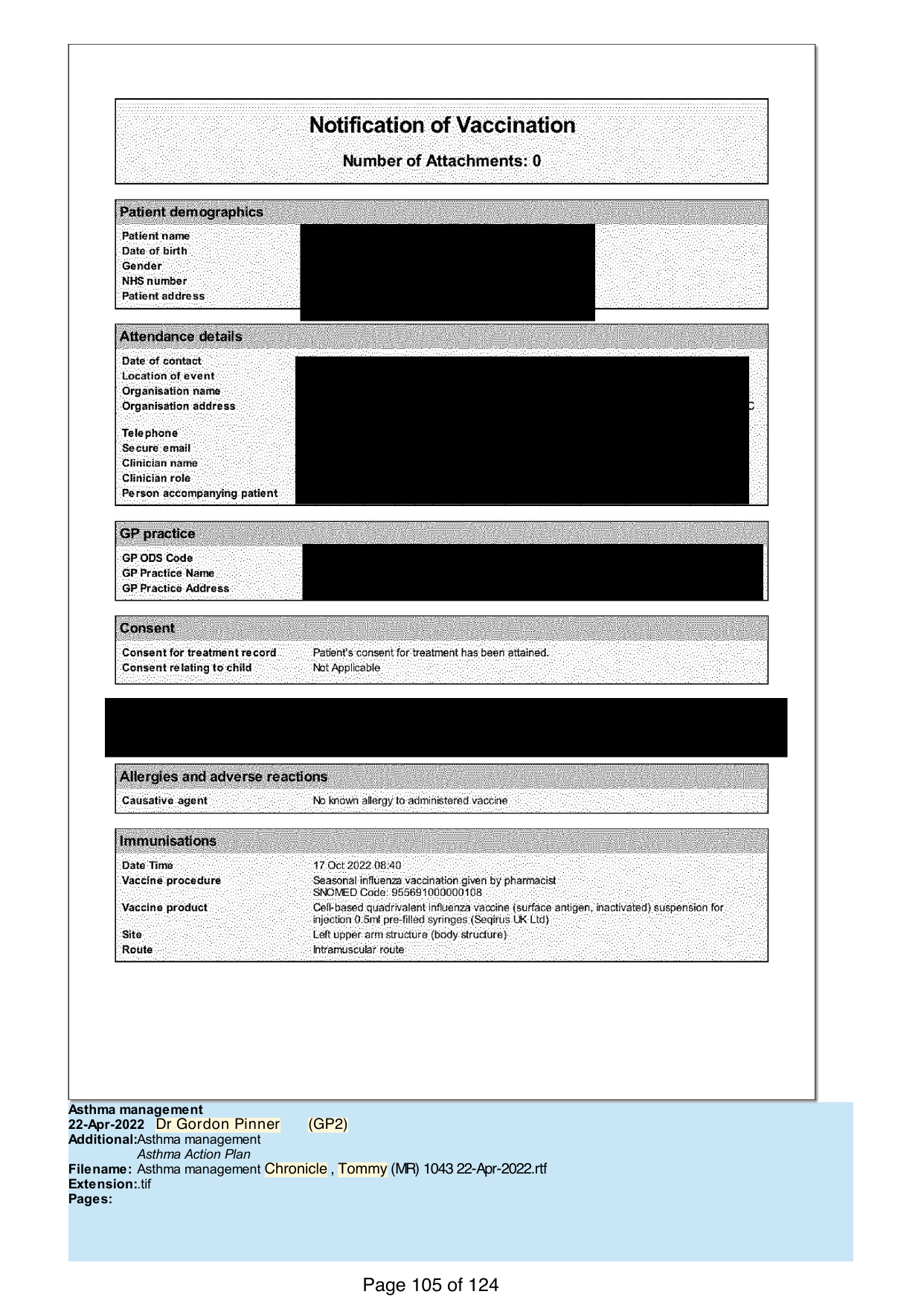
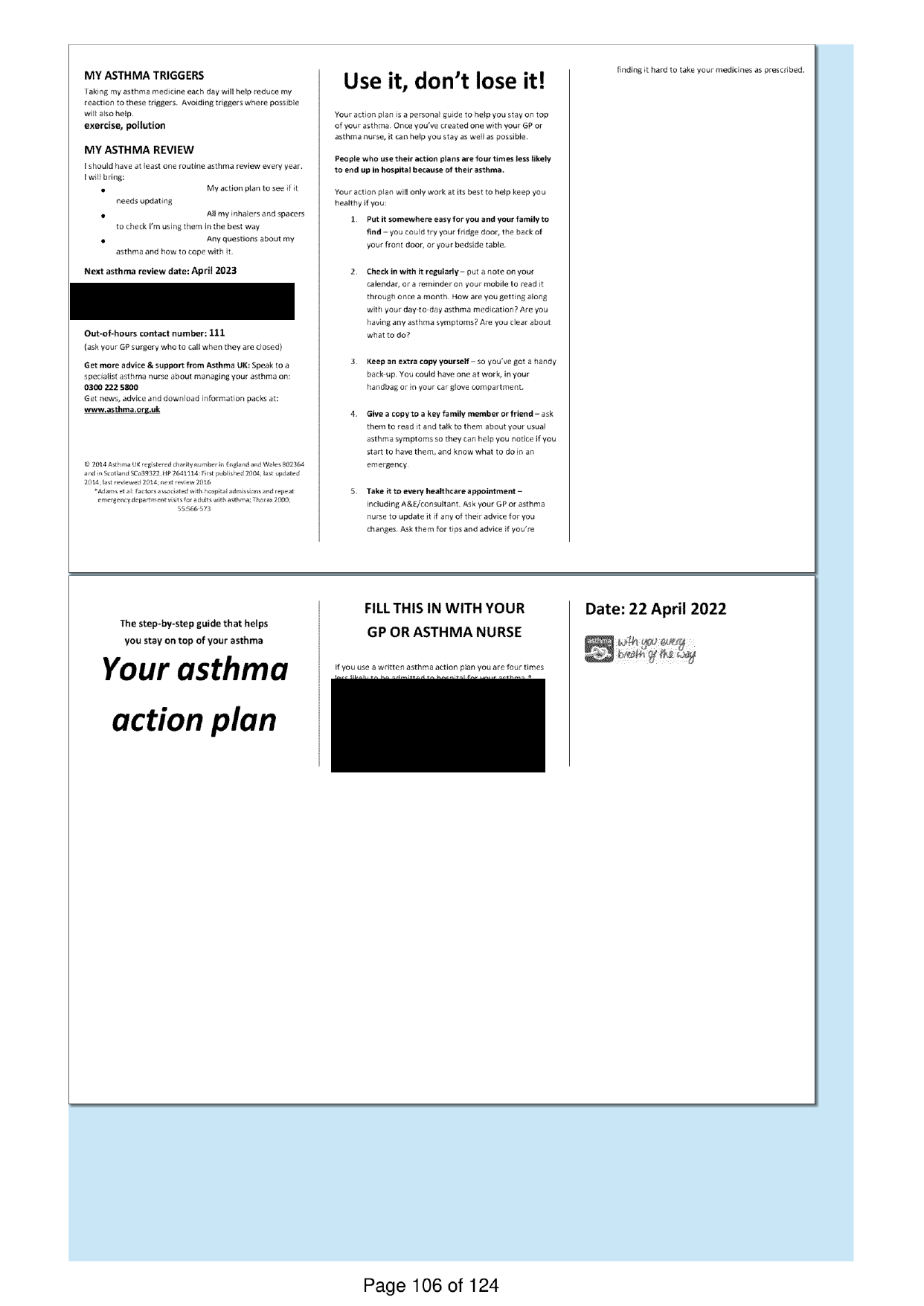
The self-management plan of 22 April 2022 is the plan in force: preventer two puffs morning and night; reliever one puff as needed for wheeze, chest tightness, breathlessness or cough; if symptoms return or the reliever is used three or more times a week, the preventer increases to two puffs four times a day until symptoms resolve and the reliever is taken as needed up to one puff four times a day; if there is no improvement within 48 hours, an urgent GP or asthma nurse appointment; and, for an attack, sitting upright, one puff of reliever every 30 to 60 seconds up to ten puffs, calling 999, and rescue prednisolone if it has been prescribed. The plan set its own next review for April 2023.
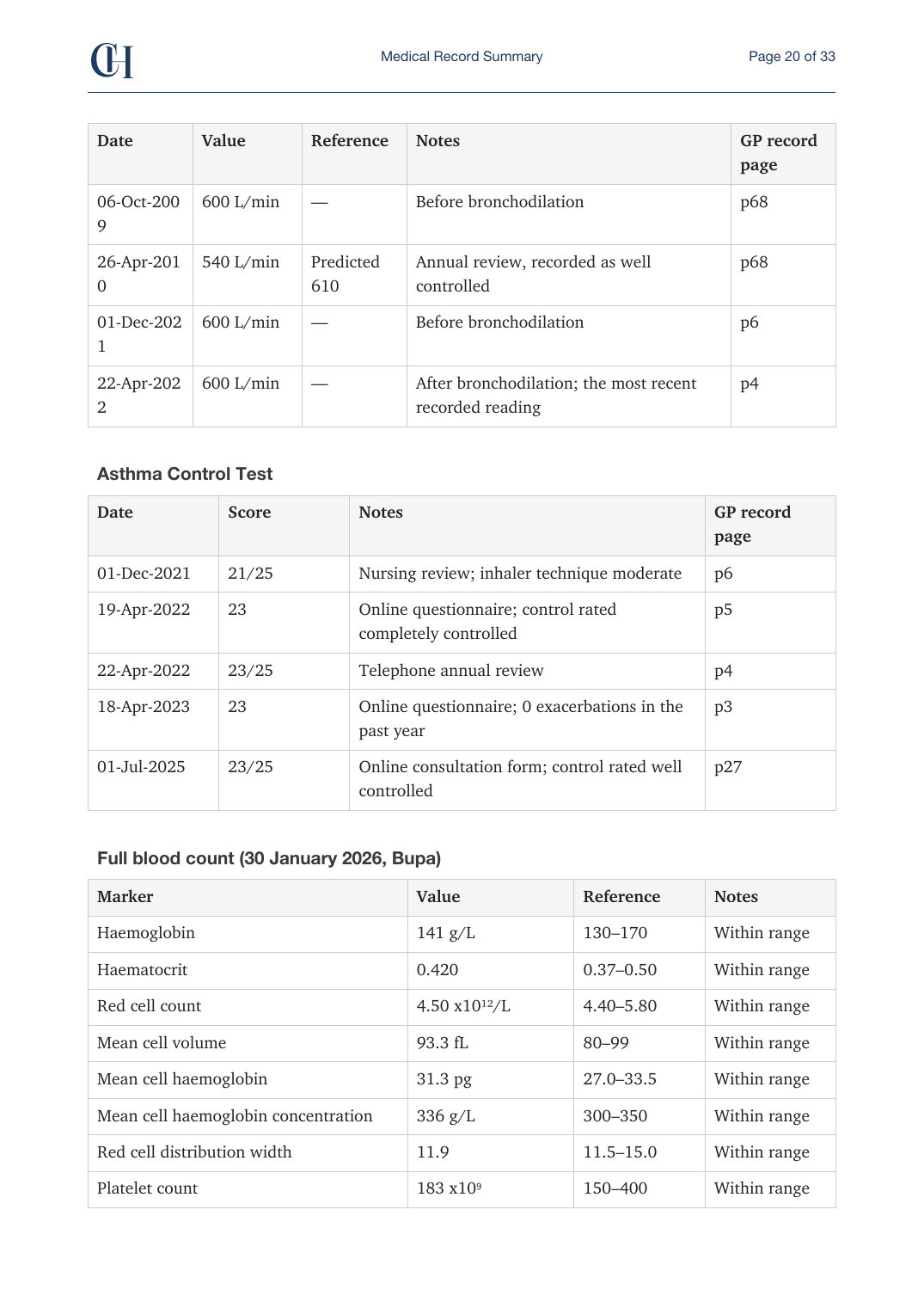
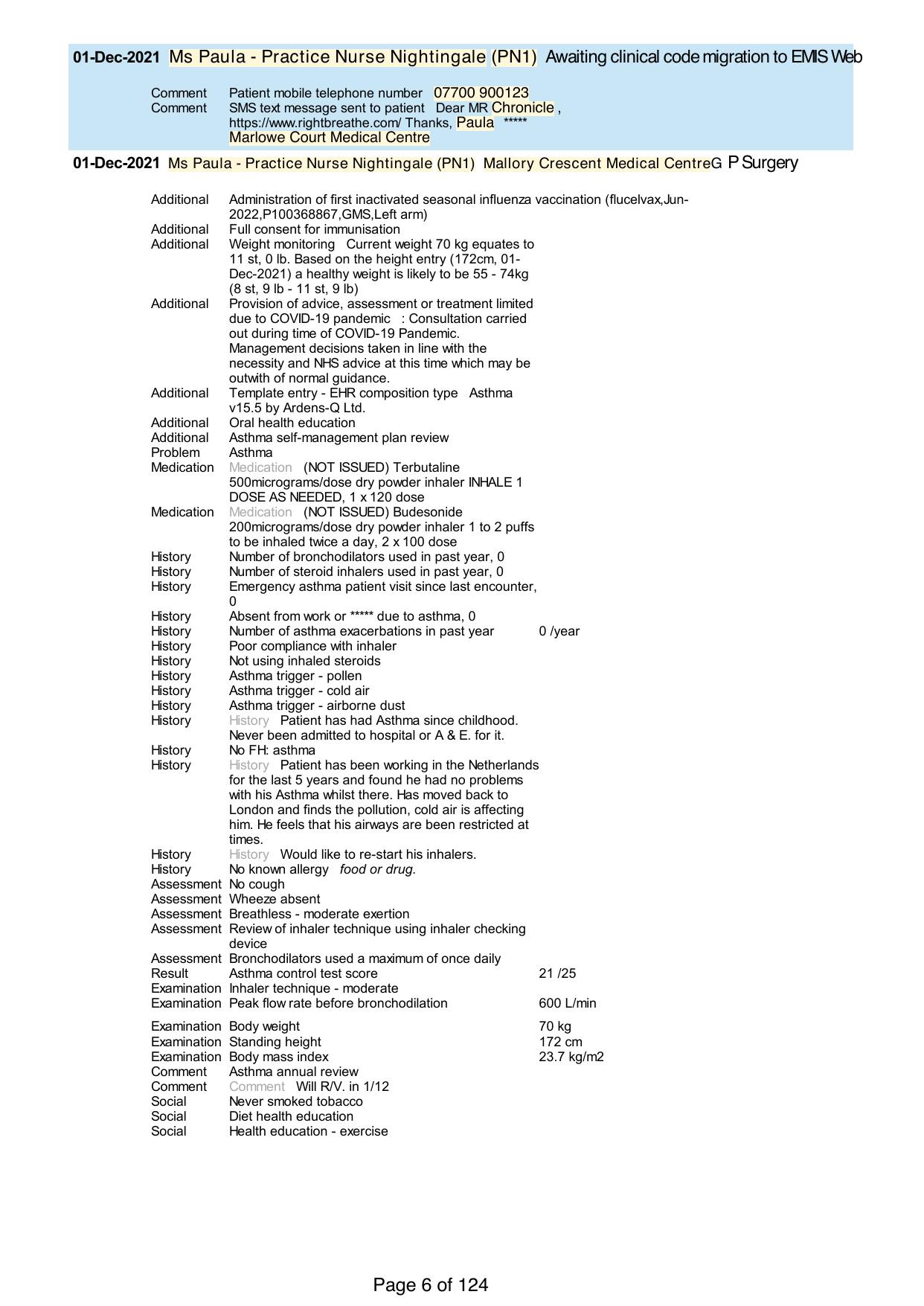
Control at the most recent assessment, the online consultation form of 1 July 2025, was rated well controlled with an Asthma Control Test score of 23 out of 25, two or fewer salbutamol inhalers used in twelve months, an inhaler lasting more than six months, and no emergency nebuliser or overnight hospital stay for asthma ever. The same form answered “Yes” to a single combined question covering daytime symptoms three or more times a week, night-time symptoms and symptoms on activity, and does not separate which of the three applied. Exacerbations were recorded as zero in the preceding year at the December 2021 and April 2022 assessments, and on the April 2023 questionnaire; no clinician review followed that 2023 questionnaire. Adherence gaps are documented repeatedly: inhaled steroids not in use in September 2007 and at the December 2021 review, which also coded poor compliance and zero steroid inhalers used in the preceding year; budesonide having run out some time before the November 2010 review; and the note of 21 April 2022 recording that the inhaler restarted in December 2021 had not been issued since.
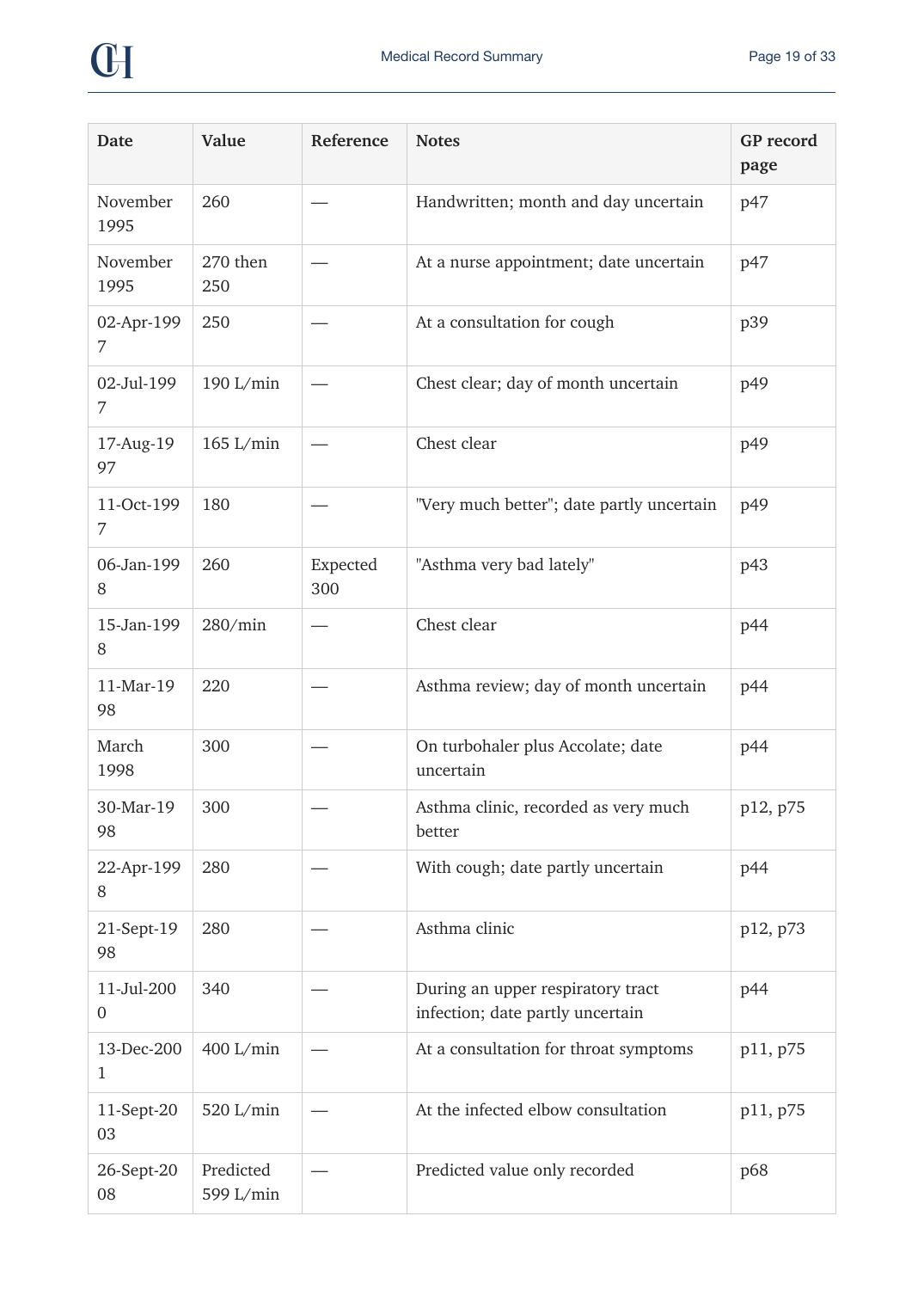
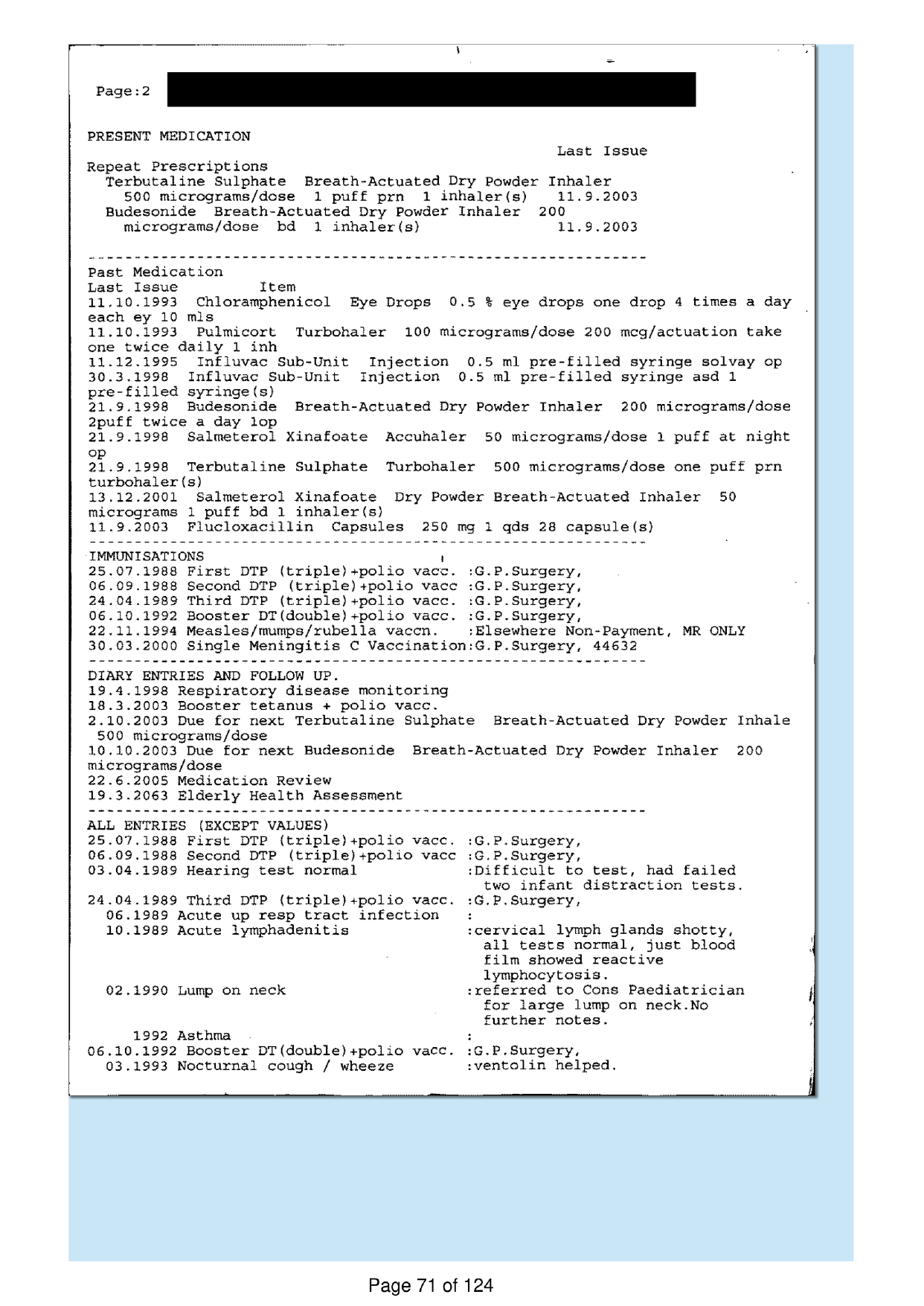
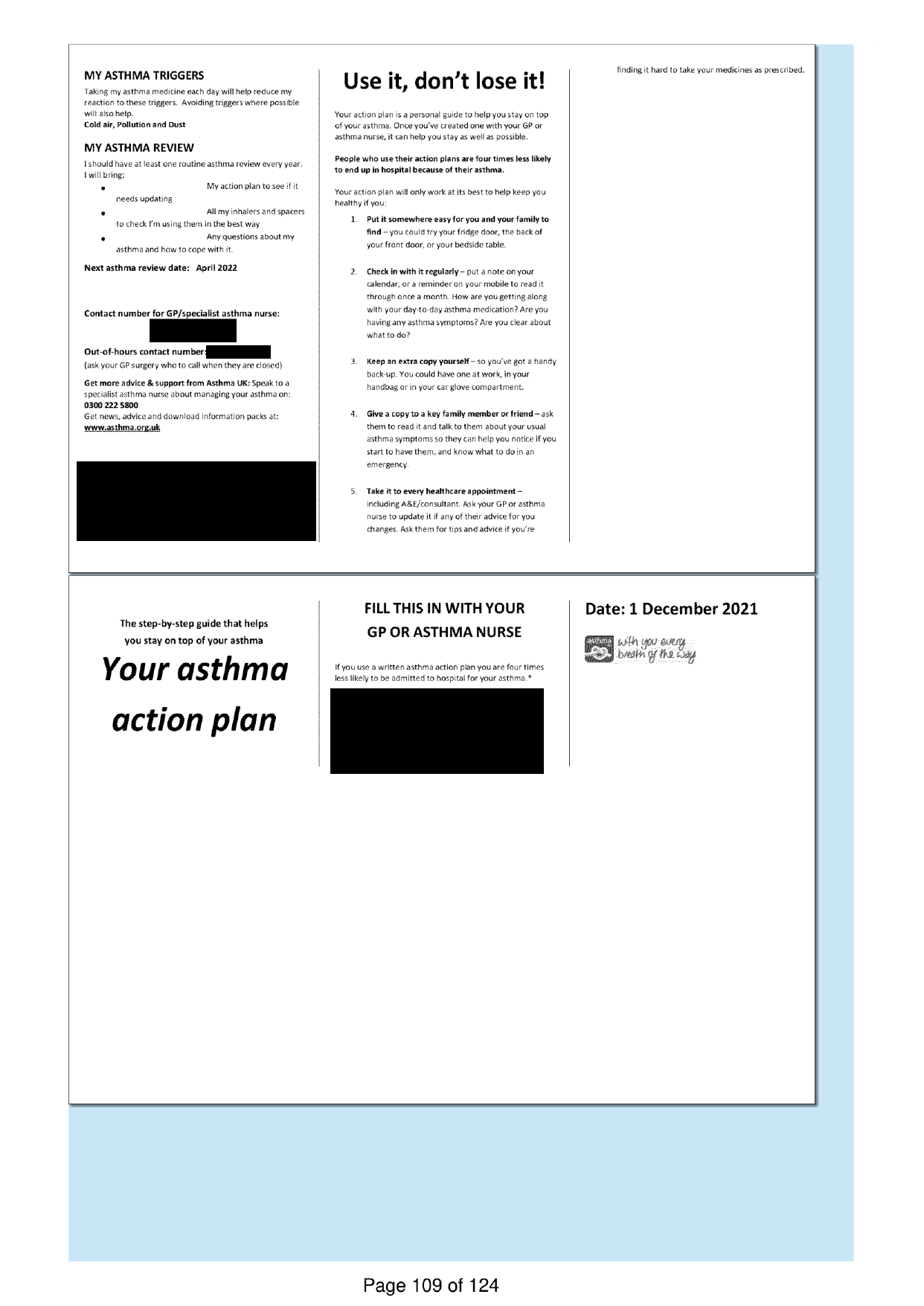
The arc of treatment runs from a nocturnal cough in January 1993, treated with a salbutamol inhaler, through the addition of a budesonide preventer in October 1993 and a peak flow meter in October 1994. The heaviest stretch for treatment is 1996 to 1998, with a peak flow of 165 L/min in August 1997, a five-day oral prednisolone course recorded in a handwritten entry with the strength uncertain, and salmeterol added as a long-acting bronchodilator between 1998 and 2001. From 2000 onwards the picture settles: reviews become annual and largely unremarkable, and the peak flow series rises. Nothing clinical is recorded between January 2015 and October 2021, a gap of nearly seven years spanning five years working in the Netherlands with no asthma problems there; on returning to the United Kingdom, pollution and cold air were recorded as affecting the airways. Reviews resumed in December 2021 and April 2022, and the April 2023 invitation is annotated “mess left to book review”, with no review after it. Recorded triggers are pollen, cold air and airborne dust (December 2021), exercise and pollution on the action plan (April 2022), and being out in the cold and dust (July 2025).
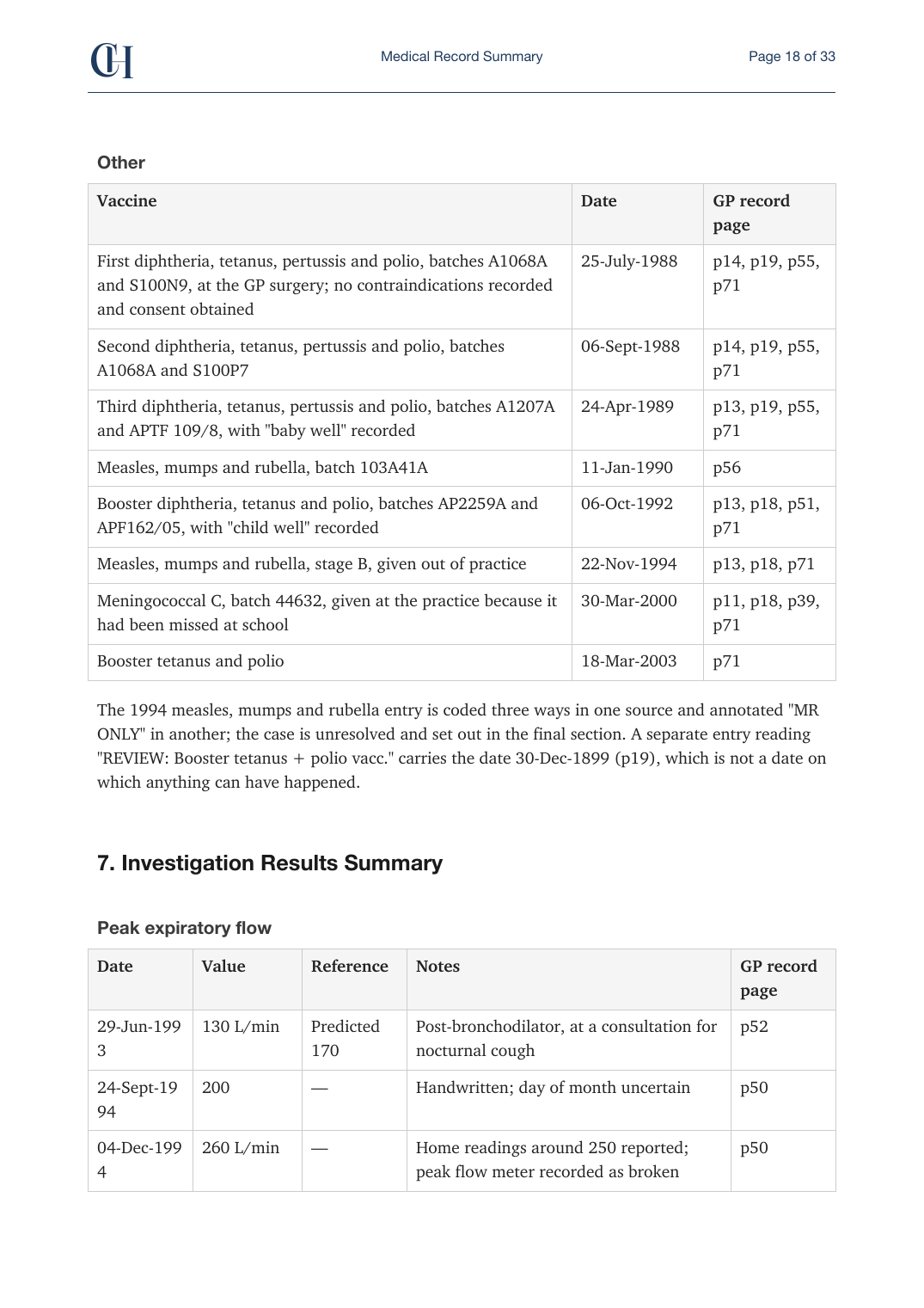
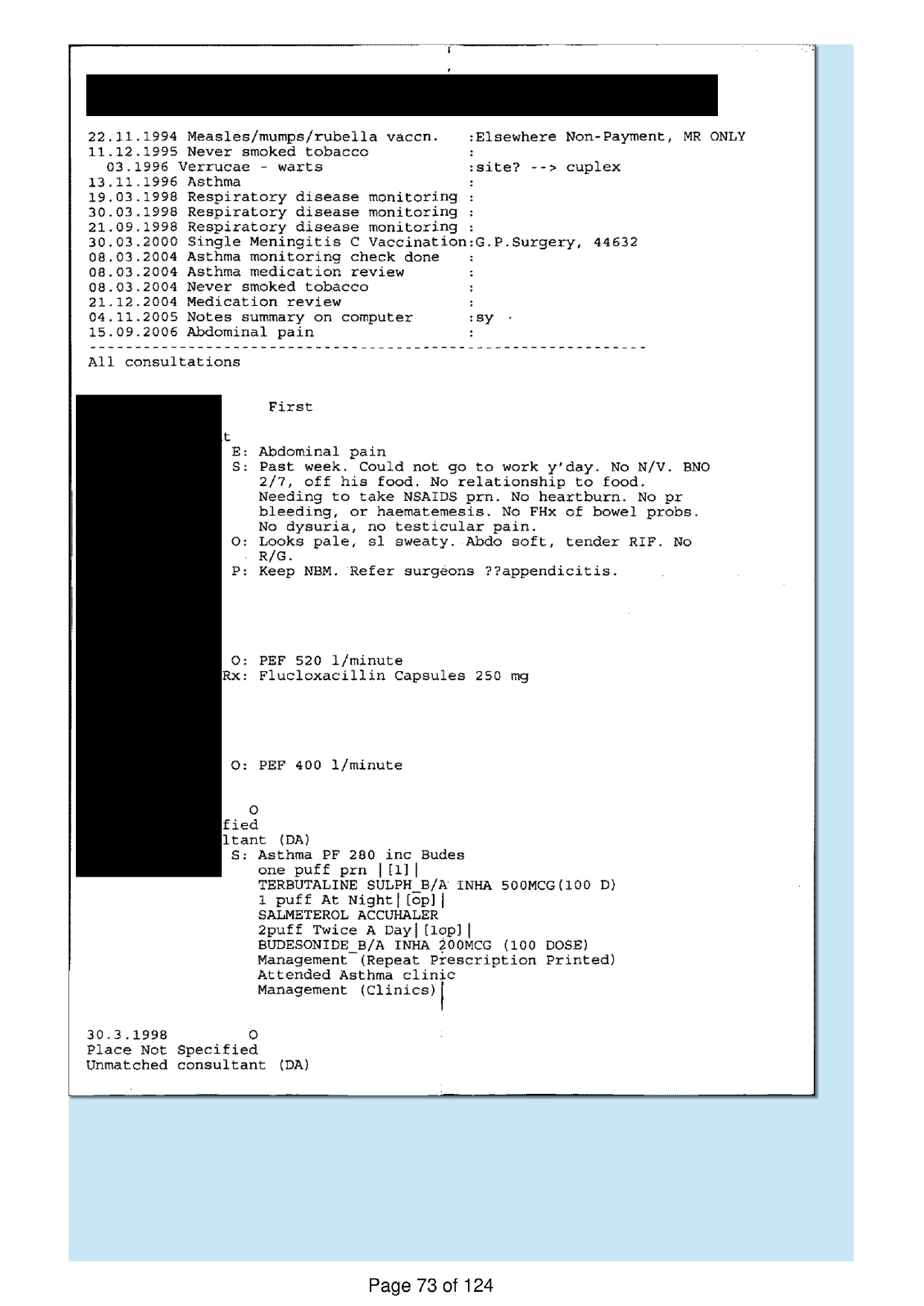
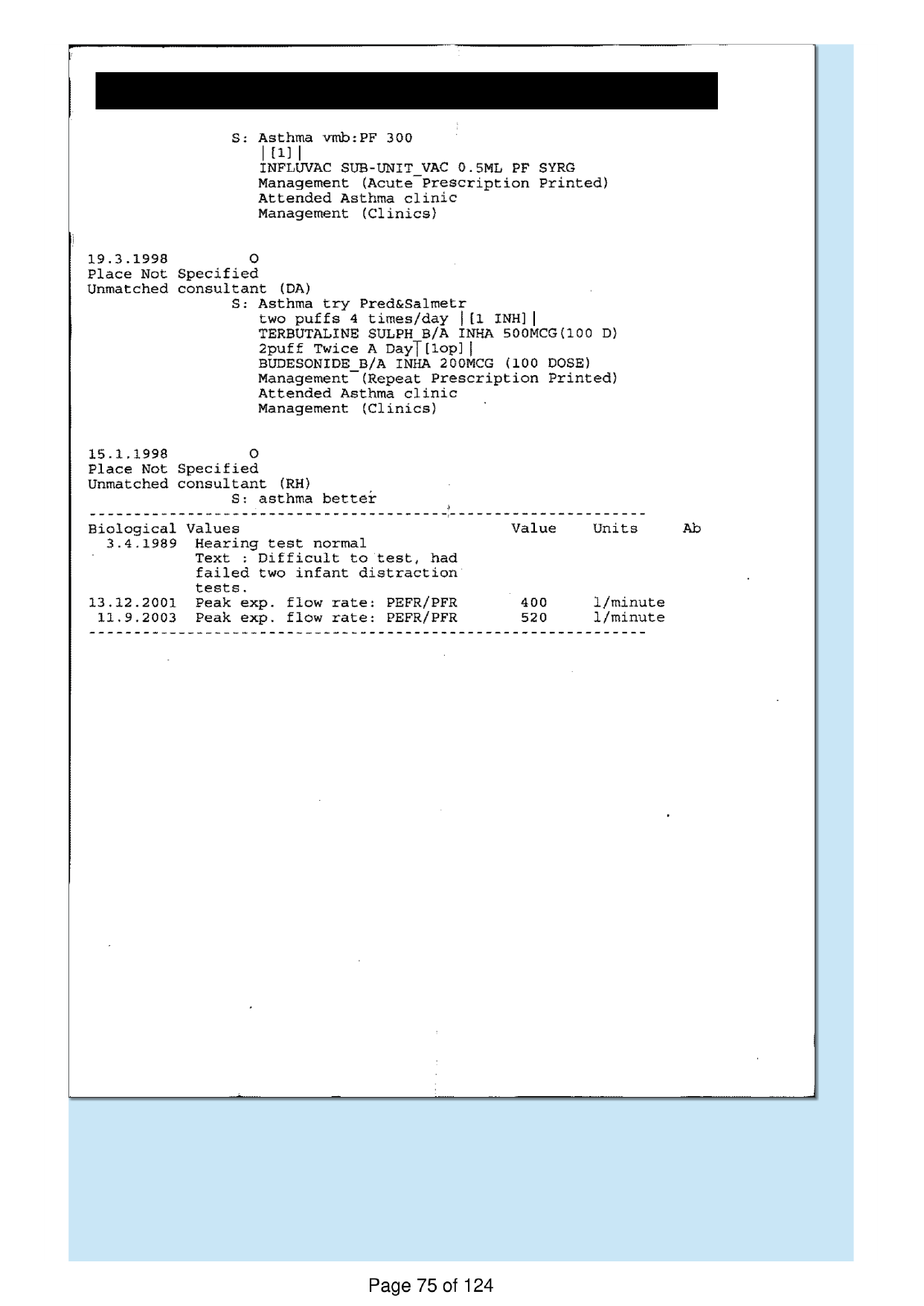
Monitoring has been almost entirely by peak expiratory flow: roughly two dozen readings from 130 L/min in June 1993, through 165 L/min in August 1997, to 400 L/min in 2001, 520 in 2003, 600 in October 2009, 540 in 2010 and 600 L/min at both the December 2021 and April 2022 reviews, the most recent recorded value. The lowest in the series is the 130 L/min of June 1993. Asthma Control Test scores were 21/25 in December 2021 and 23/25 at each of the three assessments from April 2022 to July 2025. The pack records no spirometry values or trace, no fractional exhaled nitric oxide measurement, no allergy testing and no chest imaging after 1989. Peak flow and questionnaire scores are the only airway measurements standing behind the coding.
Current findings from privately arranged testing
These are point-in-time results from privately arranged screening, assessment and laboratory panels between July 2024 and July 2026. None is coded as a diagnosis on the GP problem list. Apart from the neutrophil count, which can be read against a 1989 full blood count reported as normal, none has an NHS result before or after it to sit against. No differential values from 1989 are held.
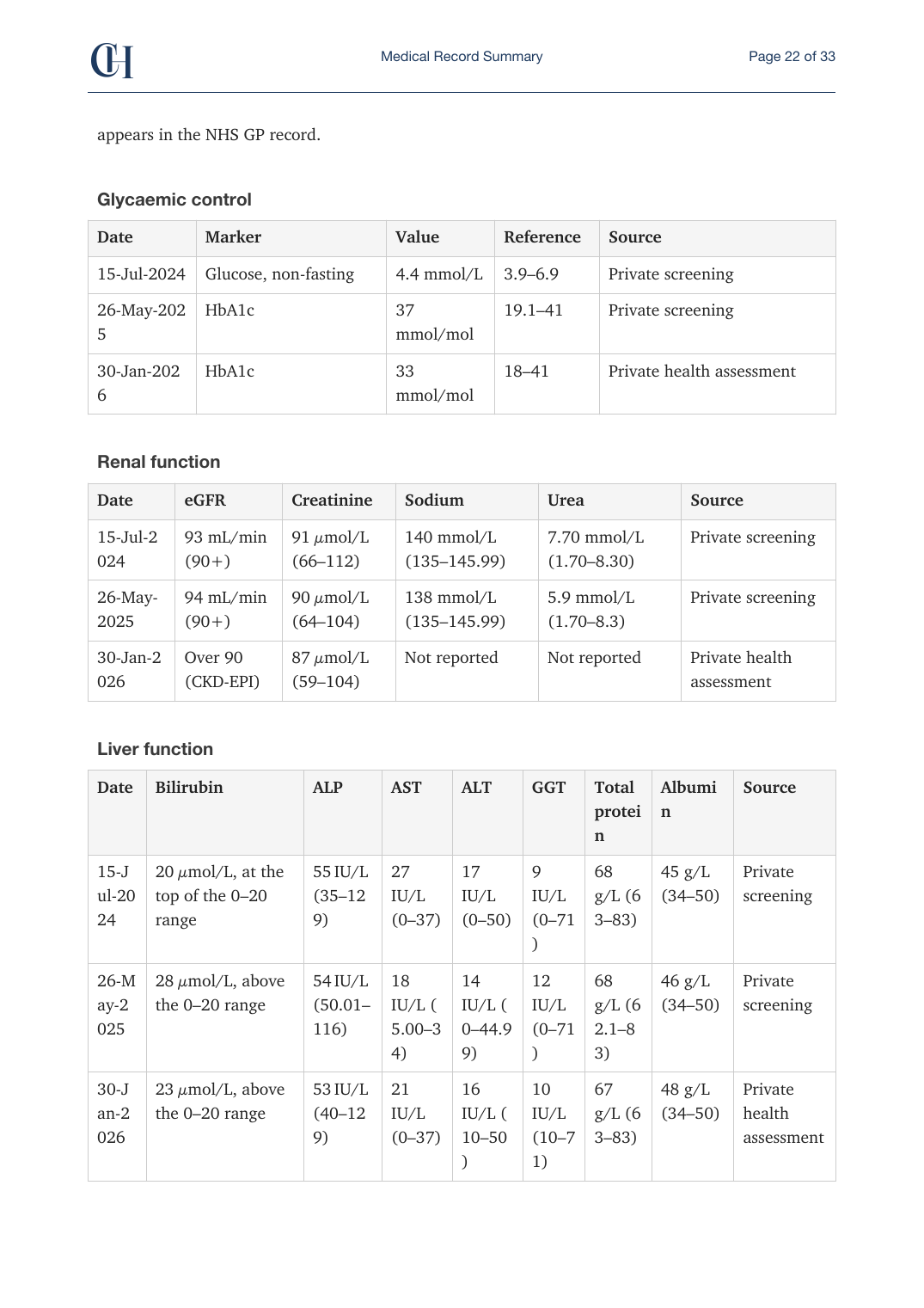
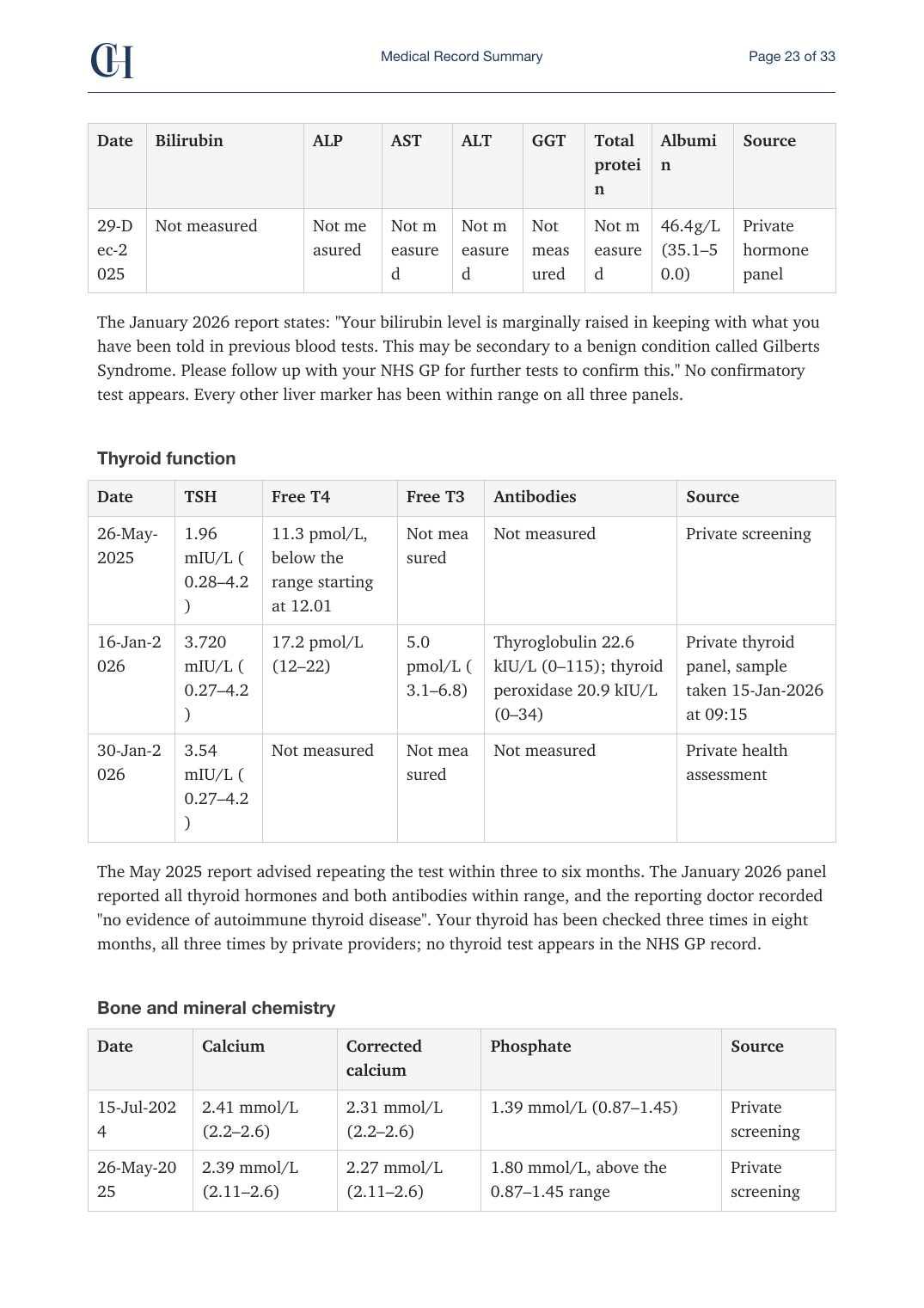
Bilirubin. 20 µmol/L at the top of the 0–20 range (15 July 2024, Bluecrest), 28 µmol/L above it (26 May 2025, Bluecrest) and 23 µmol/L above it (30 January 2026, Bupa), with every other liver marker within range on all three occasions. The reporting clinician wrote on 2 February 2026: “Your bilirubin level is marginally raised in keeping with what you have been told in previous blood tests. This may be secondary to a benign condition called Gilberts Syndrome. Please follow up with your NHS GP for further tests to confirm this.” No confirmatory test follows in the pack.
Neutrophils. 1.80 x10⁹/L against a 2.0–7.5 range (30 January 2026, Bupa), with all fifteen other indices of that full blood count within range, including haemoglobin 141 g/L, white cell count 4.30 x10⁹/L, lymphocytes 1.88 x10⁹/L and platelets 183 x10⁹/L. The reporting clinician wrote: “Your neutrophil count is marginally reduced. The rest of your full blood count indices are normal. In the first instance please arrange to have this test repeated in 4-6 weeks with your NHS GP to check the trend and arrange further investigations if this remains persistent.” No repeat count follows in the pack. The only earlier full blood count is the childhood one taken during the 1989 lymph node investigation, reported as normal apart from a reactive lymphocytosis on the film.
Thyroid. Free T4 was 11.3 pmol/L, below the range starting at 12.01, with TSH 1.96 mIU/L inside its 0.28–4.2 range (26 May 2025, Bluecrest), and the report advised repeating within three to six months. Both repeats were in range: free T4 17.2 pmol/L (12–22), TSH 3.720 mIU/L (0.27–4.2), free T3 5.0 pmol/L (3.1–6.8), thyroglobulin antibodies 22.6 kIU/L (0–115) and thyroid peroxidase antibodies 20.9 kIU/L (0–34) on 16 January 2026 (Medichecks, sample taken 15 January), with the reporting doctor recording “no evidence of autoimmune thyroid disease”; and TSH 3.54 mIU/L two weeks later (30 January 2026, Bupa).
Phosphate. 1.80 mmol/L against a 0.87–1.45 range (26 May 2025, Bluecrest), having been 1.39 mmol/L inside that range eleven months earlier (15 July 2024, Bluecrest). Calcium and corrected calcium were within range on both dates. The 2025 report recommended discussing the result with a GP, and no later phosphate result appears in the pack.
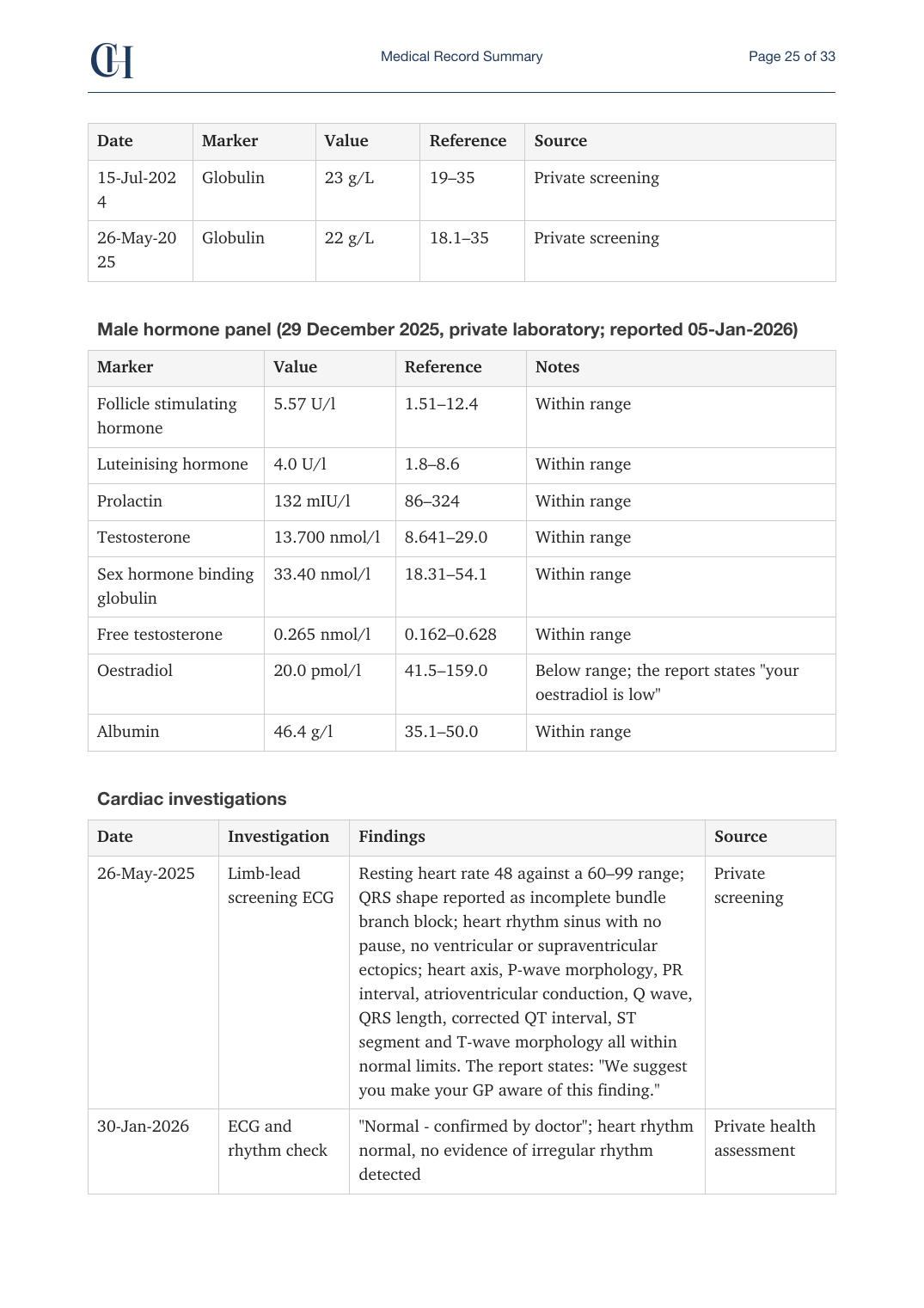
Heart trace. A limb-lead screening ECG on 26 May 2025 (Bluecrest) reported the QRS shape as incomplete bundle branch block, at a resting heart rate below the 60–99 range used. Rhythm, axis, P-wave morphology, PR interval, atrioventricular conduction, Q waves, QRS length, corrected QT interval, ST segment and T-wave morphology were all reported within normal limits, with no pause and no ectopics. The report states: “We suggest you make your GP aware of this finding.” The next trace, on 30 January 2026 (Bupa), was recorded as “Normal - confirmed by doctor”, with no irregular rhythm detected.
Male hormones. A male hormone panel taken on 29 December 2025 and reported on 5 January 2026 (Randox) placed seven of its eight markers inside the panel’s stated bands: follicle stimulating hormone 5.57 U/L, luteinising hormone 4.0 U/L, prolactin 132 mIU/L, testosterone 13.700 nmol/L, sex hormone binding globulin 33.40 nmol/L, free testosterone 0.265 nmol/L and albumin 46.4 g/L. Oestradiol was 20.0 pmol/L against a band starting at 41.5, and the report states “your oestradiol is low”. It is a single morning sample with nothing before or after it for comparison.
Vitamin D. 55 nmol/L within a 50–250 range (16 January 2026, Medichecks). The reporting doctor described it as “normal but towards the low end”, wrote that “optimal vitamin D levels are over 80”, and suggested an over-the-counter supplement. It is the only vitamin D measurement in the pack.
Dental and periodontal. A first examination at a private dental practice on 7 January 2026 found no caries clinically or on two bitewing radiographs, which also showed good bone levels, and rated caries, periodontal and oral cancer risk each as low following a visual oral cancer screening. Findings were a class 2 occlusion; mild to moderate non-carious tooth surface loss, with abrasion mild, attrition mainly of the canines under canine guidance and erosion nil, alongside a reported awareness of soft night-time grinding; and periodontal probing within the normal range with no recession, prognosis good. Existing work is a composite at the upper right central incisor, first restored after a childhood fracture and replaced about five years earlier, and posterior composites at upper right 5, upper right 4 and upper left 6. The care plan set a hygienist visit every three to six months, a twelve-month recall, and active surveillance of the upper right central incisor and of the gums; a night guard was left as something to consider.
Allergies
“No known allergy — food or drug” is coded at 1 December 2021, and “no known allergy to administered vaccine” at the influenza vaccination of 17 October 2022. On the online asthma consultation form of 1 July 2025, house dust was recorded as an allergy with no other allergies reported. No drug-class ban or contraindication appears in the pack.
A handwritten GP entry dated 24 September 1994 reads “Allergic to cats & [?hamsters?]”, with the second animal marked uncertain in the transcription. It is single-sourced, is not repeated anywhere later, and is not carried as a coded allergy.
Significant past medical history
| Condition or episode | Date or period | Details |
|---|---|---|
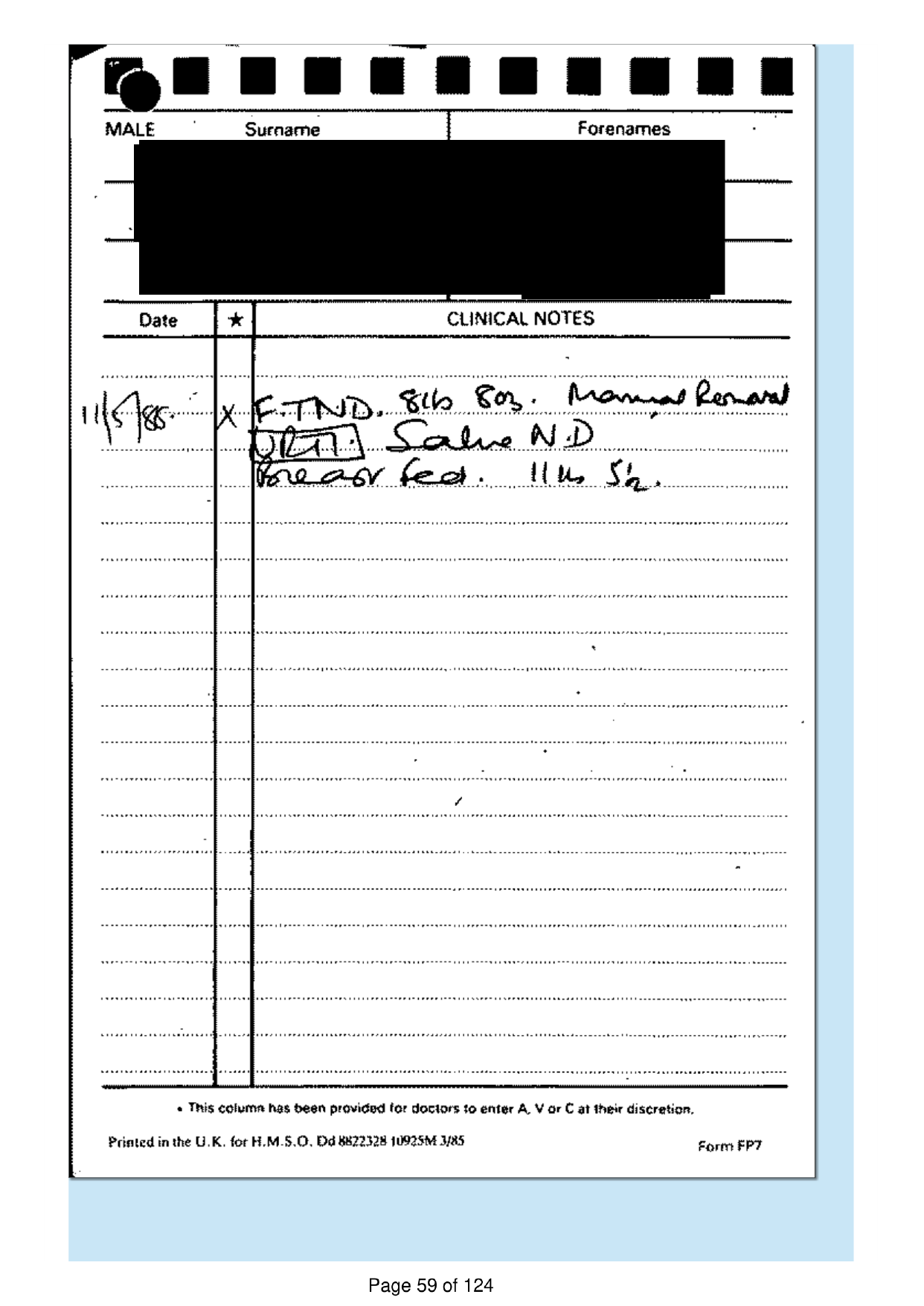
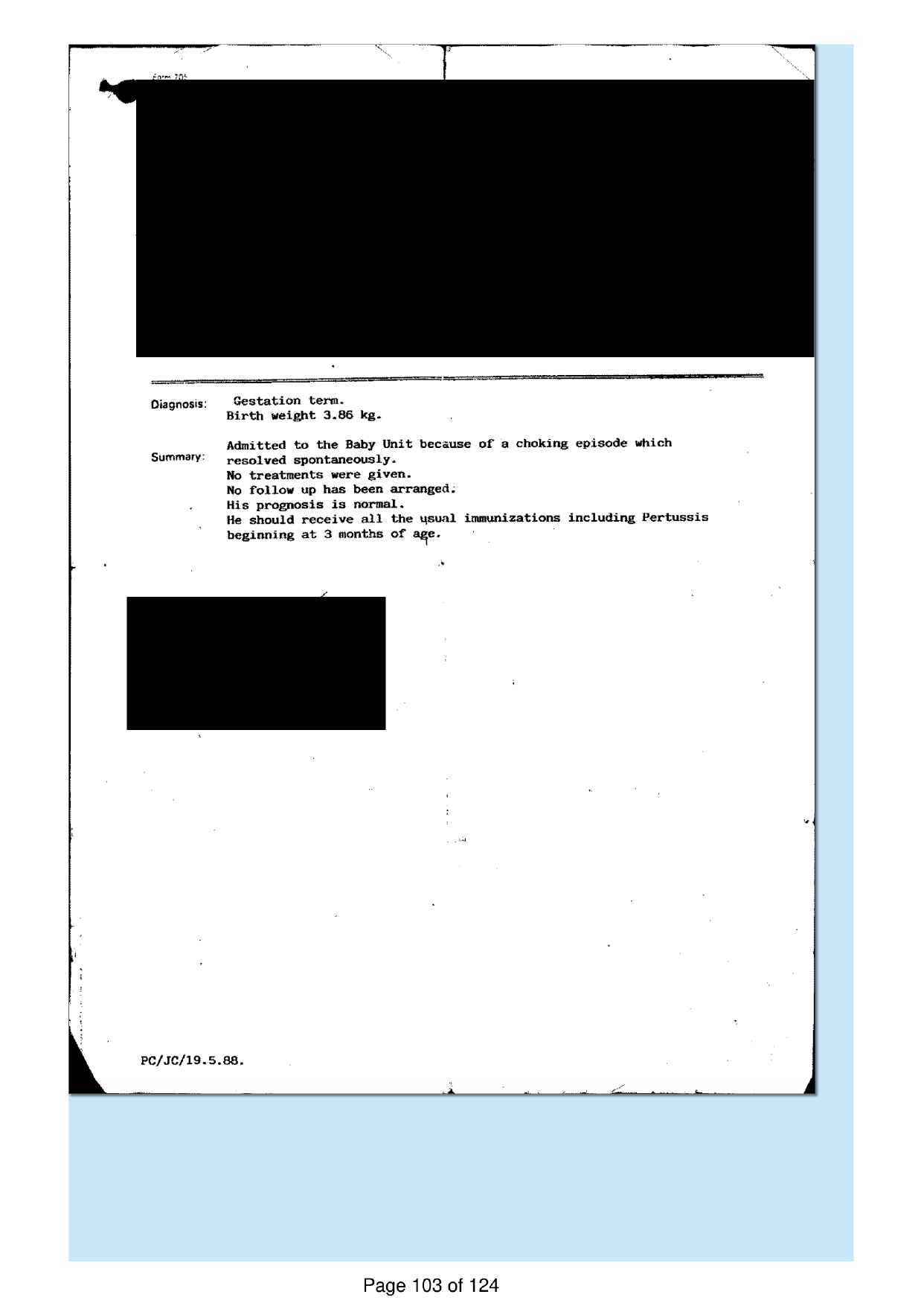
| Birth and neonatal period | Spring 1988 | Full-term normal delivery, birth weight 3.86 kg, placenta manually removed; breastfed. Admitted to a baby unit after a choking episode that resolved spontaneously, with no treatment given and no follow-up arranged. |
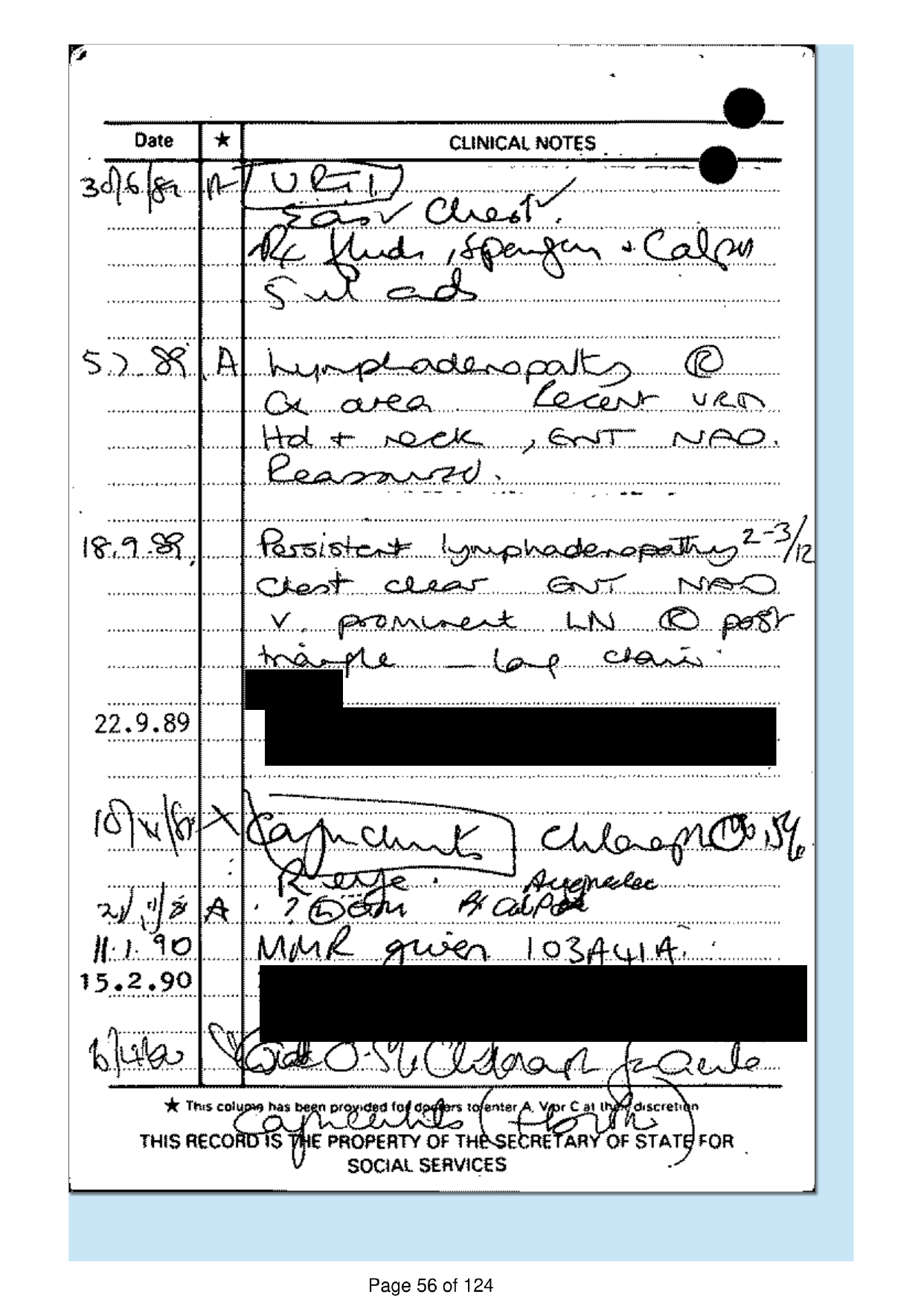
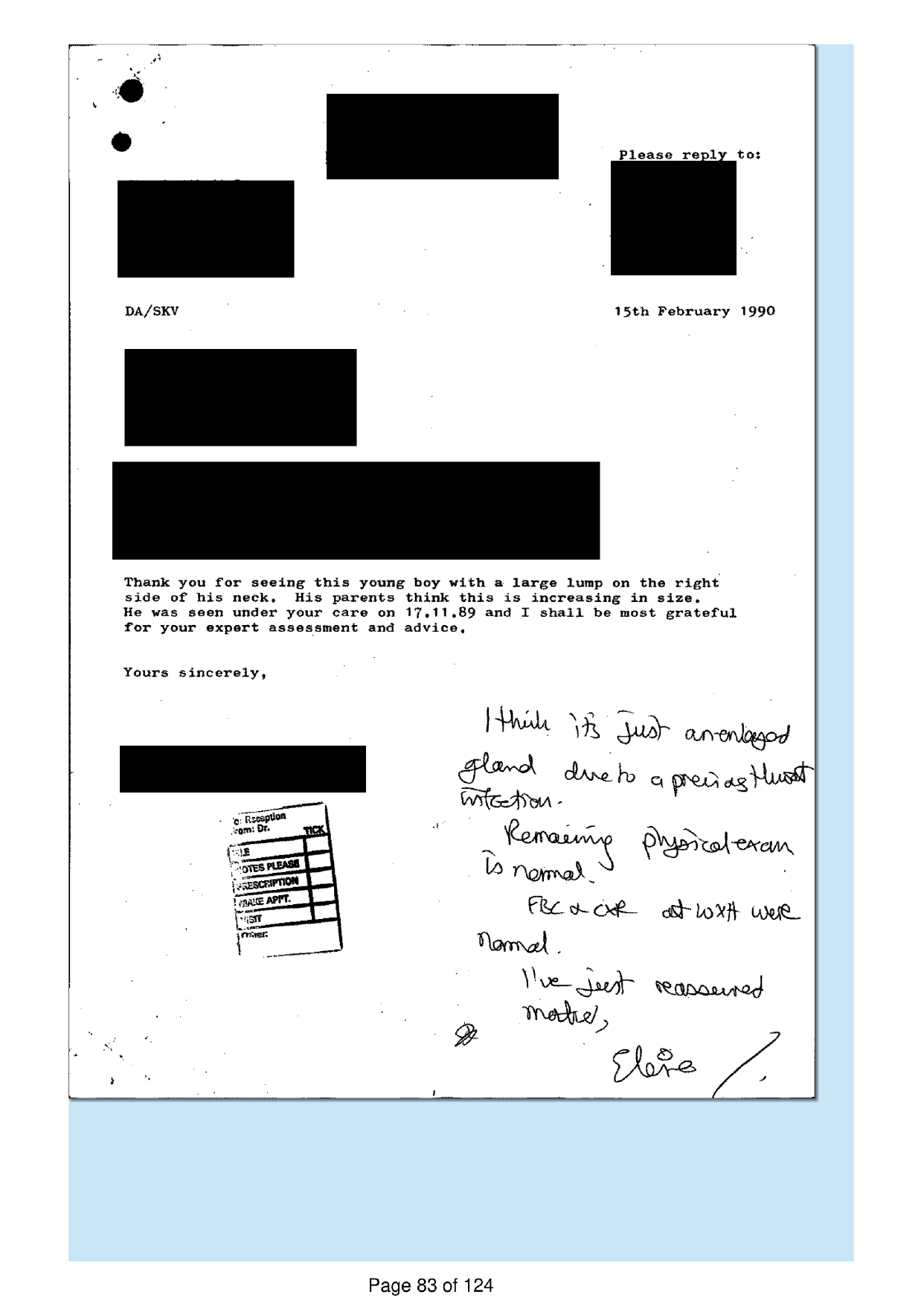
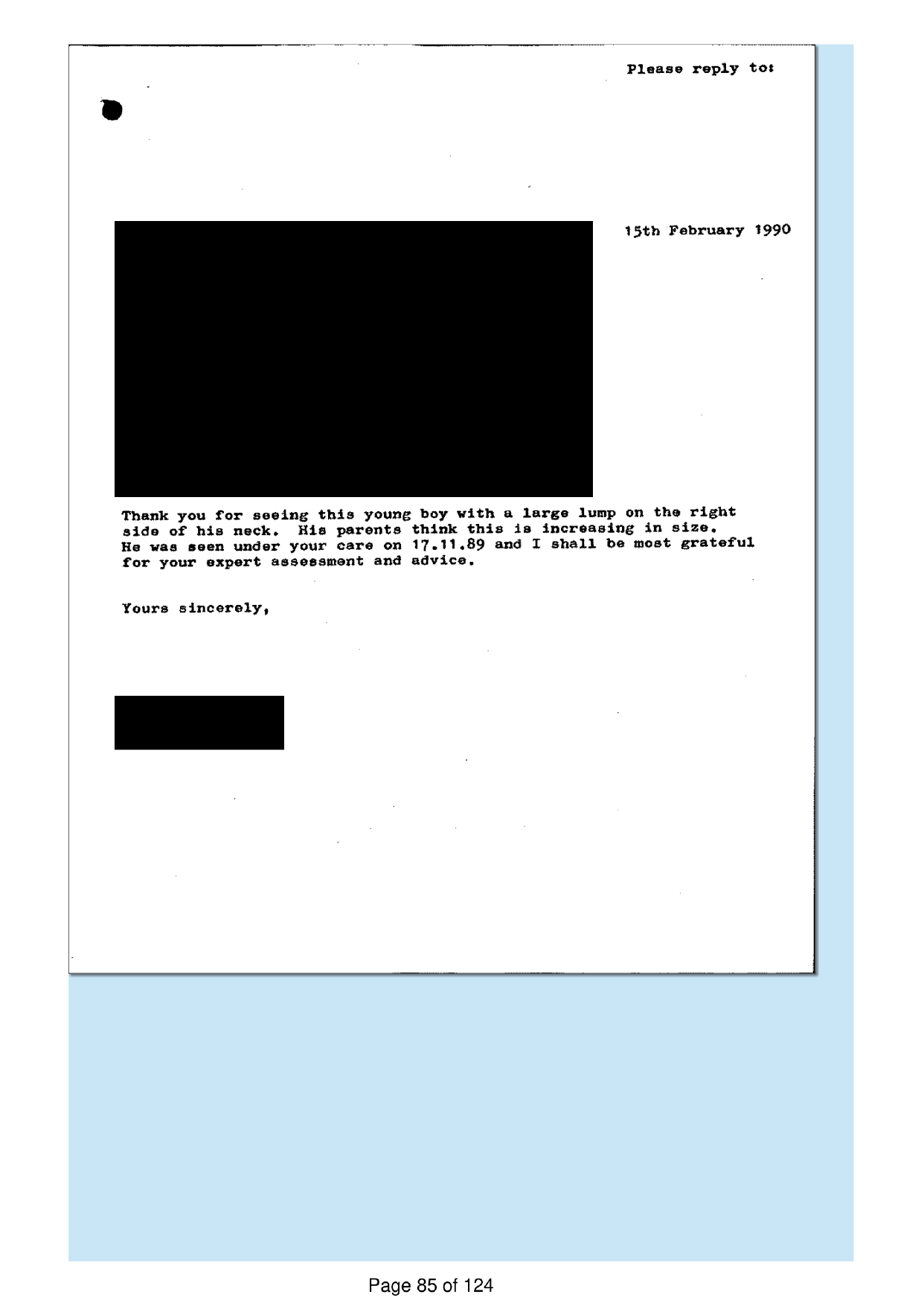
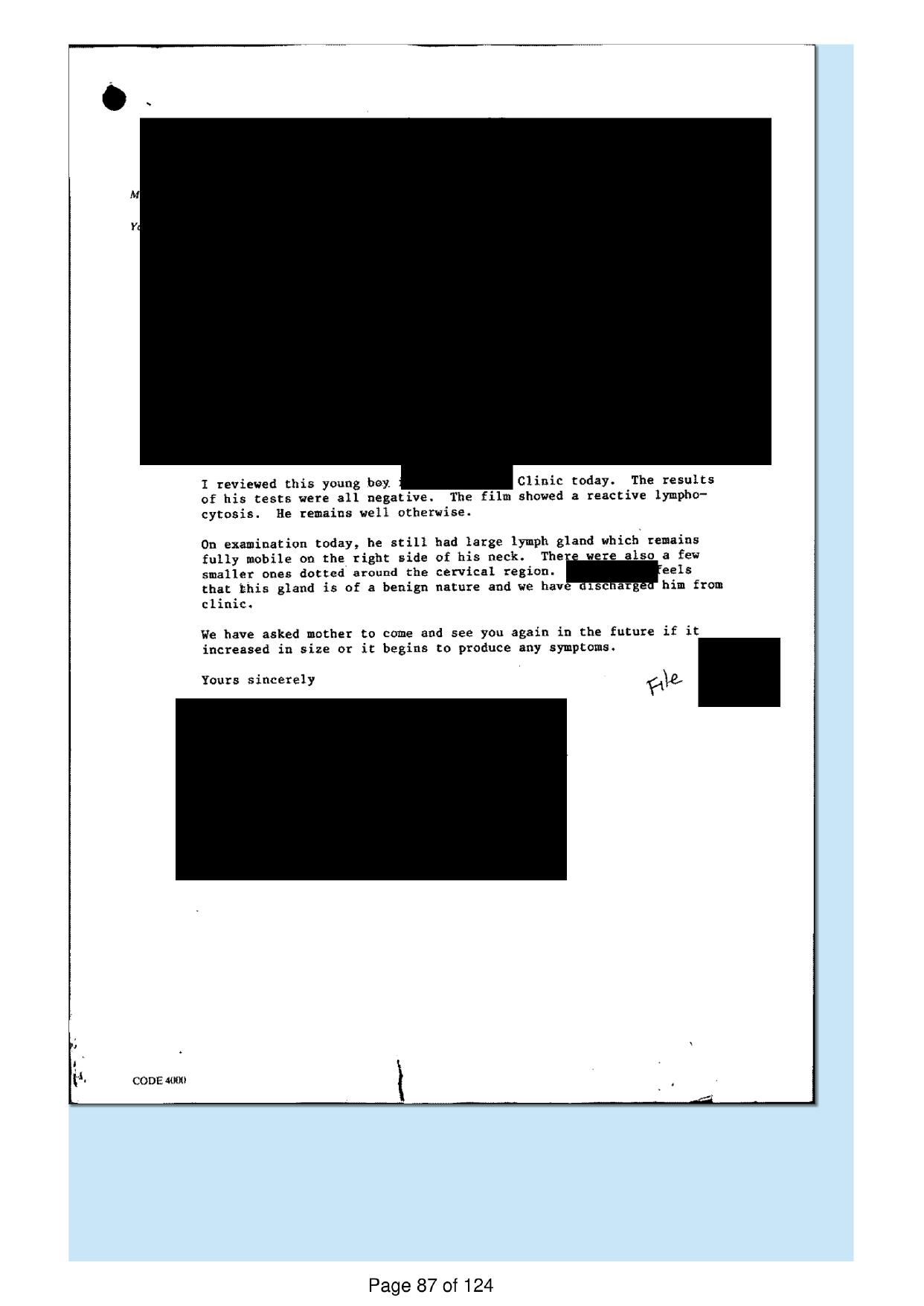
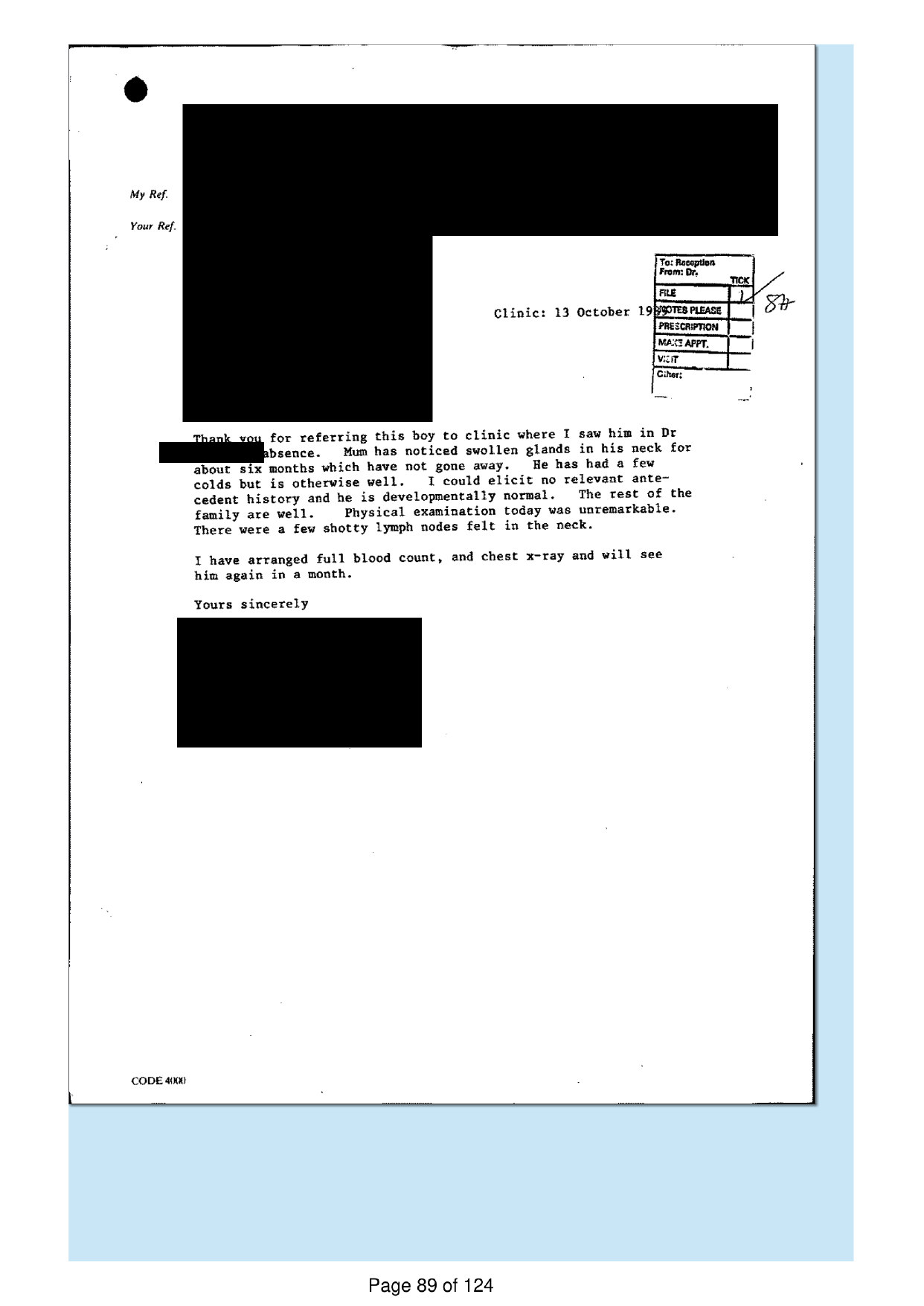
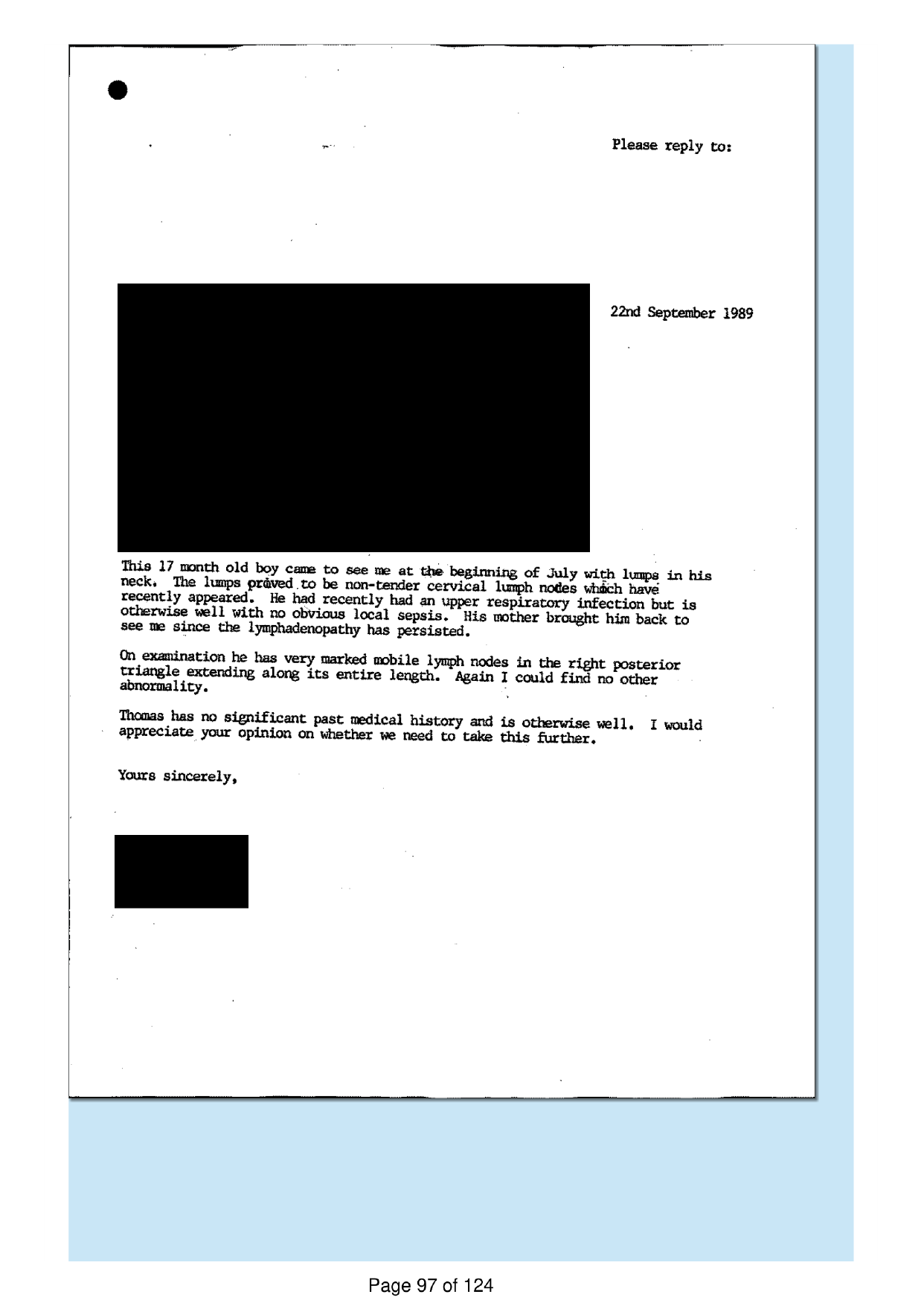
| Cervical lymphadenopathy | 1989 to 1996 | The most fully investigated episode in the record. Non-tender right posterior triangle nodes, present two to three months at referral in September 1989. Full blood count and chest X-ray normal, blood film showing reactive lymphocytosis; assessed as benign and discharged from clinic in November 1989. A second paediatric referral in February 1990 for a lump the parents thought was enlarging has no outcome recorded in the pack. The gland was re-recorded at 2½ x 1½ cm in November 1992 and 2 x 1 cm two weeks later, and was still easily palpable in April 1996. |
| Recurrent otitis media | 1990 to 1994 | Six episodes, mostly left-sided, treated with amoxicillin courses and symptomatic relief; each recorded as settling. |
| Recurrent conjunctivitis | 1988 to 1996 | Seven episodes treated with chloramphenicol drops or ointment, except May 1995, where a swollen left eye after influenza was treated with Fusithalmic drops after two days of chloramphenicol had not helped. |
| Upper respiratory tract infections | 1988 to 2000 | Four recorded episodes, treated symptomatically. The July 2000 episode was managed with a doubled budesonide dose. |
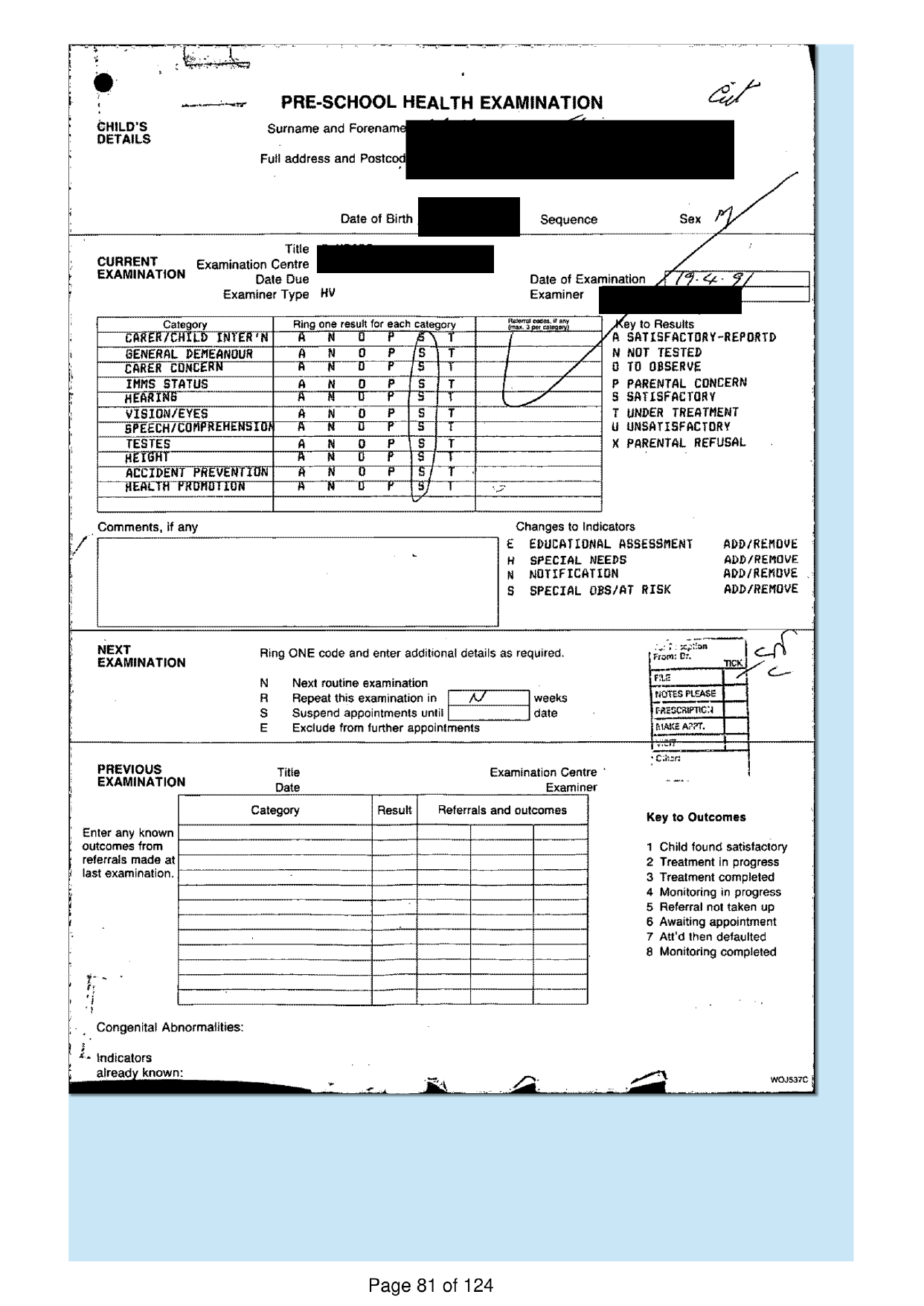
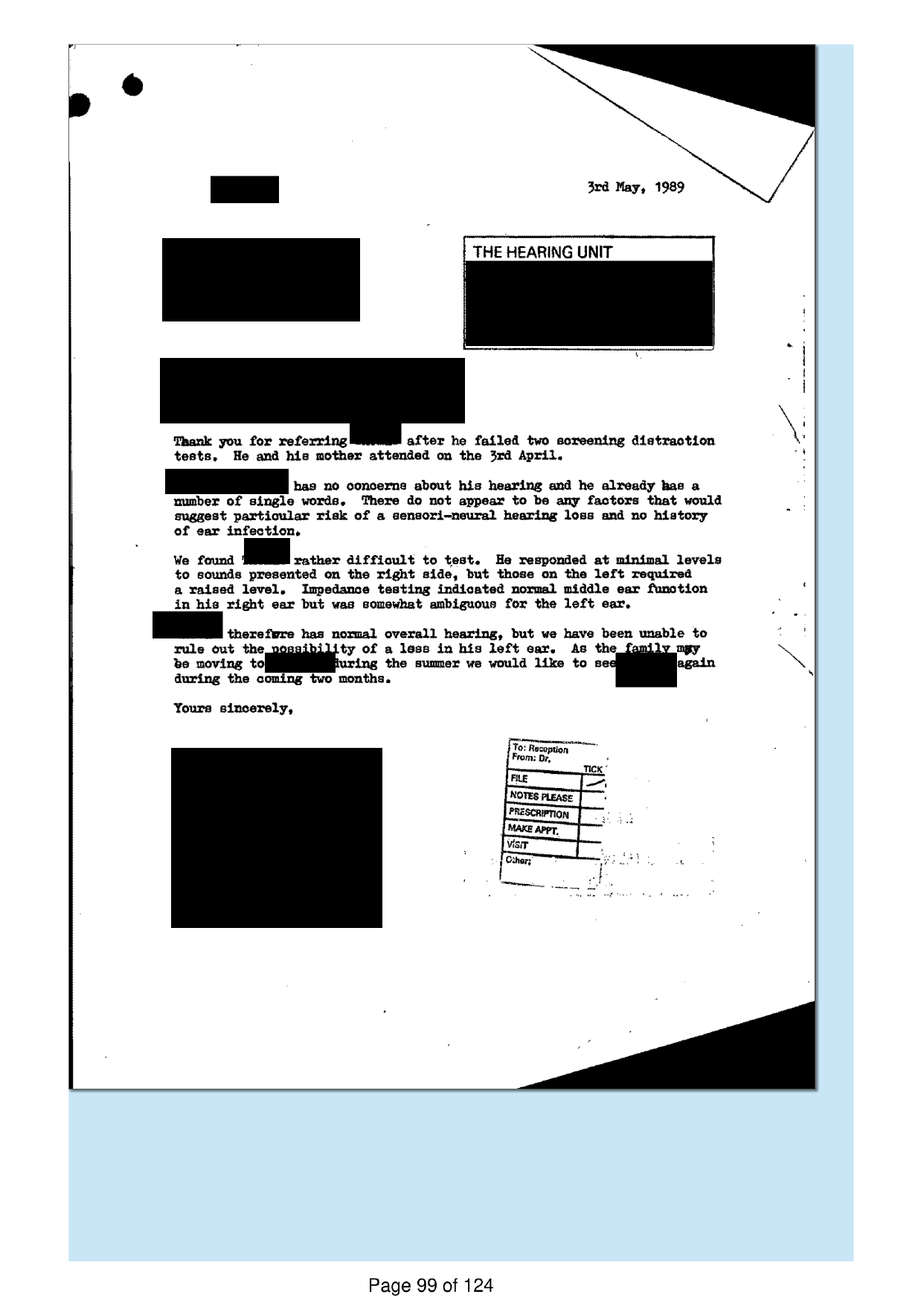
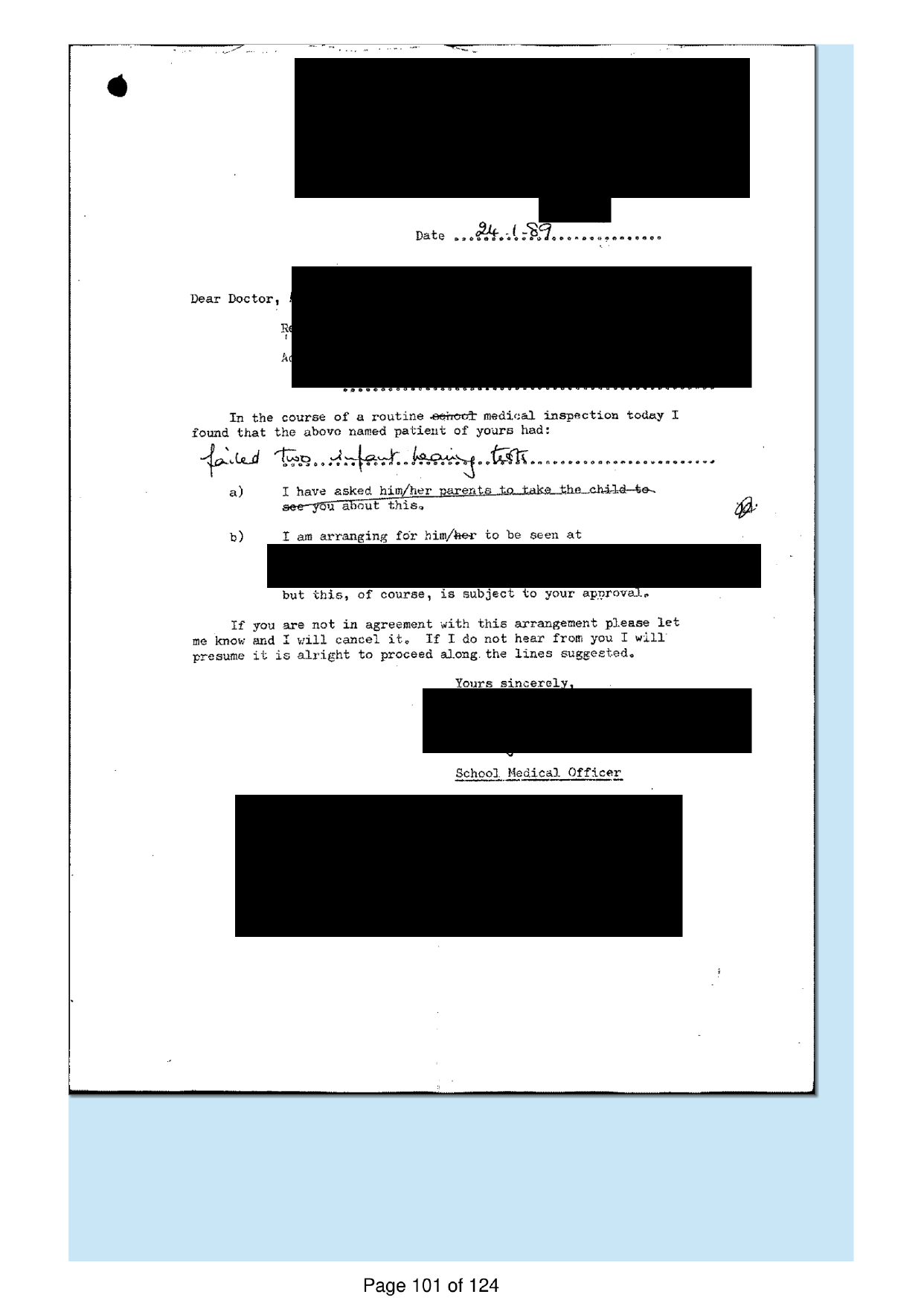
| Childhood surveillance | 1989 to 1991 | Hearing test recorded as normal in April 1989, with a note that testing was difficult after two failed infant distraction tests. Pre-school health examination in April 1991, with all twelve assessed domains rated satisfactory. |
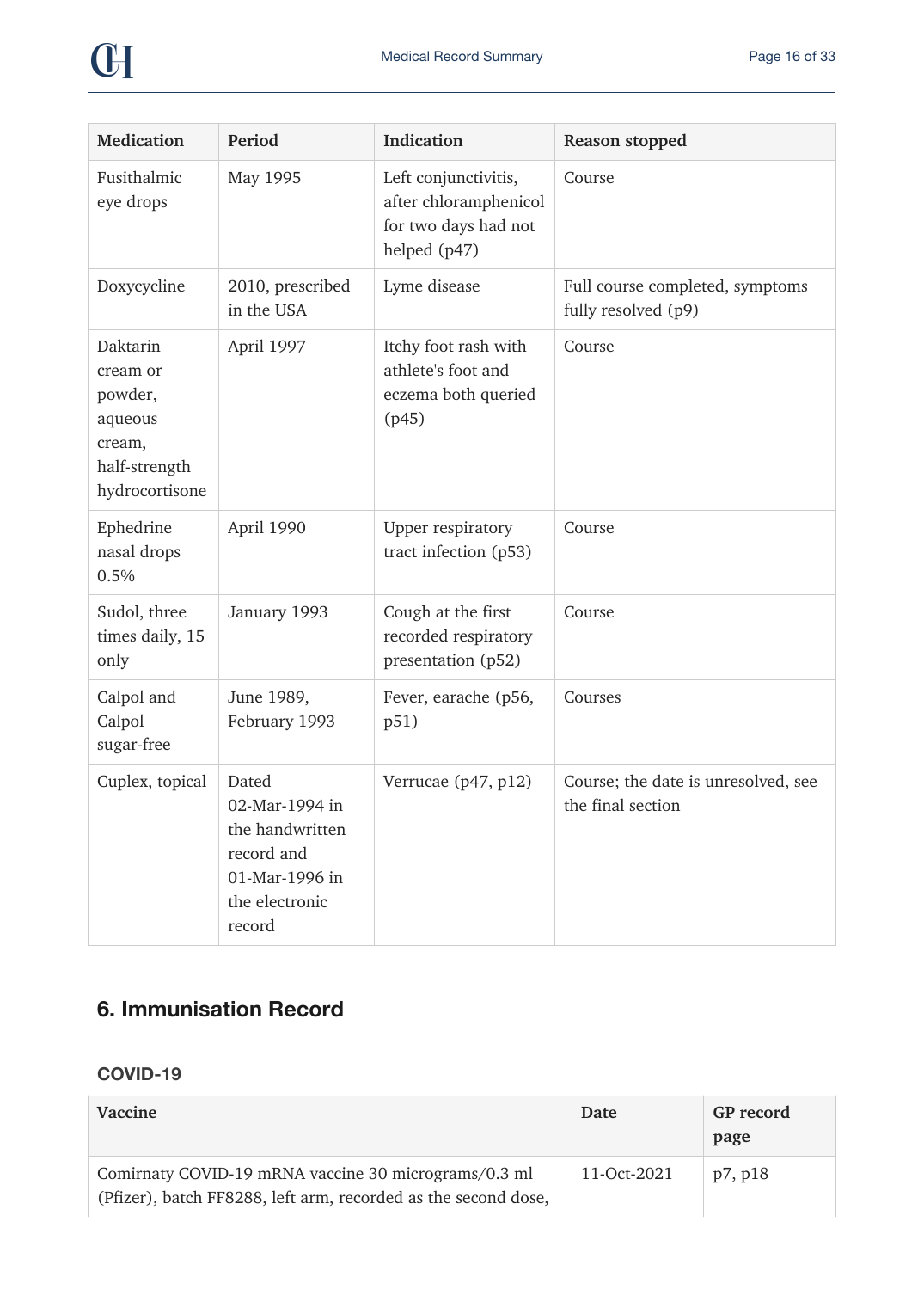
| Verrucae | March 1994 or March 1996 | Topical treatment recorded once in the handwritten record and once in the electronic record, two years apart, with the product name uncertain in the handwritten entry. The pack leaves unresolved whether this is one episode misdated or two. |
| Foot rash | April 1997 | Very itchy rash with athlete’s foot and eczema both queried, treated with a topical antifungal, aqueous cream and half-strength hydrocortisone. Several words in the handwritten entry are uncertain. |
| Minor injuries | 1996 and 2003 | Facial laceration sutured under local anaesthetic in February 1996, with sutures removed six days later. Infected right elbow wound treated with a flucloxacillin course in September 2003. |
| Abdominal pain, query appendicitis | 15 September 2006 | A week of pain, off food, bowels not opened for two days; pale and slightly sweaty with right iliac fossa tenderness and no rebound or guarding. Kept nil by mouth and referred to the surgeons. No admission, operation note, discharge summary or outcome for that referral appears in the pack. |
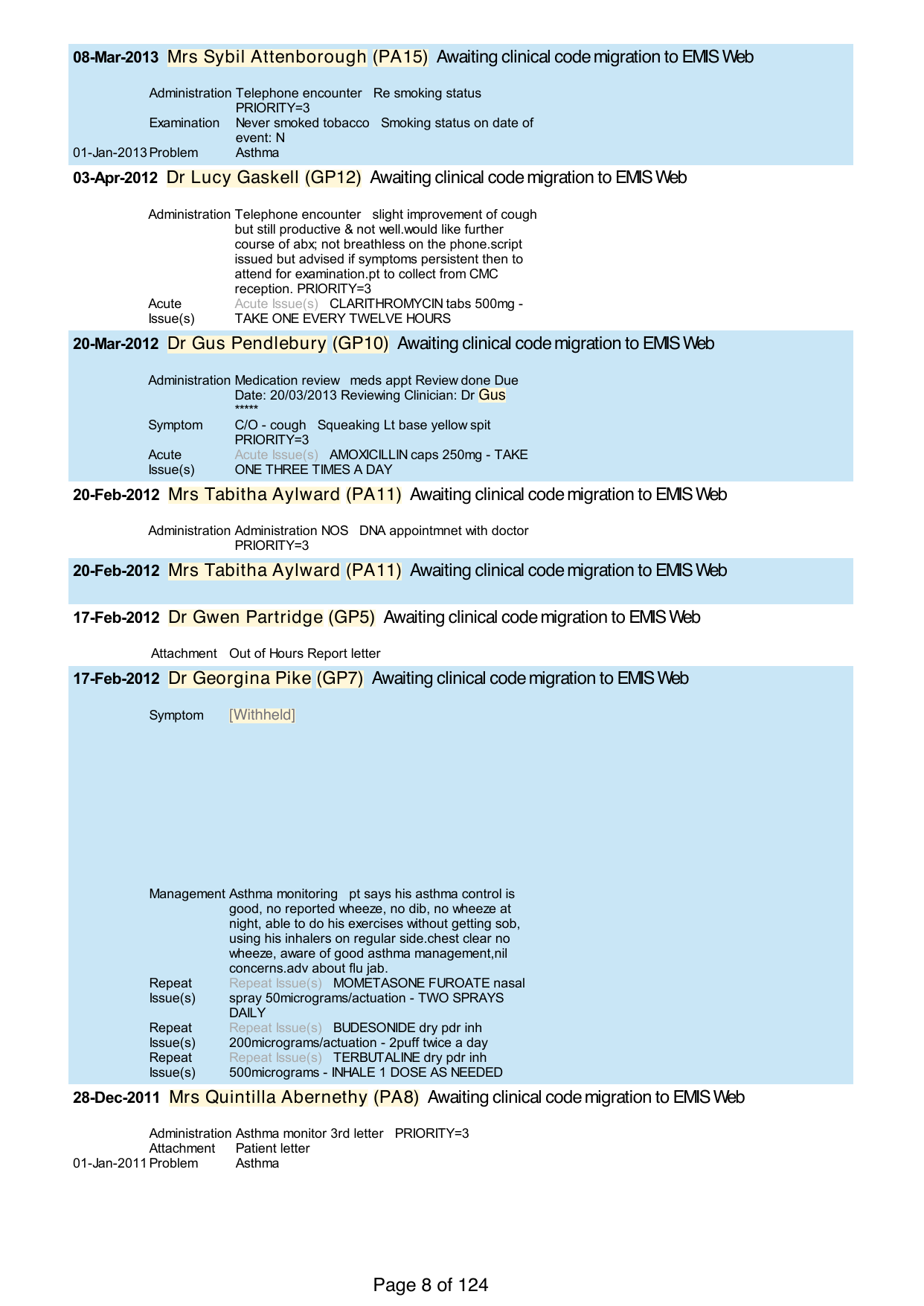
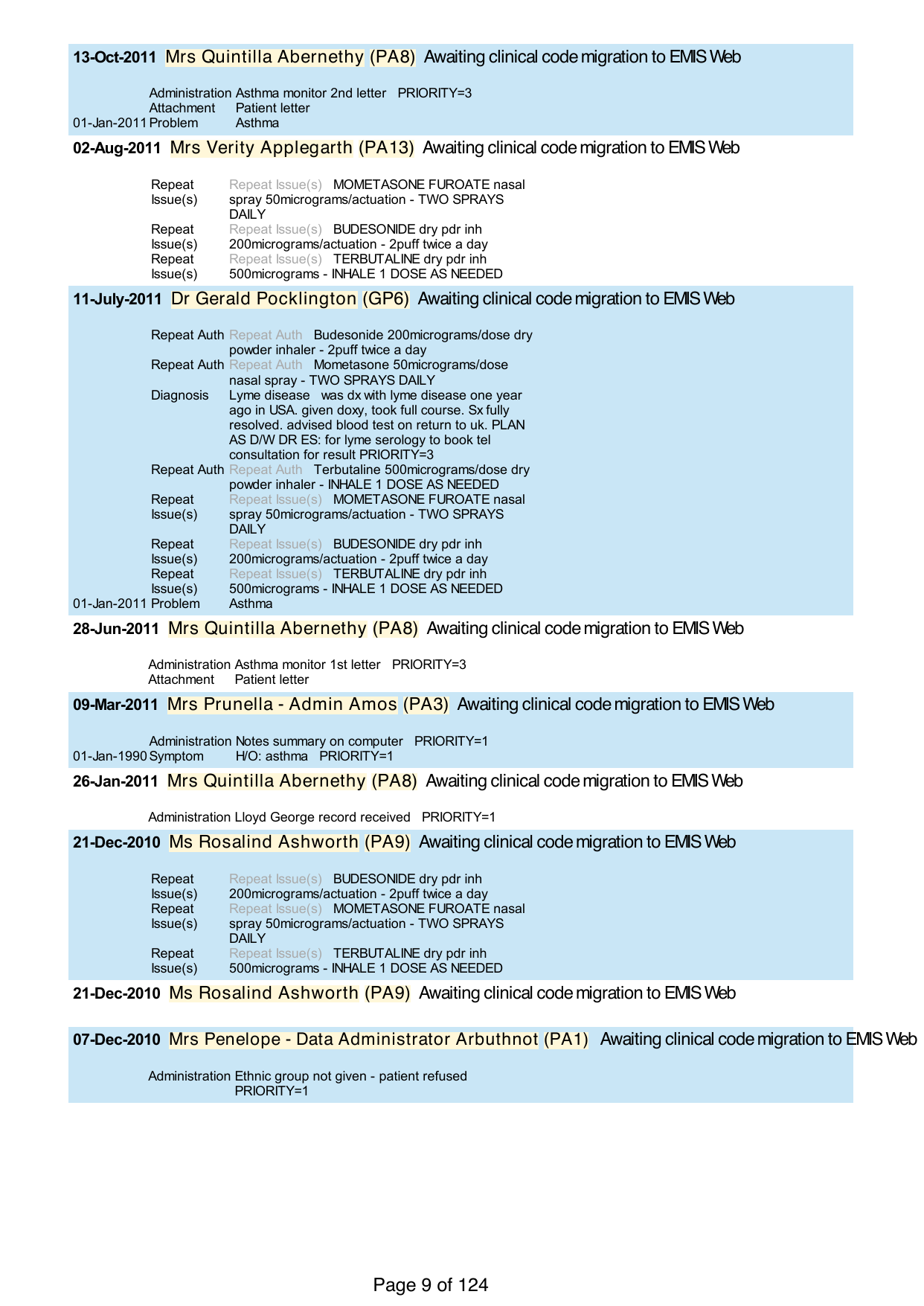
| Lyme disease | 2010 | Diagnosed in the USA, treated with a full doxycycline course, symptoms fully resolved. Recorded at a UK consultation in July 2011, at which serology and a telephone consultation for the result were planned; no serology result appears in the pack. |
| Lower respiratory tract infections | March and April 2012 | Productive cough with a squeak at the left base, treated with amoxicillin, then with clarithromycin two weeks later when it remained productive. |
| Rhinitis | September 2008 to January 2015 | A mometasone nasal spray ran on repeat for those years. The indication is recorded once, in November 2010, as query vasomotor rhinitis, and no formal diagnosis is coded. |
Current medications
The date given is when each item was last prescribed or authorised. It records what was made available, not confirmation that it is being taken.
| Last prescribed | Medication | Dose | Frequency | Purpose |
|---|---|---|---|---|
| 22 April 2022 | Clenil Modulite (beclometasone dipropionate) pressurised metered-dose inhaler | 250 micrograms/dose | Two puffs twice a day | Asthma preventer |
| 22 April 2022 | Terbutaline dry powder inhaler | 500 micrograms/dose | One dose as needed | Asthma reliever |
| 1 July 2025 | Ventolin Evohaler (salbutamol) | 100 micrograms/dose, two inhalers dispensed (400 doses) | As directed by the prescribing service | Asthma reliever, same class as the terbutaline above; the two are not reconciled anywhere in the record |
Both practice items were authorised on 22 April 2022 and no issue of either is recorded after that date. The salbutamol inhaler was prescribed by an online doctor service and notified to the practice, but does not appear on the practice repeat list, so two relievers of the same class, both short-acting beta-2 agonists, sit on the record from two different prescribers, unreconciled.
Past medications of note
Every item here stopped at the date shown; where one was later restarted, the row says so. A medicine appearing here records only that it was prescribed at the time, for the reason given: it does not indicate a current need for it, a current supply, or that it is being taken now. Several carry no stop entry and simply ceased to be reissued, so they are discontinued by omission rather than by a recorded decision.
| Last prescribed | Medication | Purpose | Why stopped |
|---|---|---|---|
| December 2021 | Budesonide breath-actuated dry powder inhaler 200 micrograms/dose | Asthma preventer, on repeat for most of the period from November 1996 | Replaced by beclometasone at the review of 22 April 2022, at which it was recorded as unused for some time |
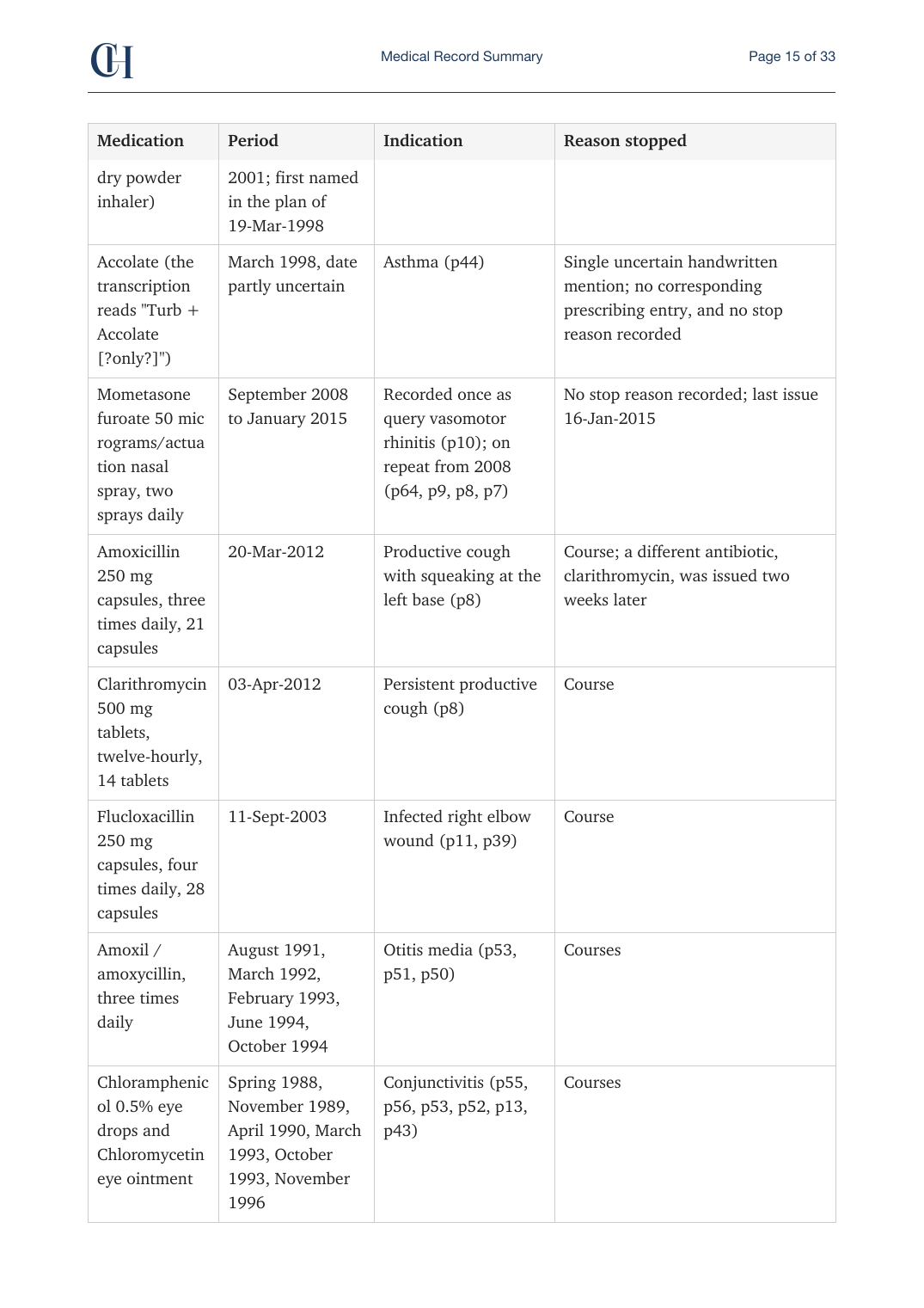
| January 2015 | Mometasone furoate nasal spray 50 micrograms/actuation, two sprays daily | Query vasomotor rhinitis | No stop reason recorded; discontinued by omission after the last issue |
| April 2012 | Amoxicillin, then clarithromycin two weeks later | Productive cough with left basal signs | Courses completed |
| 2010 | Doxycycline, prescribed in the USA | Lyme disease | Full course completed, symptoms fully resolved |
| September 2003 | Flucloxacillin 250 mg four times daily | Infected right elbow wound | Course completed |
| December 2001 | Salmeterol xinafoate 50 micrograms, Accuhaler (a breath-actuated dry powder inhaler) | Add-on long-acting bronchodilator for asthma, from September 1998 | No stop reason recorded |
| March 1998 | Accolate | Asthma; a single handwritten mention with the wording uncertain, and no corresponding prescribing entry | No stop reason recorded |
| August 1997 | Prednisolone, oral, five days | Cough and breathlessness; the handwritten entry reads “prednisolone [?5mg?] (4) for 5/7 stopped”, with the strength uncertain | Recorded as stopped at five days. The July 2025 online form answered that steroid tablets had never been taken; the pack adopts the 1997 course on the balance of the sources |
| April 1997 | Topical antifungal, aqueous cream and half-strength hydrocortisone | Itchy foot rash; several words in the handwritten entry are uncertain | Course completed |
| December 1995 | Pulmicort (budesonide) Turbohaler 100 micrograms/actuation, from October 1993 | Asthma preventer, dose doubled in December 1995 | Succeeded in November 1996 by budesonide at 200 micrograms/dose; a Turbohaler is itself a dry powder inhaler, so the change was of strength, not device type |
| 1988 to 1996 | Childhood courses: amoxicillin for otitis media, chloramphenicol eye preparations and Fusithalmic drops for conjunctivitis, ephedrine nasal drops, a cough preparation transcribed as “Sudol” and not identifiable as a cough medicine, and Calpol | The childhood infection episodes above | Courses completed |
| January 1993 | Salbutamol (Ventolin) inhaler | First recorded asthma treatment | Superseded by terbutaline, with no stop reason recorded. Restarted July 2025 by a private online prescriber and current: see Current medications |
Immunisation record
COVID-19
| Date | Vaccine |
|---|---|
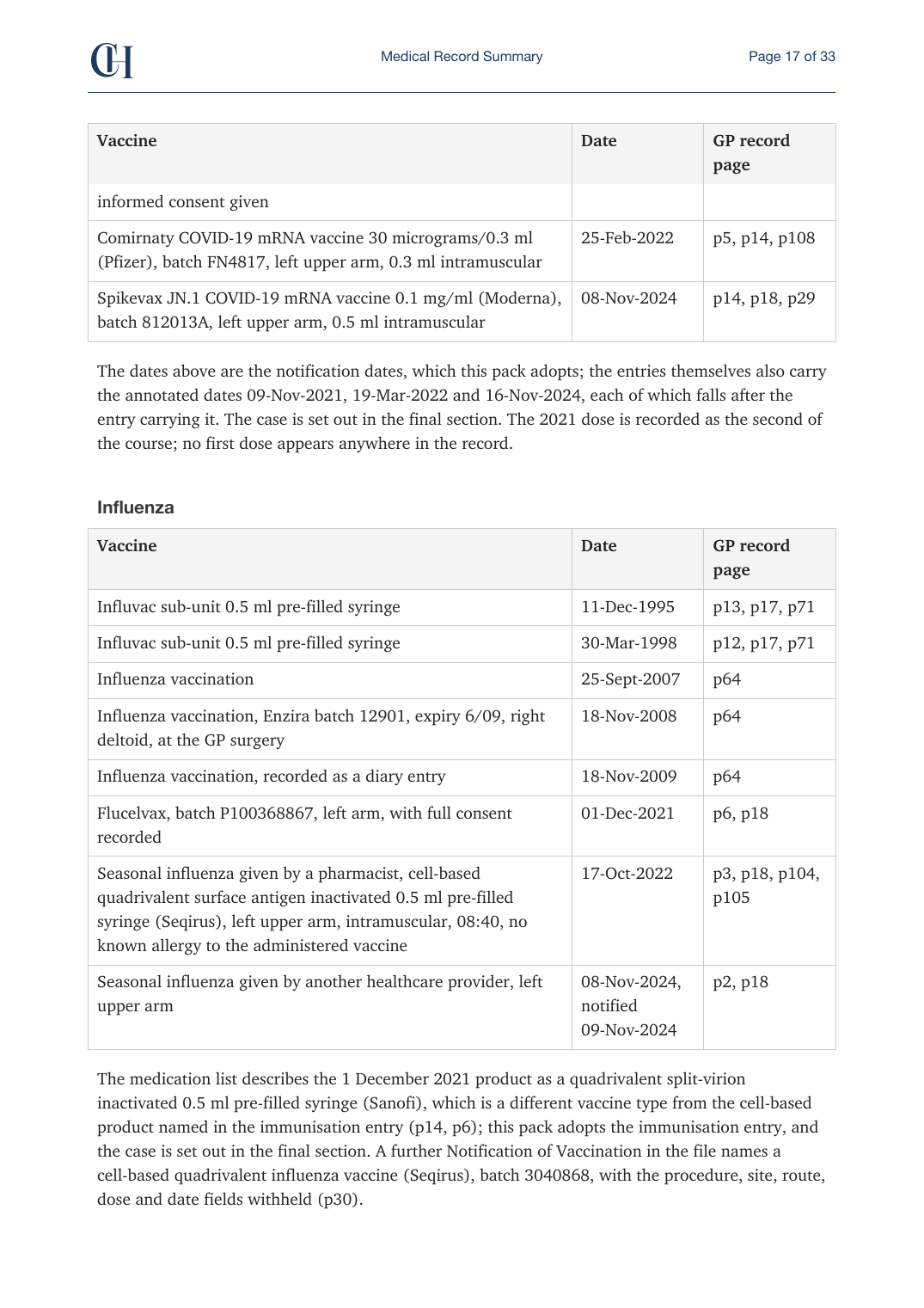
| 11 October 2021 | Comirnaty (Pfizer), recorded as the second dose |
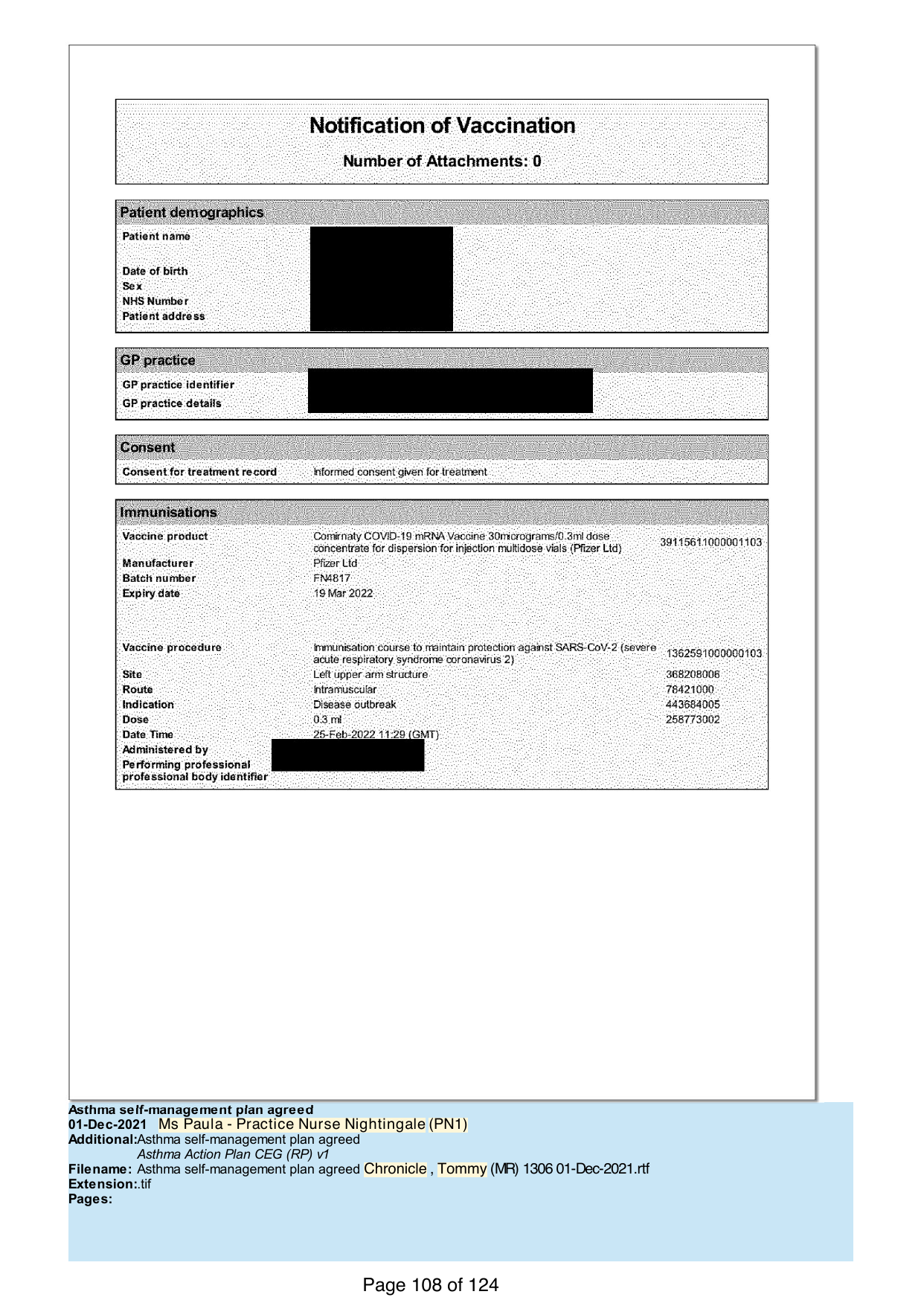
| 25 February 2022 | Comirnaty (Pfizer) |
| 8 November 2024 | Spikevax JN.1 (Moderna) |
Influenza
| Date | Vaccine |
|---|---|
| 11 December 1995 | Influvac sub-unit |
| 30 March 1998 | Influvac sub-unit |
| 25 September 2007 | Seasonal influenza |
| 18 November 2008 | Enzira |
| 18 November 2009 | Seasonal influenza |
| 1 December 2021 | Flucelvax |
| 17 October 2022 | Cell-based quadrivalent influenza vaccine |
| 8 November 2024 | Seasonal influenza |
Childhood and other
| Date | Vaccine |
|---|---|
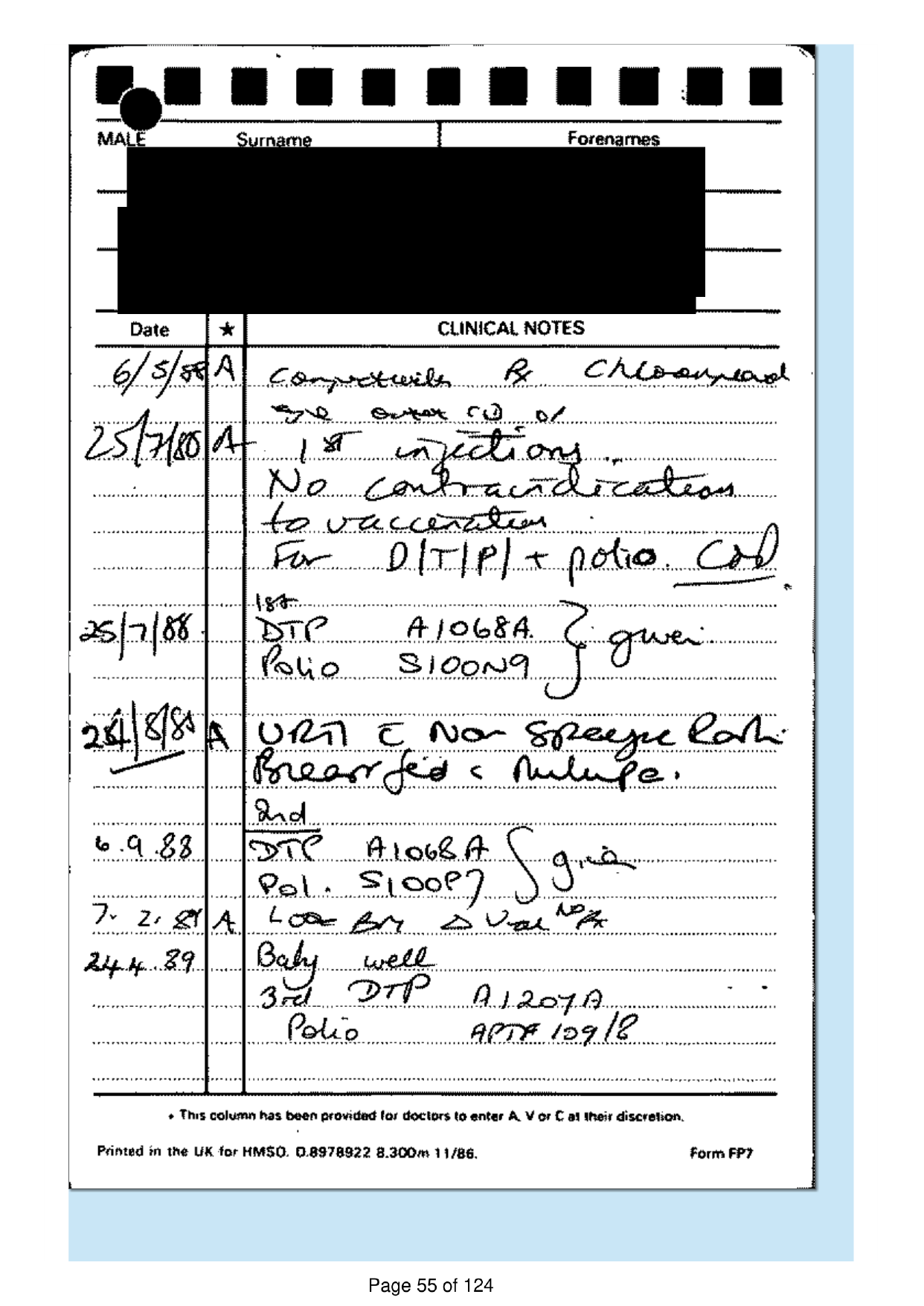
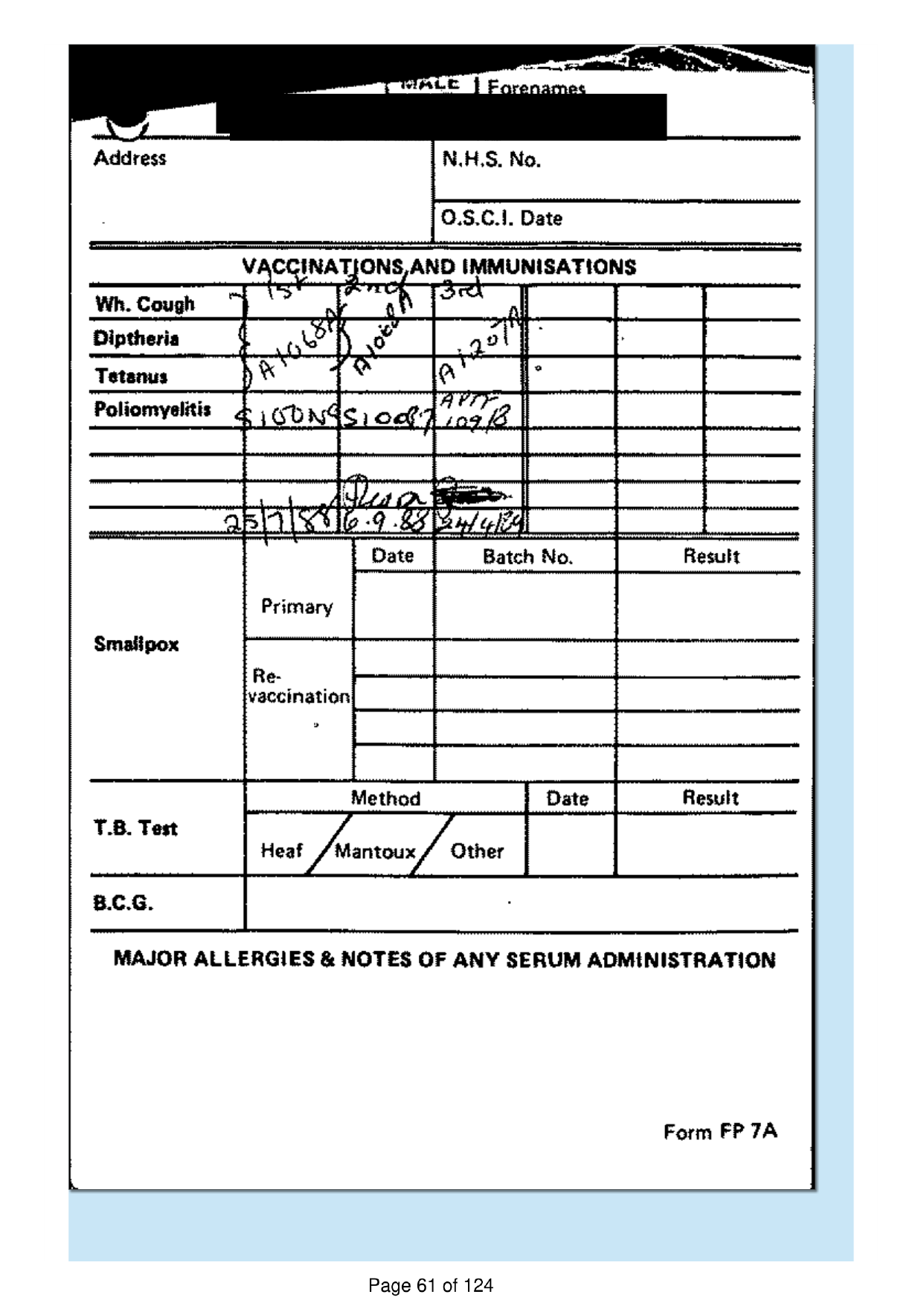
| 25 July 1988 | Diphtheria, tetanus, pertussis and polio, first |
| 6 September 1988 | Diphtheria, tetanus, pertussis and polio, second |
| 24 April 1989 | Diphtheria, tetanus, pertussis and polio, third |
| 11 January 1990 | MMR |
| 6 October 1992 | Diphtheria, tetanus and polio booster |
| 22 November 1994 | MMR, stage B, given outside the practice |
| 30 March 2000 | Meningococcal C |
| 18 March 2003 | Tetanus and polio booster |
The childhood schedule is one of the best-documented parts of the record, with a complete primary course, a pre-school booster and an adolescent tetanus and polio booster. Two entries do not resolve. The October 2021 COVID-19 dose is recorded as the second of the course, and no first dose appears in the pack. The November 1994 MMR dose is coded in one place as separate measles, mumps and rubella components and annotated in another as measles and rubella only, and nothing in the pack settles which is right.
Investigation results summary
Every laboratory result here was privately arranged. The pack records no NHS laboratory result other than the childhood full blood count of 1989.
Lipids
| Date | Total cholesterol | LDL | HDL | Non-HDL | Triglycerides | Notes |
|---|---|---|---|---|---|---|
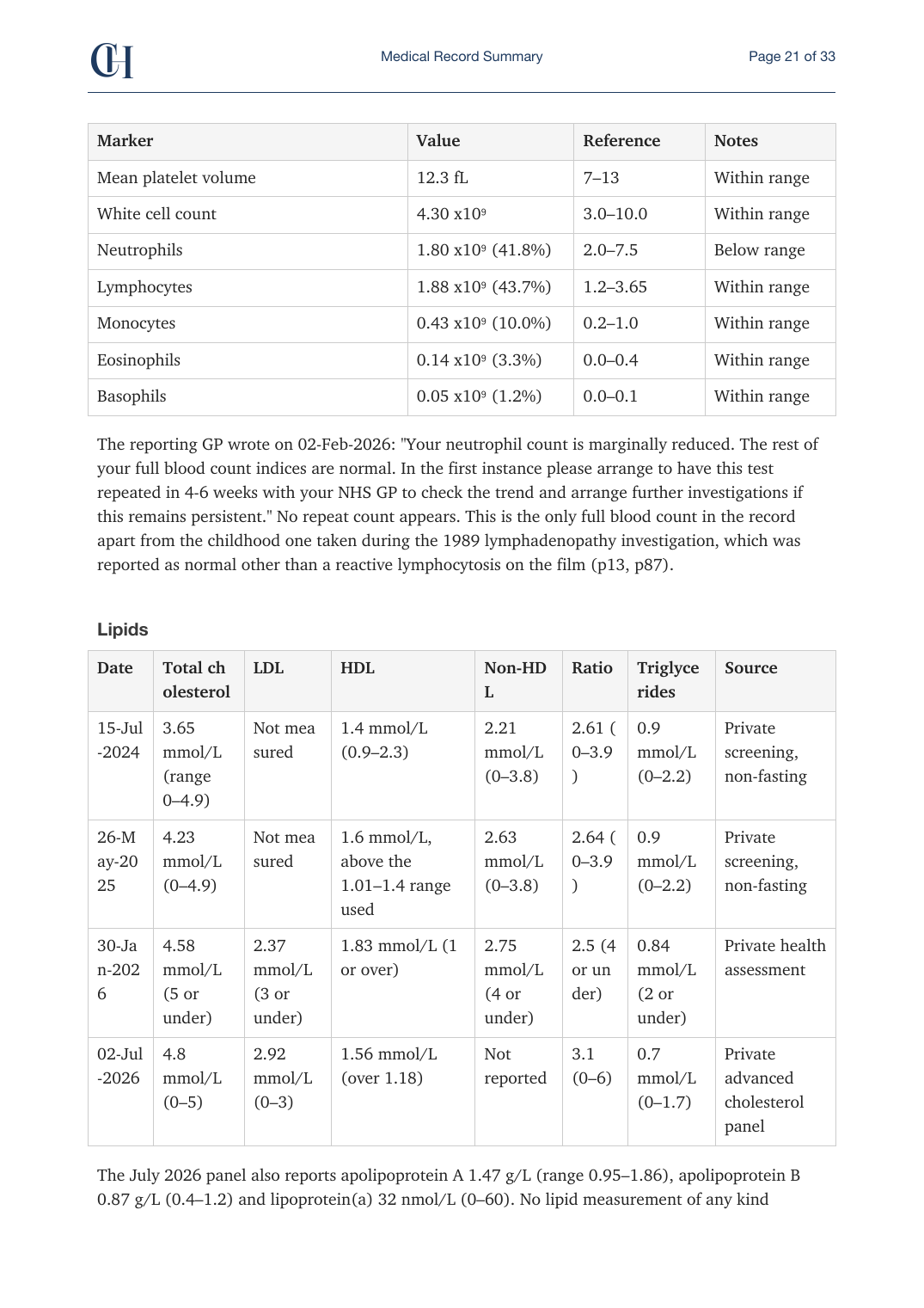
| 15 July 2024 | 3.65 mmol/L (0–4.9) | Not measured | 1.4 mmol/L (0.9–2.3) | 2.21 mmol/L (0–3.8) | 0.9 mmol/L (0–2.2) | Bluecrest, non-fasting; ratio 2.61 |
| 26 May 2025 | 4.23 mmol/L (0–4.9) | Not measured | 1.6 mmol/L, above the 1.01–1.4 range used | 2.63 mmol/L (0–3.8) | 0.9 mmol/L (0–2.2) | Bluecrest, non-fasting; ratio 2.64 |
| 30 January 2026 | 4.58 mmol/L (5 or under) | 2.37 mmol/L (3 or under) | 1.83 mmol/L (1 or over) | 2.75 mmol/L (4 or under) | 0.84 mmol/L (2 or under) | Bupa; ratio 2.5 |
| 2 July 2026 | 4.8 mmol/L (0–5) | 2.92 mmol/L (0–3) | 1.56 mmol/L (over 1.18) | Not reported | 0.7 mmol/L (0–1.7) | Forth; ratio 3.1 |
Total cholesterol has risen gradually across the four panels and LDL across the two that measured it. Every value is inside its stated range except HDL in May 2025, at 1.6 mmol/L against a 1.01 to 1.4 range, which is a favourable direction for HDL. The July 2026 panel adds apolipoprotein A 1.47 g/L (0.95–1.86), apolipoprotein B 0.87 g/L (0.4–1.2) and lipoprotein(a) 32 nmol/L (0–60), all in range; the May 2025 report had recommended additional testing of lipoprotein(a), and the pack does not itself connect the two.
Glycaemic markers
HbA1c was 37 mmol/mol against a 19.1–41 range (26 May 2025, Bluecrest) and 33 mmol/mol against an 18–41 range (30 January 2026, Bupa), with a single non-fasting glucose of 4.4 mmol/L against 3.9–6.9 before them (15 July 2024, Bluecrest). All three are within range, and no fasting glucose appears in the pack.
Kidney function
eGFR was 93 mL/min (July 2024), 94 mL/min (May 2025) and above 90 by the CKD-EPI equation (January 2026), with creatinine 91, 90 and 87 µmol/L against the ranges used on each occasion, and sodium and urea within range on the first two. All values are within range, and the pack holds no urine test, so there is no albumin-to-creatinine ratio alongside the filtration estimate.
Liver function
Apart from bilirubin, described under Current findings, every liver marker has been within range on all three panels: ALP 55, 54 and 53 IU/L, AST 27, 18 and 21 IU/L, ALT 17, 14 and 16 IU/L, GGT 9, 12 and 10 IU/L, total protein 68, 68 and 67 g/L, and albumin 45, 46 and 48 g/L (15 July 2024 and 26 May 2025, Bluecrest; 30 January 2026, Bupa).
Iron, vitamins and inflammation
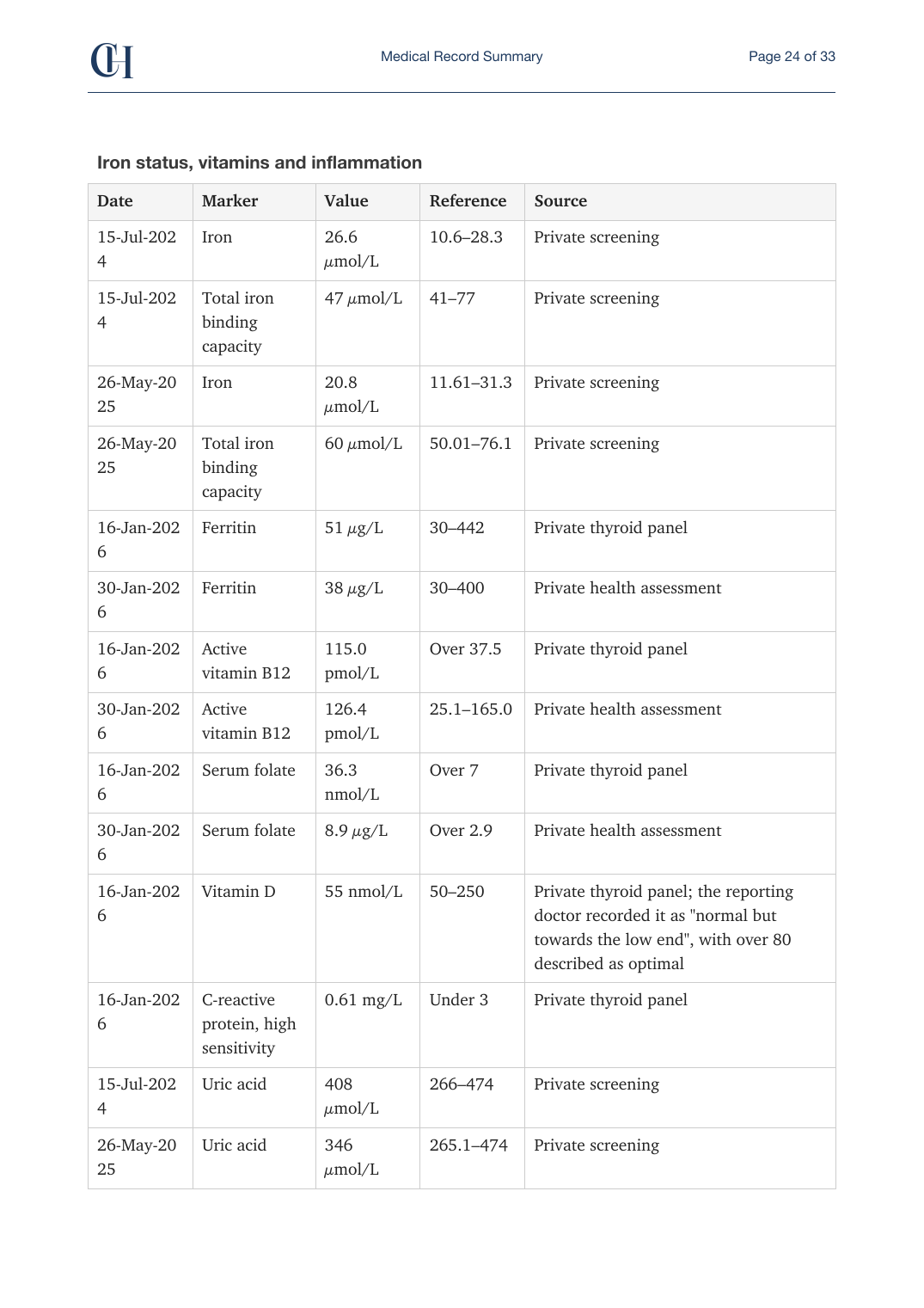
All within range. Iron 26.6 µmol/L (10.6–28.3) in July 2024 and 20.8 µmol/L (11.61–31.3) in May 2025, with total iron binding capacity 47 then 60 µmol/L (Bluecrest). Ferritin 51 µg/L (30–442) on 16 January 2026 (Medichecks) and 38 µg/L (30–400) on 30 January 2026 (Bupa); active vitamin B12 115.0 pmol/L (over 37.5) then 126.4 pmol/L (25.1–165.0); serum folate 36.3 nmol/L (over 7) then 8.9 µg/L (over 2.9). High-sensitivity C-reactive protein 0.61 mg/L (under 3) in January 2026. Uric acid 408 then 346 µmol/L, globulin 23 then 22 g/L, and calcium and corrected calcium within range on both Bluecrest screenings.
Blood pressure
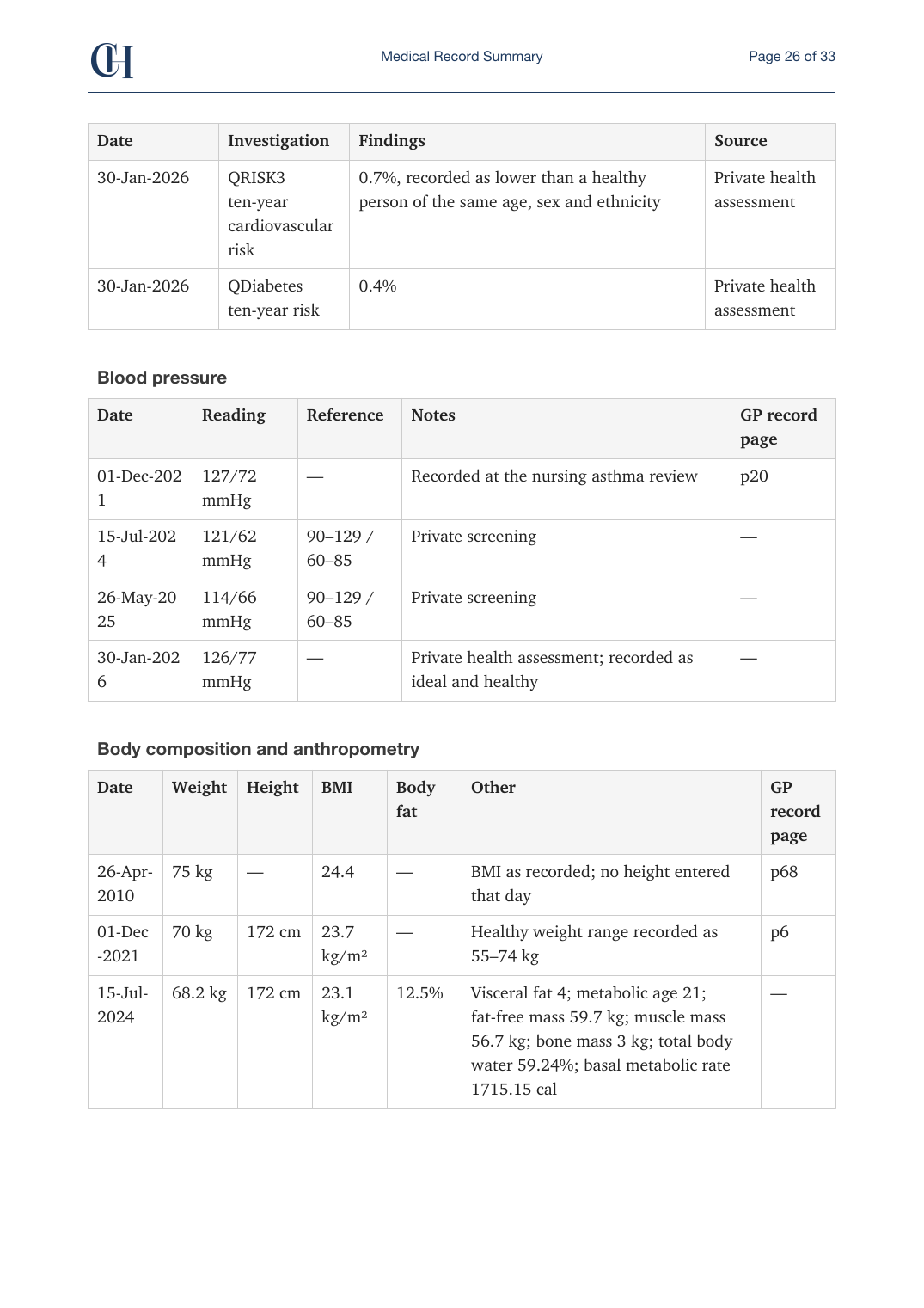
Four readings between December 2021 and January 2026, all within range: systolic 114 to 127 mmHg and diastolic 62 to 77 mmHg. The first, at the nursing asthma review of December 2021, is the only blood pressure reading taken at the GP practice; the rest come from private screening and assessment. No home series and no 24-hour ambulatory recording appear in the pack.
Cardiac risk scores
At the Bupa assessment of 30 January 2026, the QRISK3 ten-year cardiovascular risk was 0.7%, recorded as lower than for a healthy person of the same age, sex and ethnicity, and the QDiabetes ten-year risk was 0.4%. The ECG findings from May 2025 and January 2026 are under Current findings.
Body composition
Weight was 75 kg with a body mass index of 24.4 in April 2010, and 70 kg with 23.7 in December 2021, the only two anthropometric records from the GP practice. The 2010 figures were recorded with no height that day and do not reproduce from the 172 cm recorded later. Private assessments give 68.2 kg and 23.1 (July 2024), 70.1 kg and 23.7 (May 2025), and the January 2026 figures in Profile. Body fat was 12.5% then 12.9% on the two Bluecrest screenings, with visceral fat rating 4, muscle mass 56.7 then 58 kg, and basal metabolic rate 1715 then 1754 kcal; the January 2026 assessment recorded a waist-to-height ratio of 0.46, reported as 45.9%, and a basal metabolic rate of 1865 kcal.
Fitness and functional measures
All from the Bupa assessment of 30 January 2026: estimated VO2 max recorded as considerably above average for age and sex, cardiorespiratory fitness percentile 90, predicted maximum heart rate 196 bpm, maximal minute power 307 watts, functional threshold power 218 watts, and grip strength in the moderate range. There is no earlier fitness measurement to compare them with, and all of it comes from one day.
Respiratory monitoring values, peak flow and Asthma Control Test scores, are in the Asthma subsection.
Open items on the record
- Repeat full blood count. Advised in the report of 2 February 2026, to be repeated in four to six weeks with the NHS GP. No repeat count appears in the pack.
- Bilirubin. The same report asked for follow-up with the NHS GP for confirmatory tests. Nothing after that date records a follow-up.
- Phosphate. The May 2025 report recommended discussing the raised result with a GP. No later phosphate result appears.
- Heart trace finding. The May 2025 report suggested making a GP aware of the QRS finding. A later trace in January 2026 was recorded as normal, and nothing records the 2025 finding reaching a GP.
- Asthma review. The action plan of April 2022 set the next review for April 2023; the invitation of 26 April 2023 is annotated “mess left to book review”, and no review after April 2022 appears.
- Vitamin D. Described in January 2026 as normal but towards the low end, against an optimal of over 80, with a supplement suggested. No later result appears.
- Dental follow-up. A hygienist visit every three to six months and a twelve-month recall were set in January 2026, with a night guard left to consider. No hygienist visit or night guard entry appears after that date.
- Lyme serology. Planned at the consultation of July 2011, with a telephone consultation booked for the result. No serology result appears.
- Paediatric referral of February 1990. A second referral for a lump the parents thought was enlarging. No outcome, reply or discharge entry appears in the pack.
- Two relievers on the record at once. Terbutaline on the practice repeat list from April 2022 and salbutamol prescribed privately in July 2025, same class, with no entry reconciling or stopping either.
- Surgical referral of September 2006. Referred querying appendicitis. No admission, operation note, discharge summary or outcome appears.
Glossary
- ALP: alkaline phosphatase, a liver and bone enzyme measured in liver function panels.
- ALT: alanine aminotransferase, a liver enzyme.
- AST: aspartate aminotransferase, a liver enzyme.
- AUDIT: Alcohol Use Disorders Identification Test, a screening questionnaire scoring drinking risk.
- CKD-EPI: the equation used to estimate kidney filtration rate from creatinine.
- ECG: electrocardiogram, a tracing of the heart’s electrical activity.
- eGFR: estimated glomerular filtration rate, a measure of how much blood the kidneys filter per minute.
- Free T3: free triiodothyronine, the active thyroid hormone.
- Free T4: free thyroxine, the main hormone the thyroid gland produces.
- GGT: gamma-glutamyl transferase, a liver enzyme.
- GPPAQ: General Practice Physical Activity Questionnaire, a four-level activity rating.
- HbA1c: glycated haemoglobin, a measure of average blood glucose over roughly three months.
- HDL: high-density lipoprotein cholesterol.
- LDL: low-density lipoprotein cholesterol.
- MMR: measles, mumps and rubella vaccine.
- Non-HDL: total cholesterol minus HDL cholesterol.
- QDiabetes: a ten-year risk score for developing type 2 diabetes.
- QRISK3: a ten-year cardiovascular risk score used in UK practice.
- TSH: thyroid stimulating hormone, the pituitary signal to the thyroid gland.
- VO2 max: maximum rate of oxygen uptake during exercise, an estimate of aerobic fitness.
Provenance
This is a record of one long-standing condition against a thin NHS background, with a dense private dataset bolted on at the end. It spans thirty-seven years from birth at a single GP practice until a move to another practice in December 2025, and asthma accounts for most of what is in it: the reviews, prescriptions and peak flow readings attached to it outnumber everything else combined. The NHS portion holds one laboratory result, a full blood count from 1989; every other blood test in this file was privately arranged from July 2024 onwards, which is also where cholesterol, thyroid, hormone, vitamin and fitness measurement enter the picture for the first time.
This file consolidates a personal health record pack built from:
- The NHS GP medical record, obtained by Subject Access Request, covering spring 1988 to December 2025: the practice’s electronic record, scanned hospital and clinic letters, and older handwritten GP notes covering roughly the first two decades.
- Two private health screening reports, Bluecrest, 15 July 2024 and 26 May 2025.
- A private health assessment, Bupa, 30 January 2026, with additional blood results reported on 2 February 2026.
- Three private laboratory panels: a male hormone panel, Randox, sample 29 December 2025; an advanced thyroid panel, Medichecks, sample 15 January 2026; and an advanced cholesterol panel, Forth, 2 July 2026.
- A dental examination record, 7 January 2026.
Everything other than the NHS GP record was supplied by the record’s owner.
Handwritten and scanned content was transcribed with AI assistance and may contain errors, particularly in drug names and dates. Any clinical detail originating from a handwritten note, including the entries marked uncertain above, should be verified against the original record before being relied upon.
Important note
This file is an organisational restatement of a personal health record. It is not medical advice, not a diagnosis, and not a substitute for a clinician. Transcriptions of handwritten and scanned material were produced with AI assistance and may contain errors.
The NHS GP Record It Was Built From
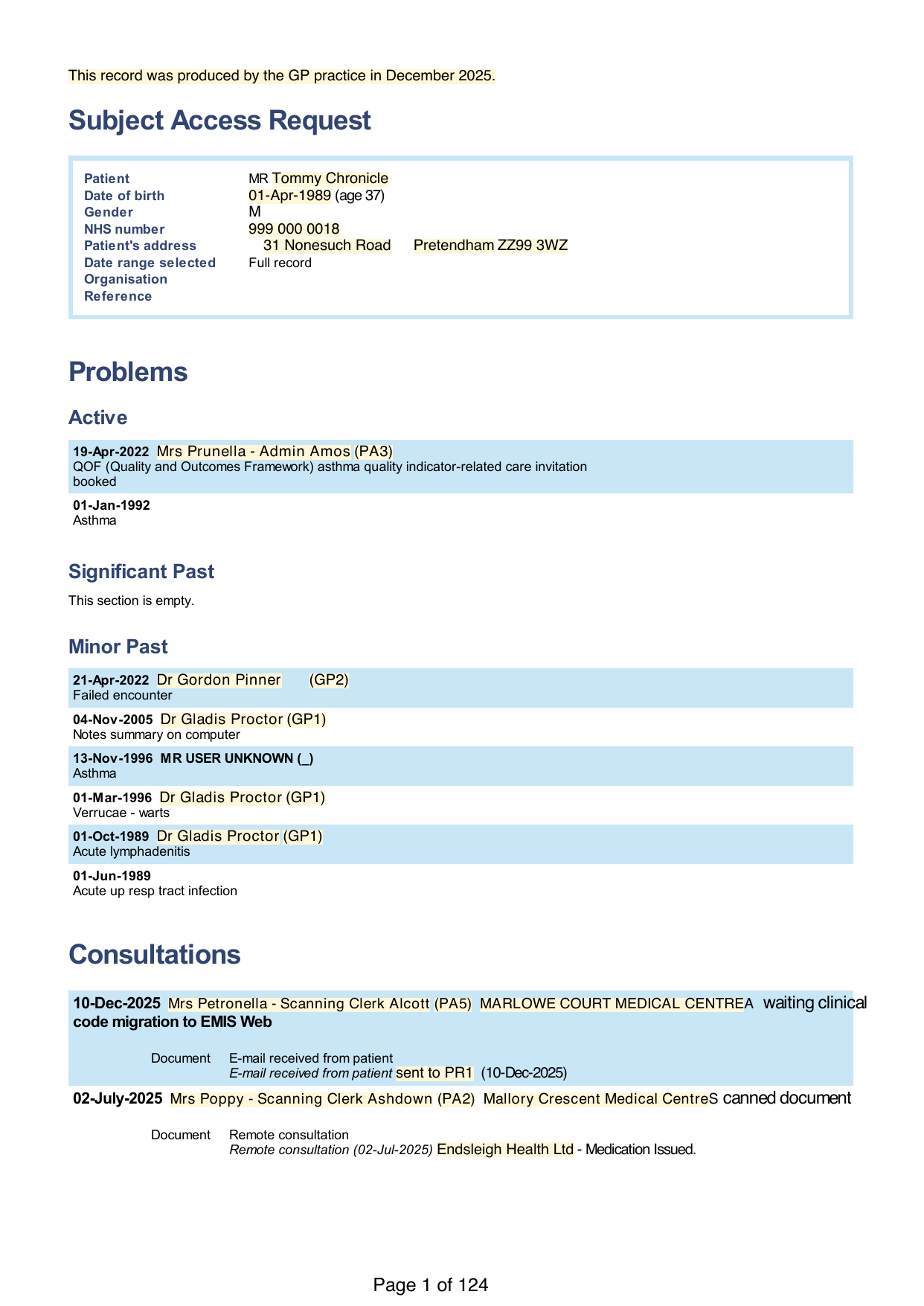
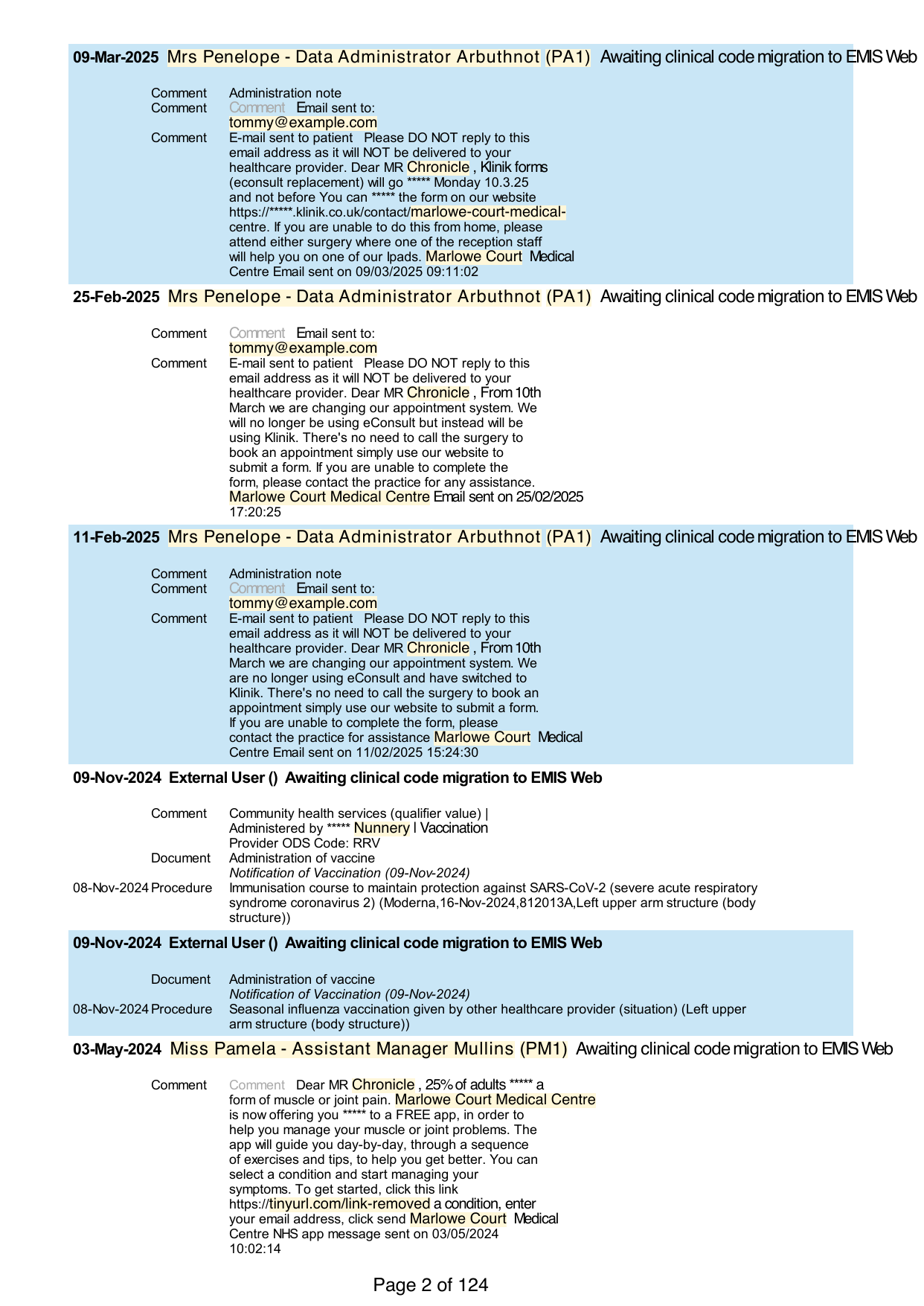
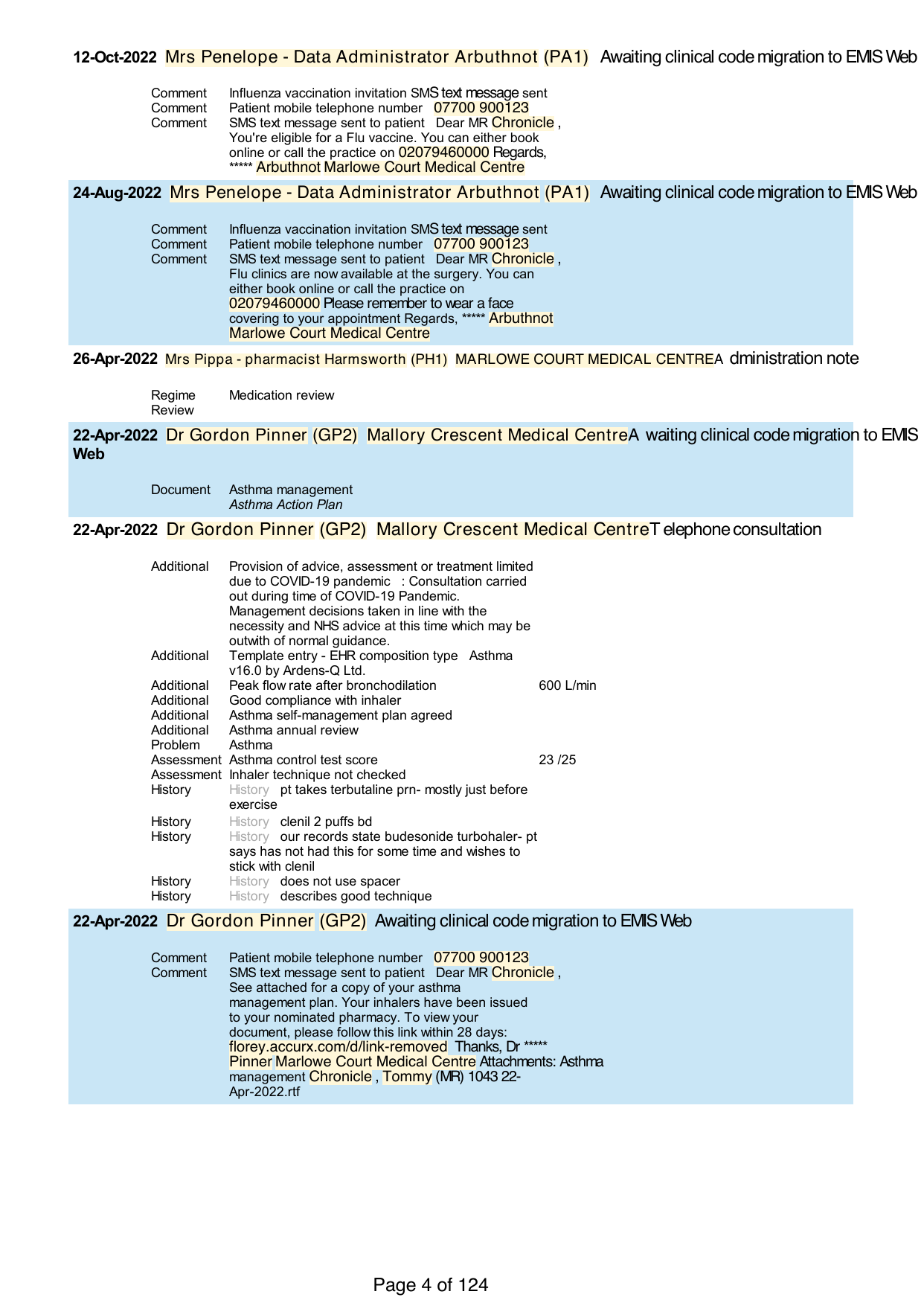
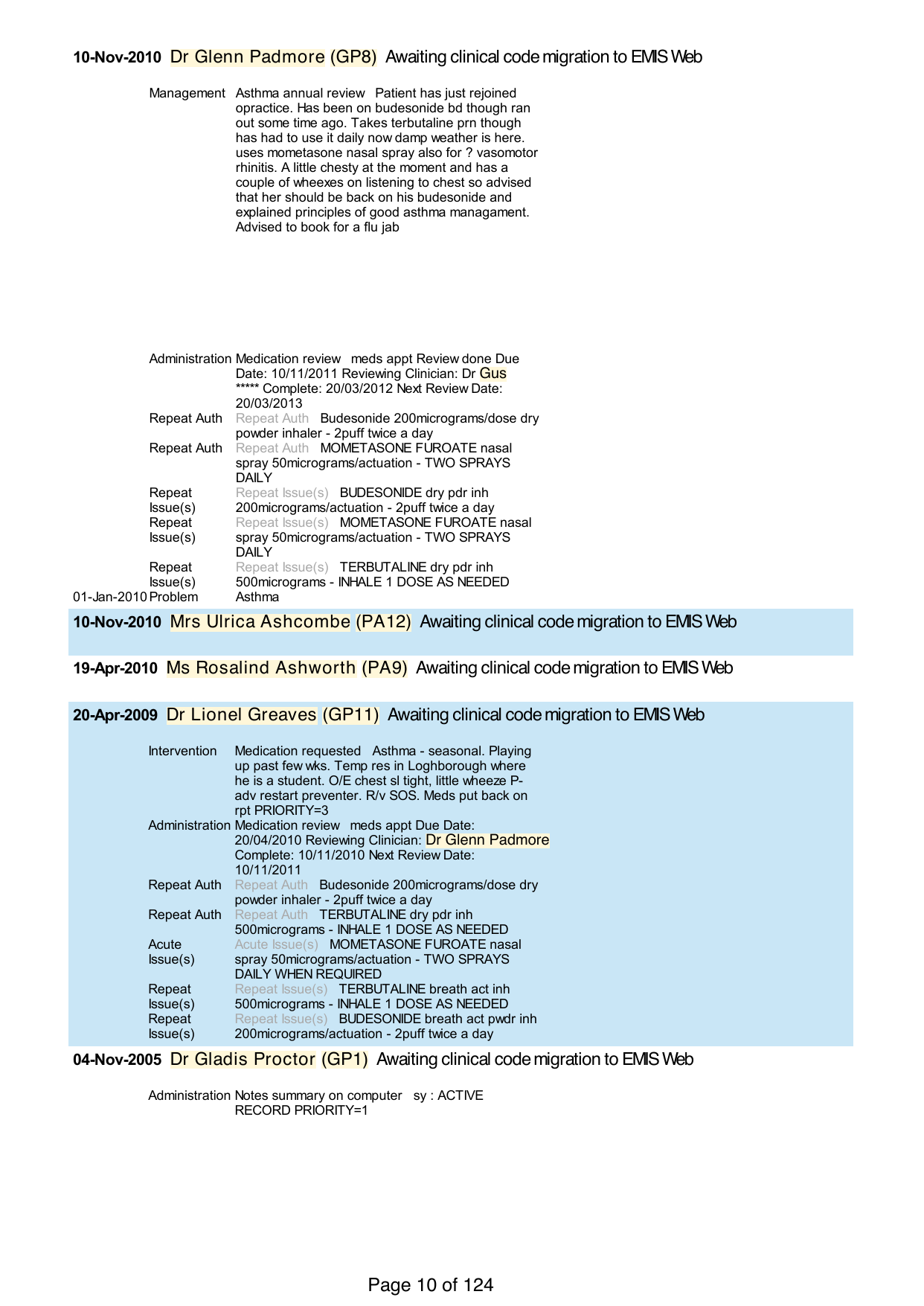
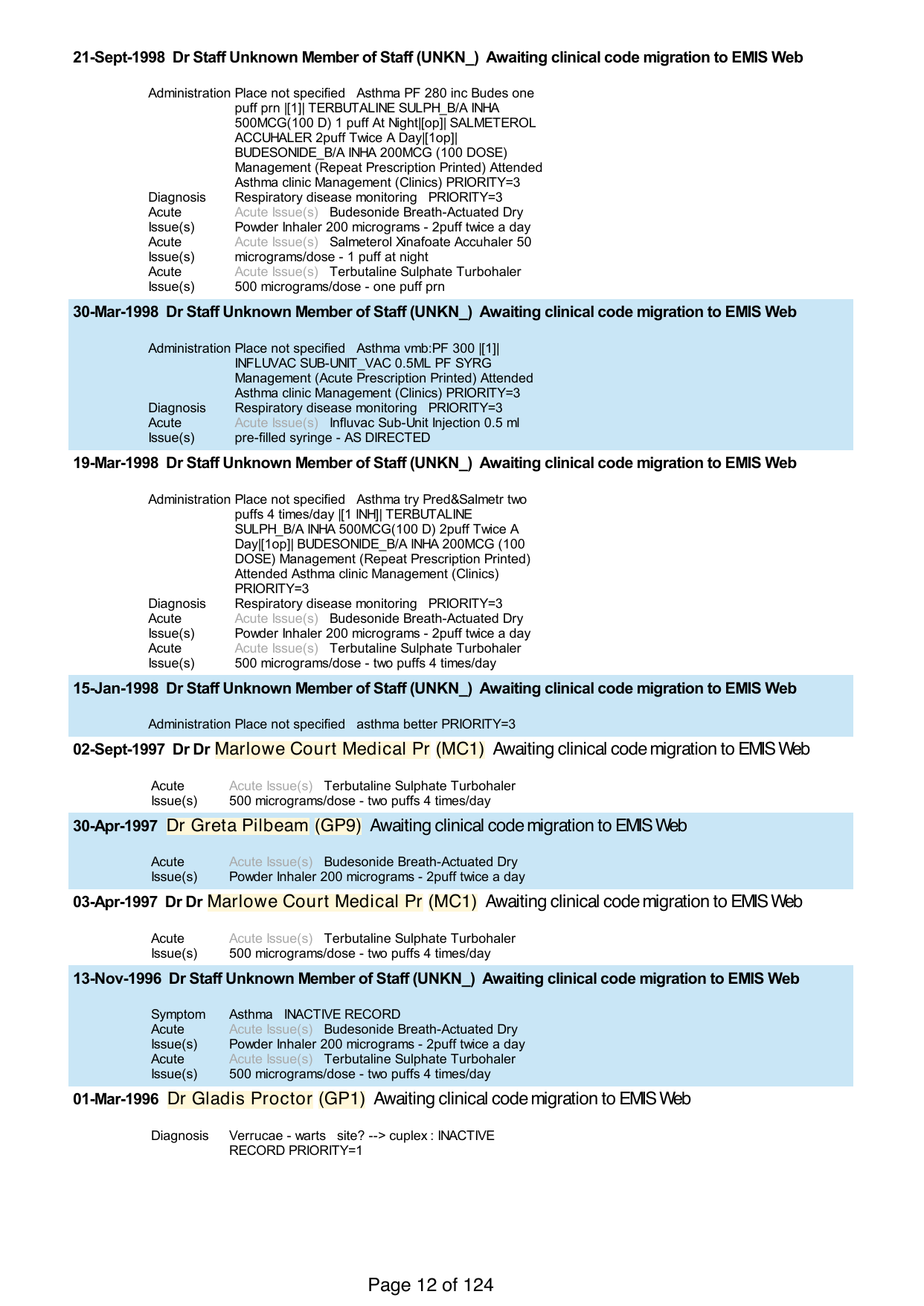
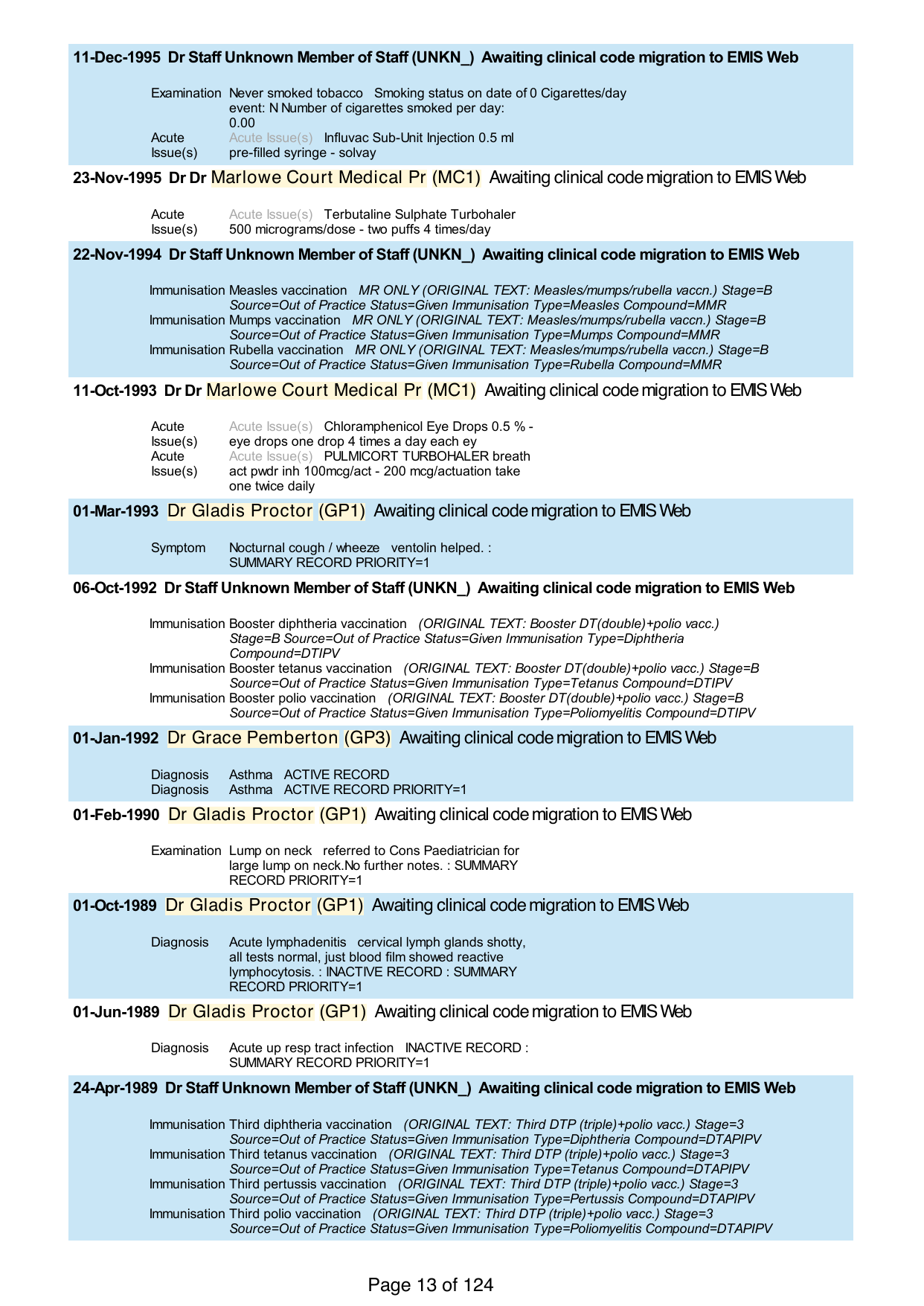
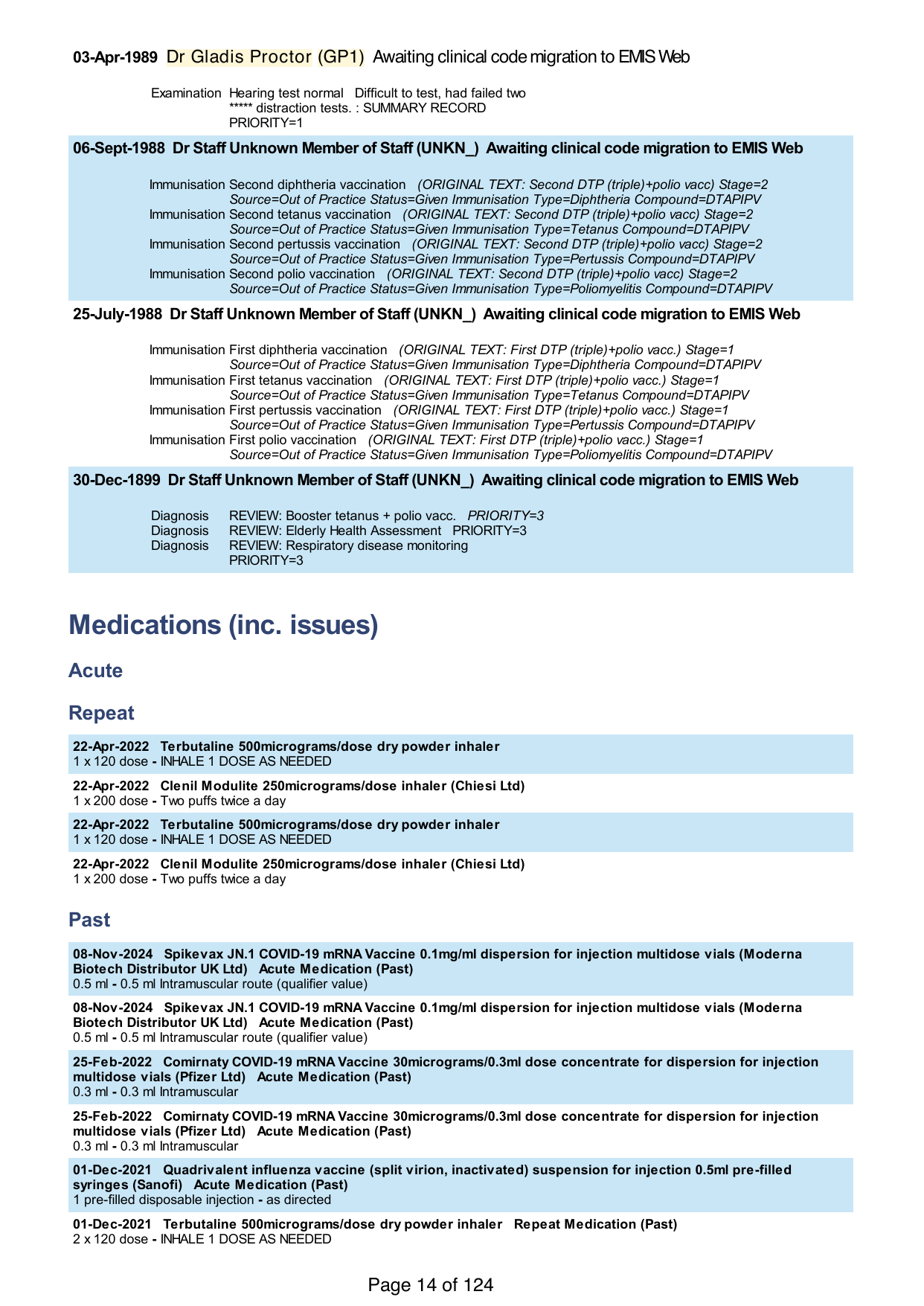
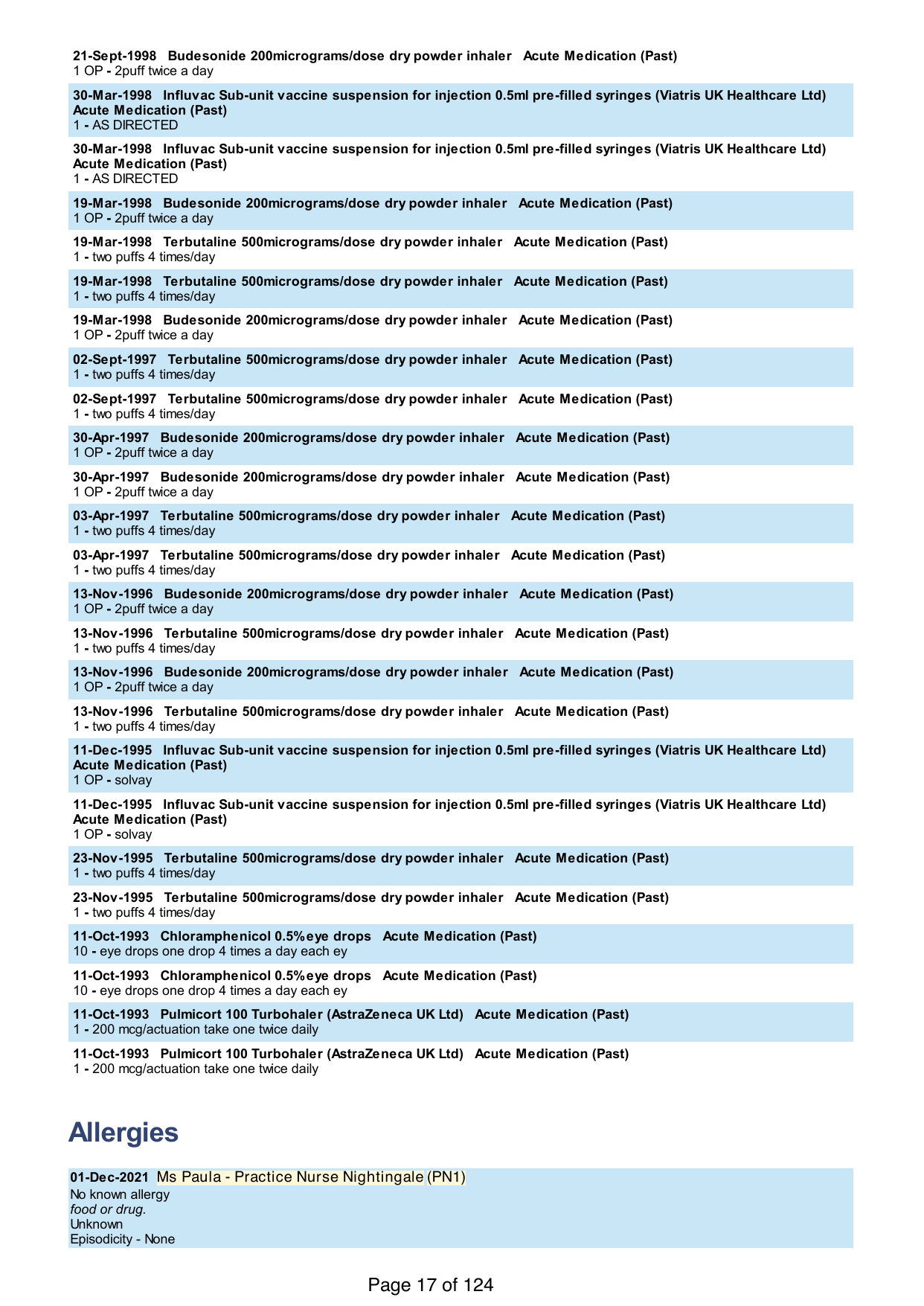
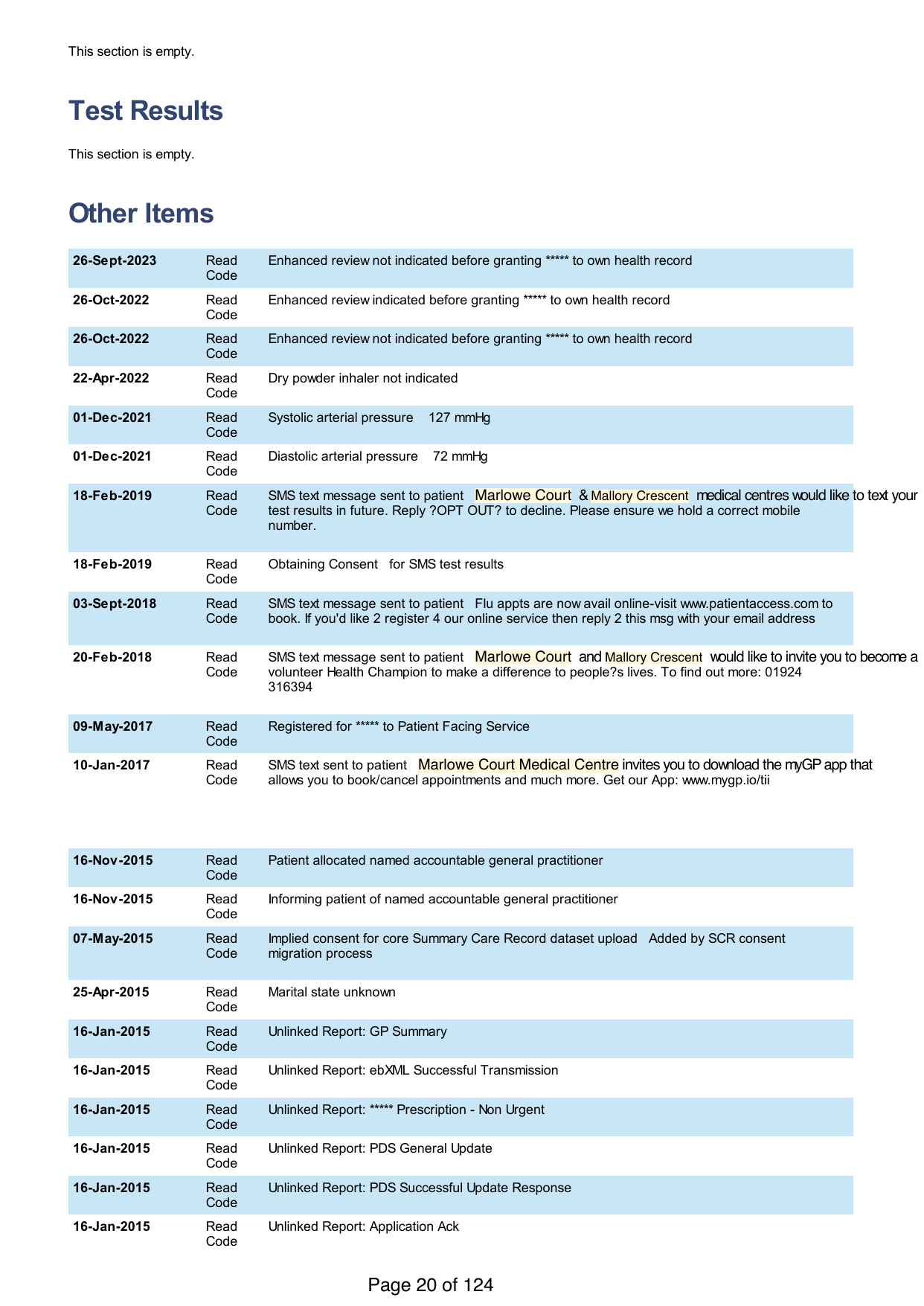
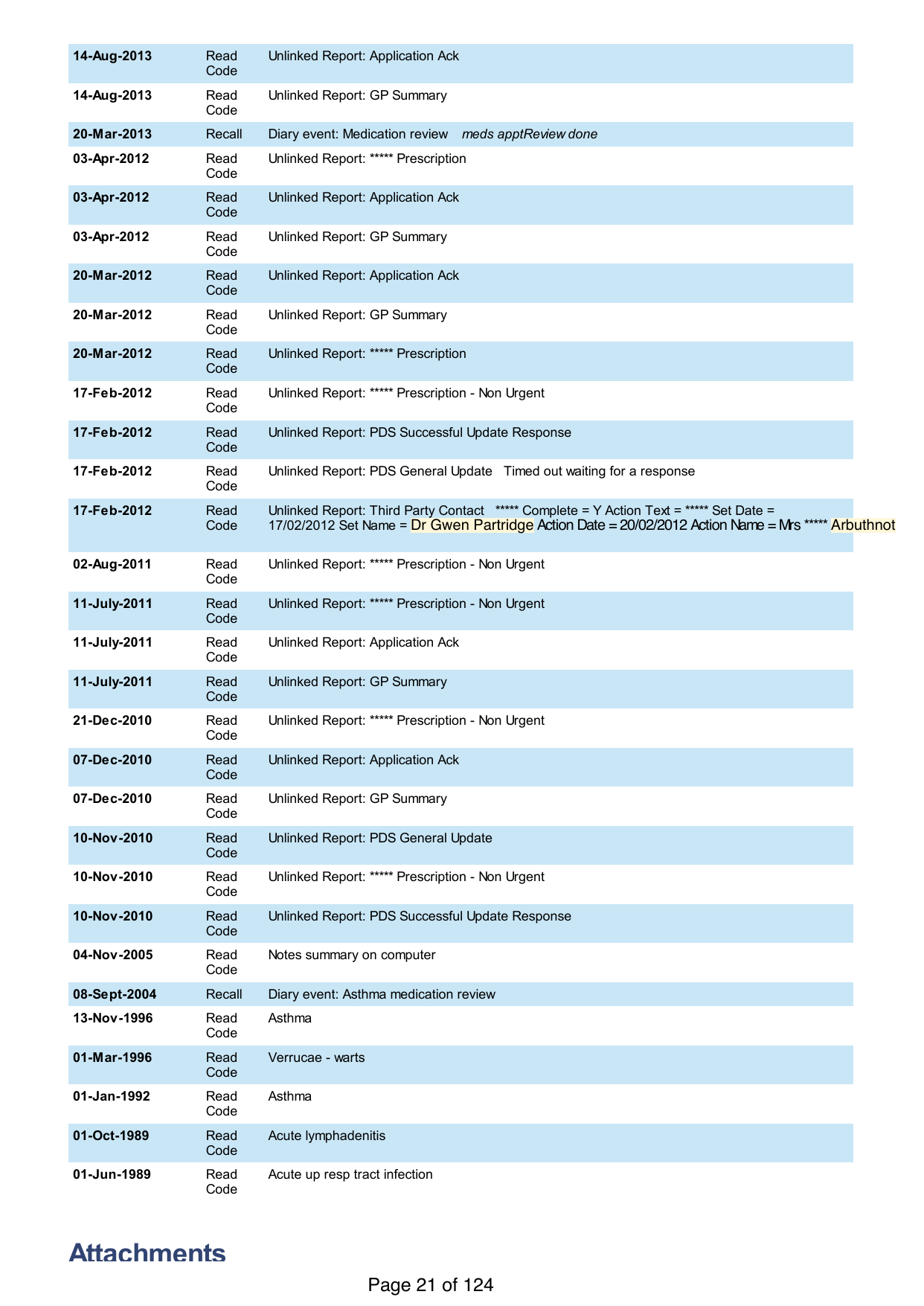
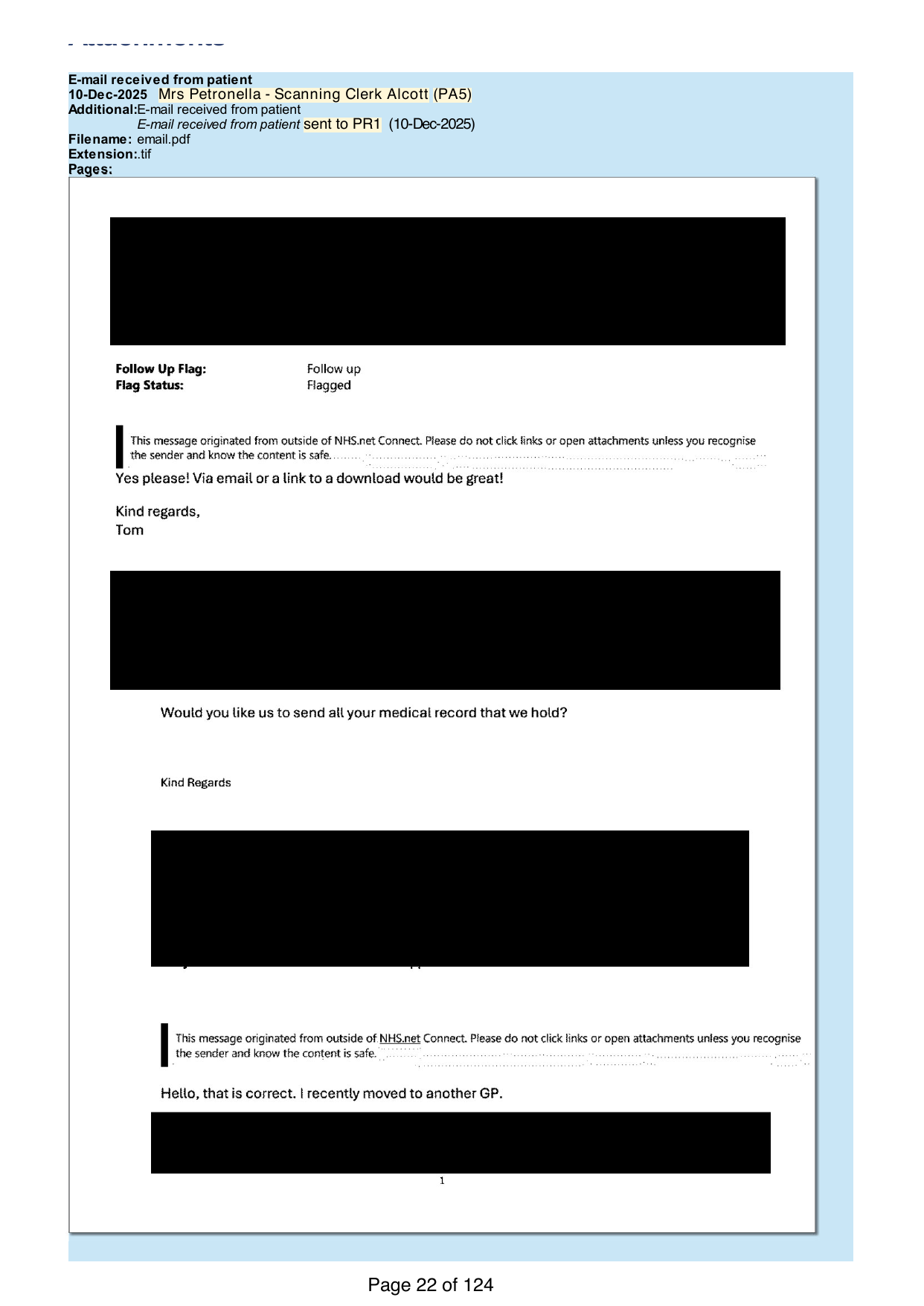
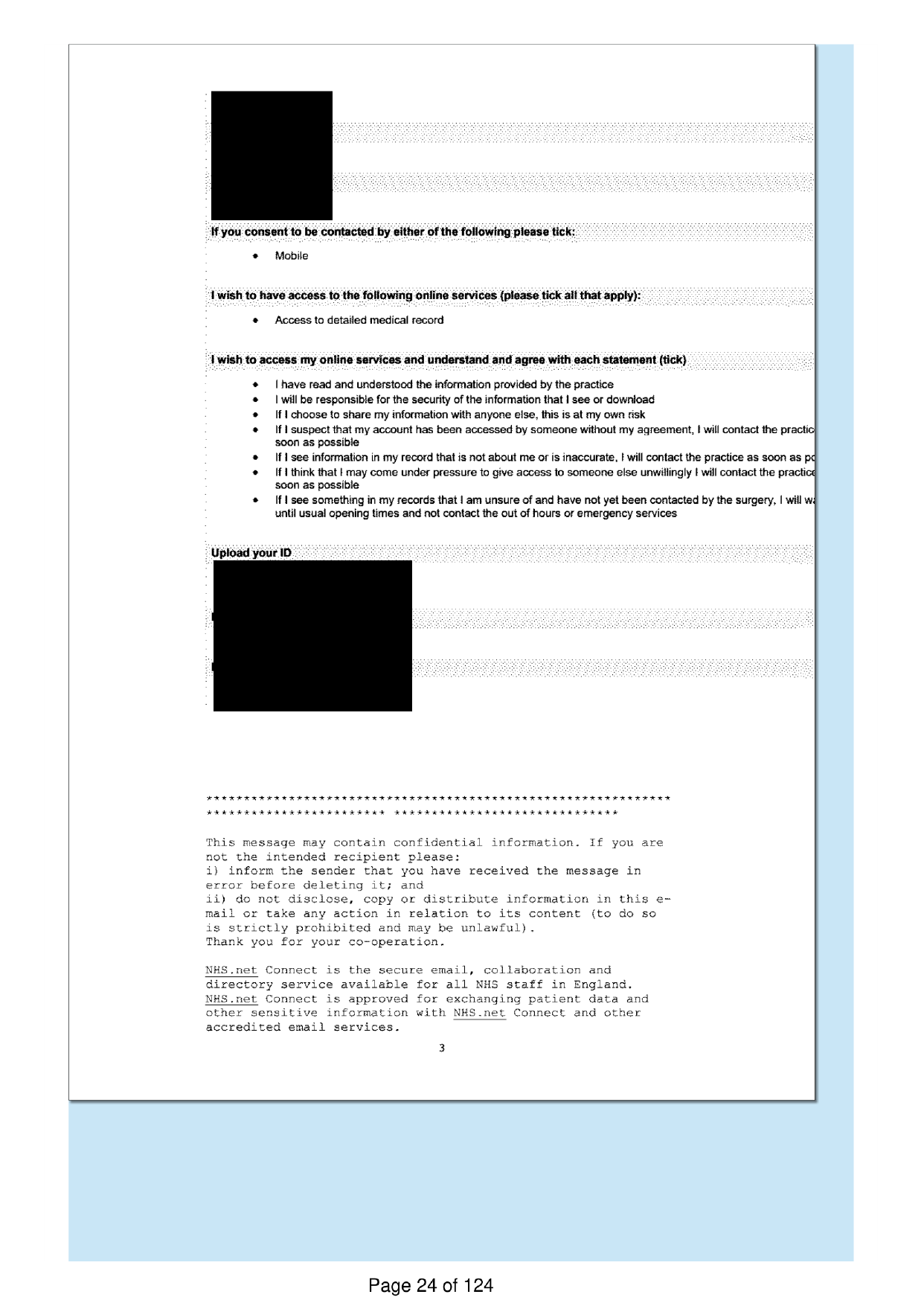
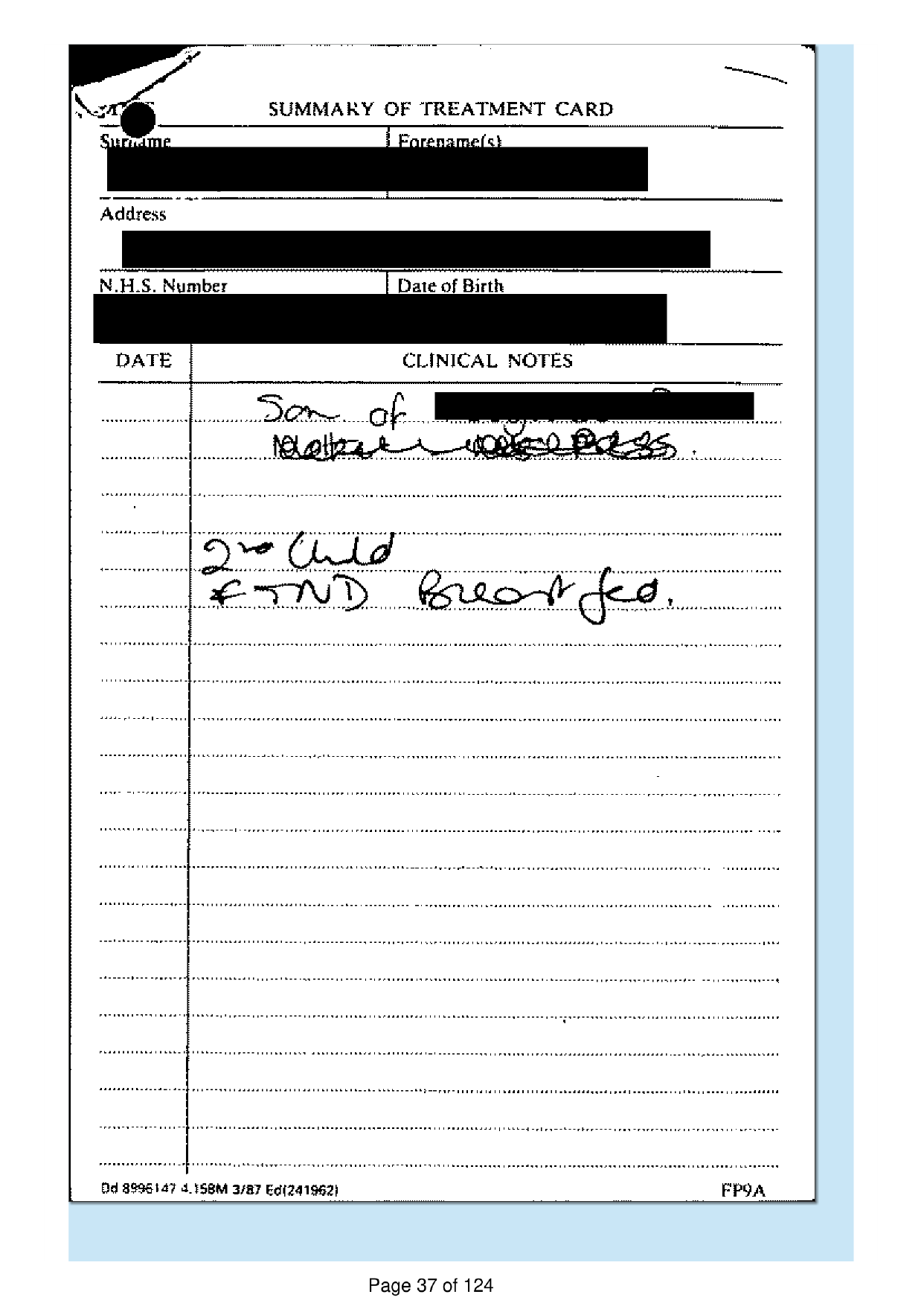
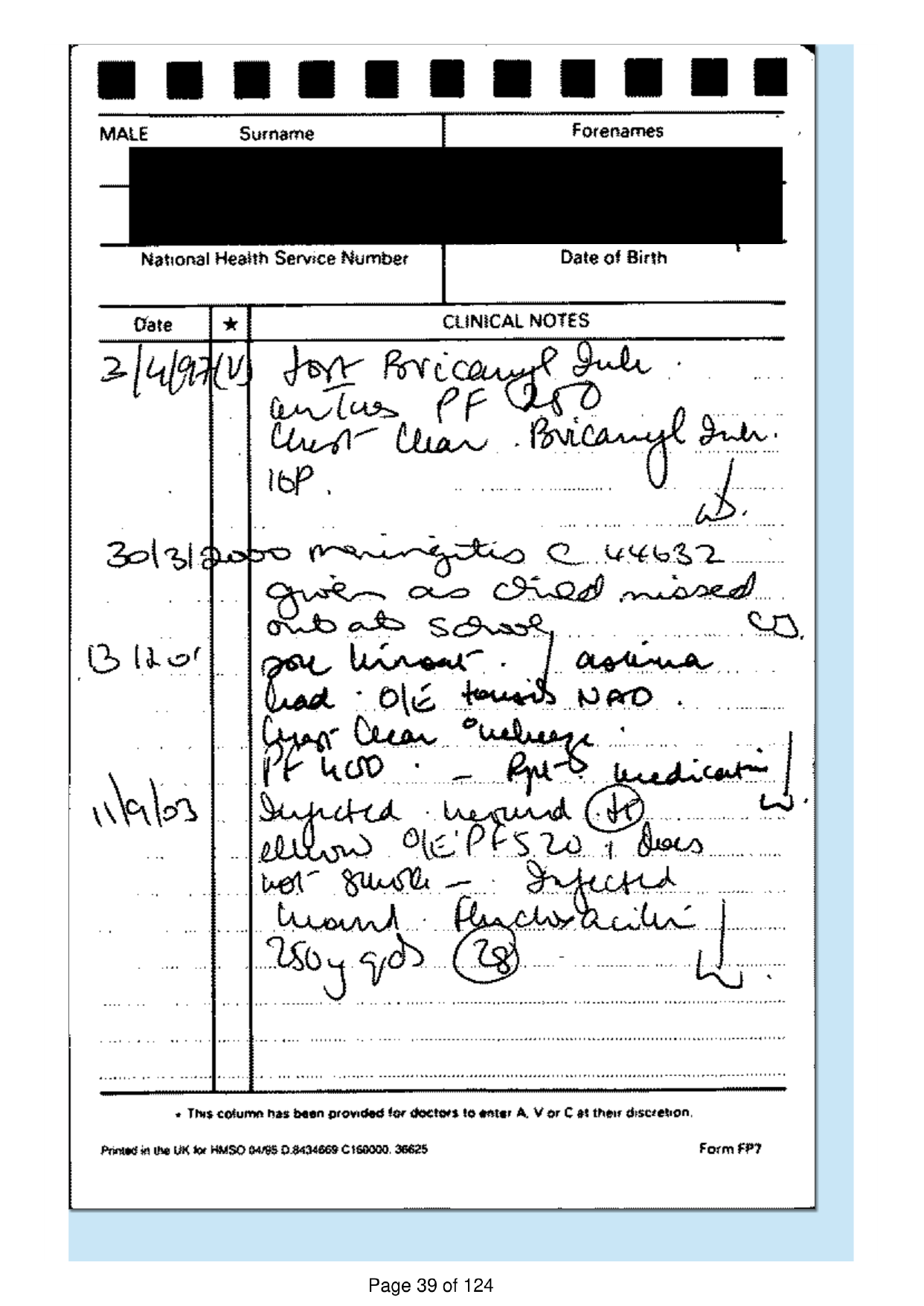
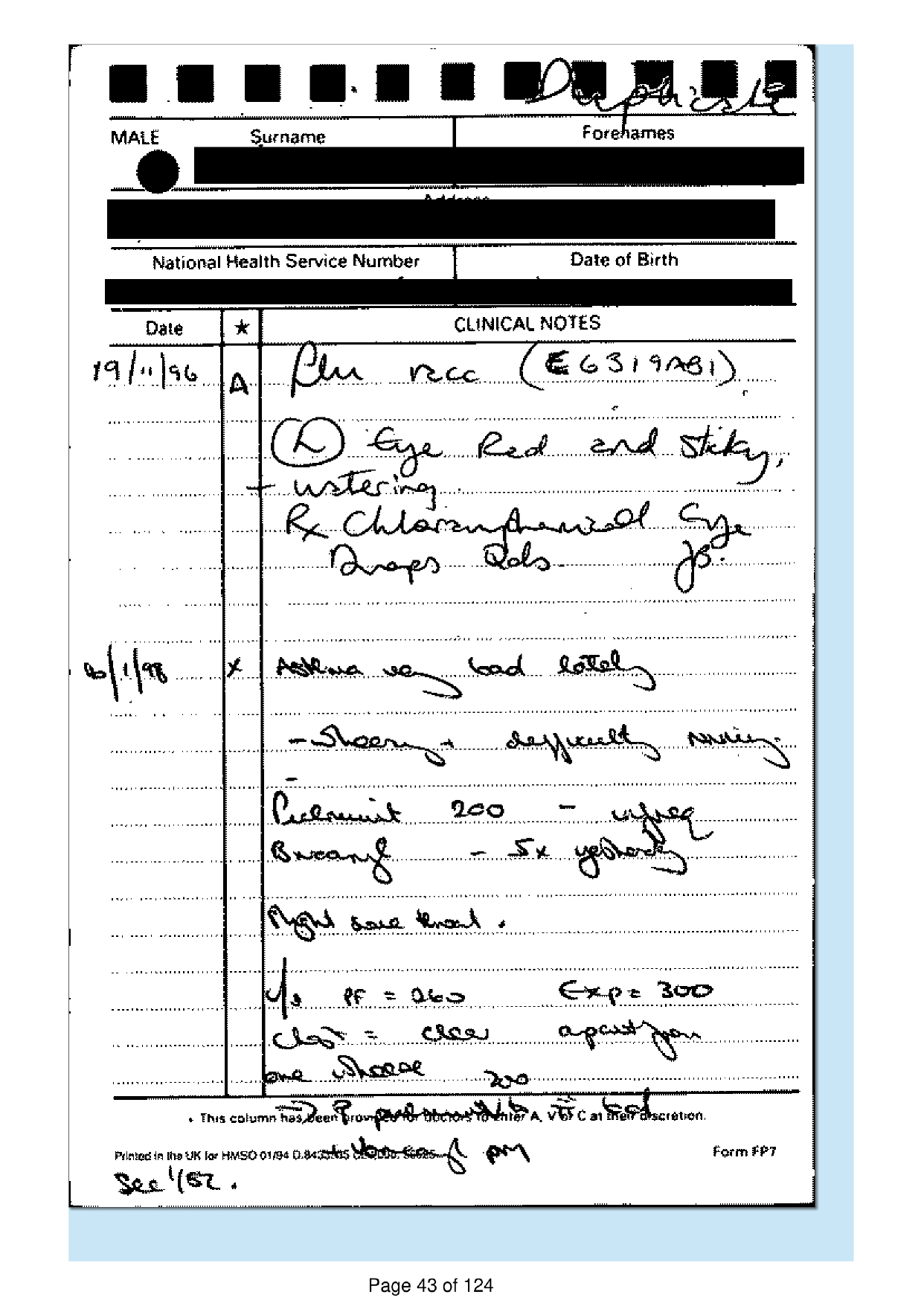
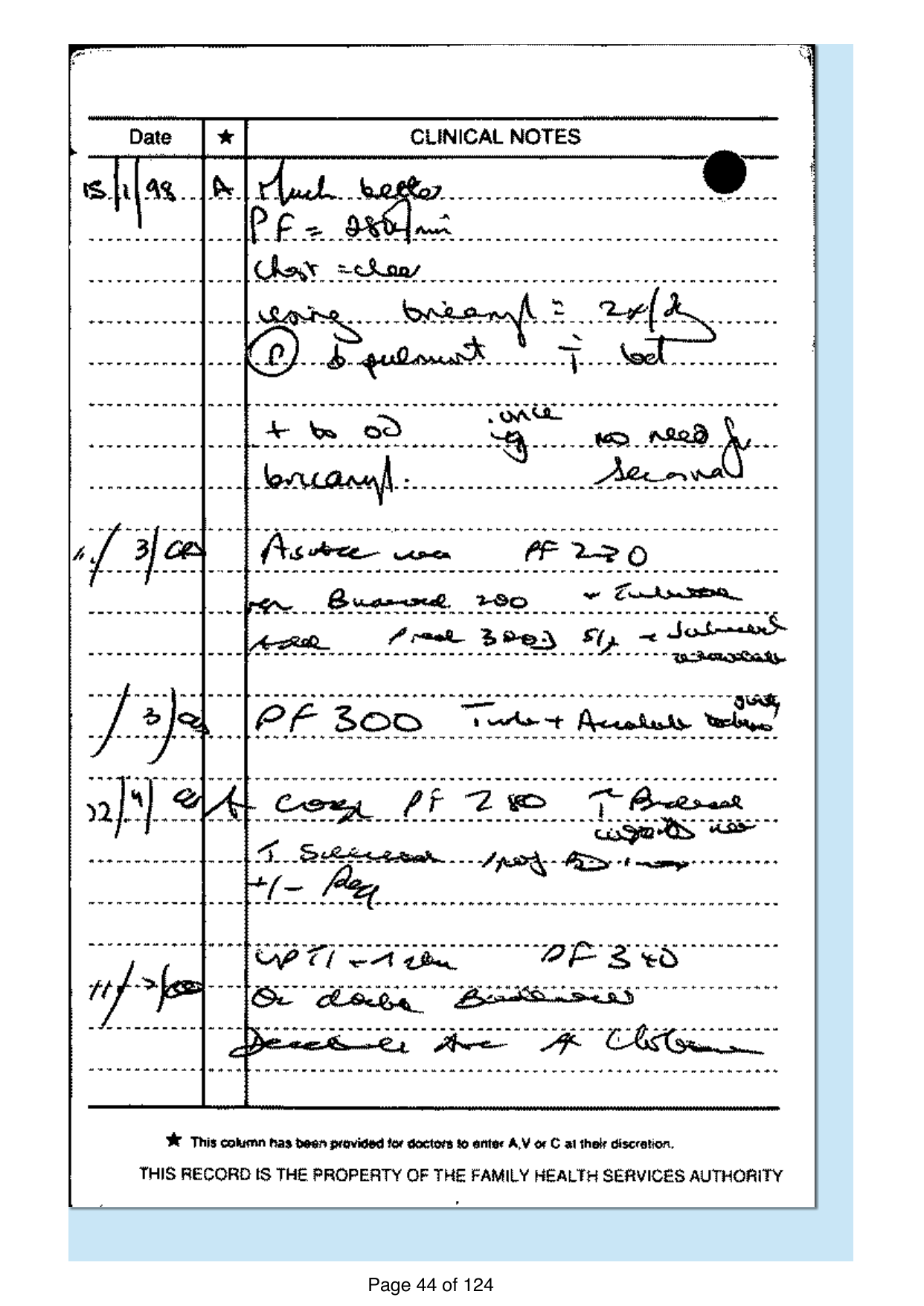
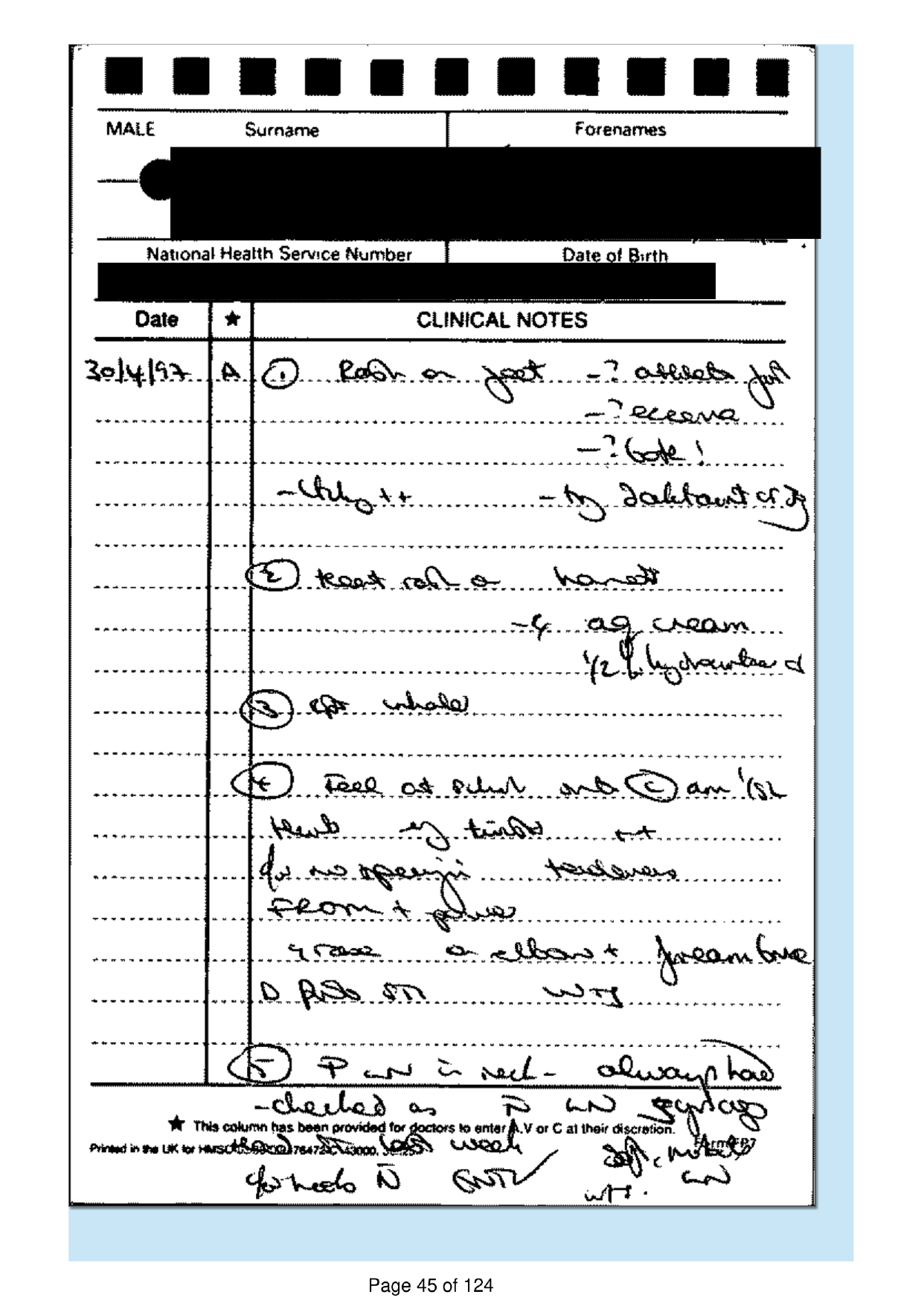
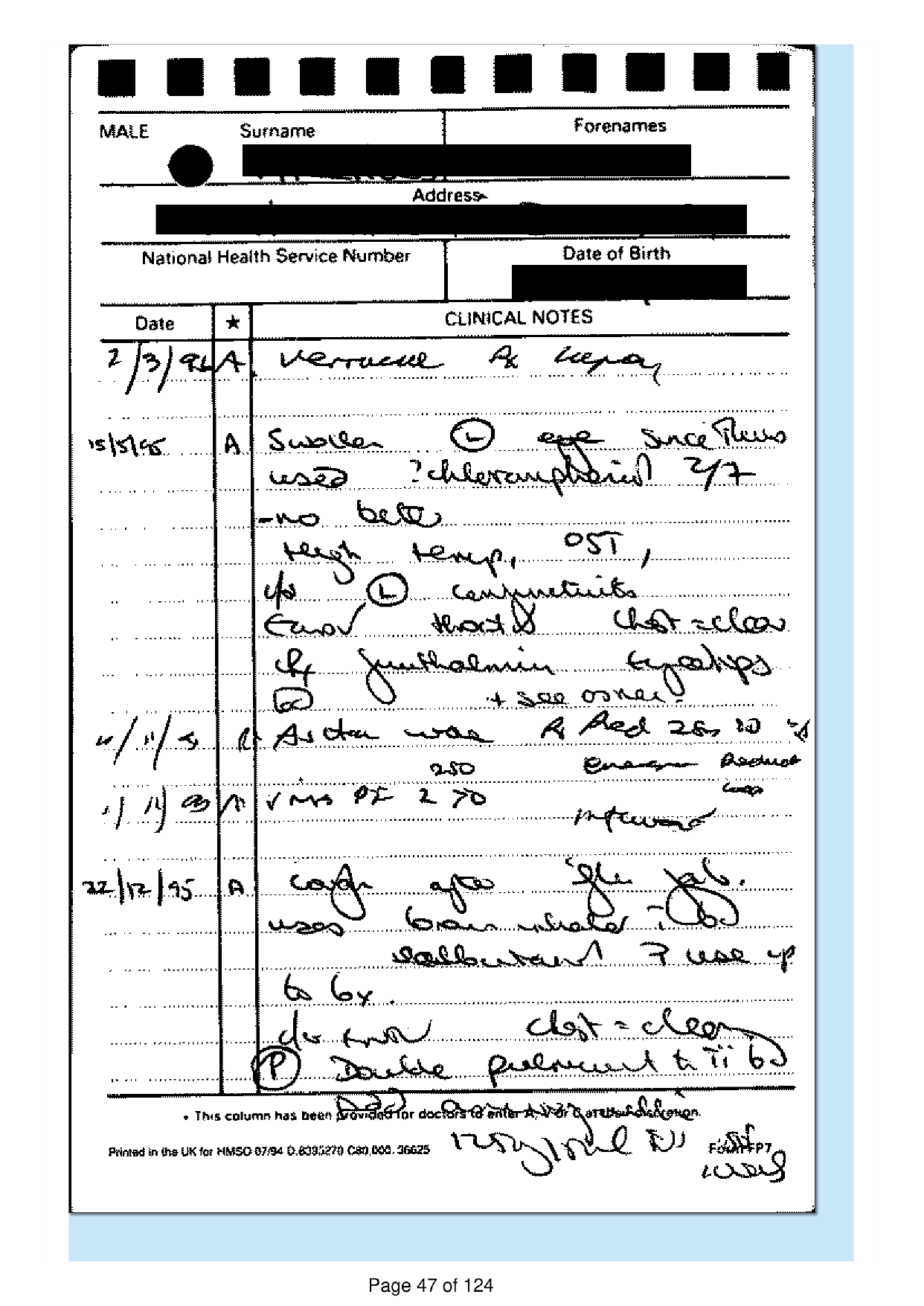
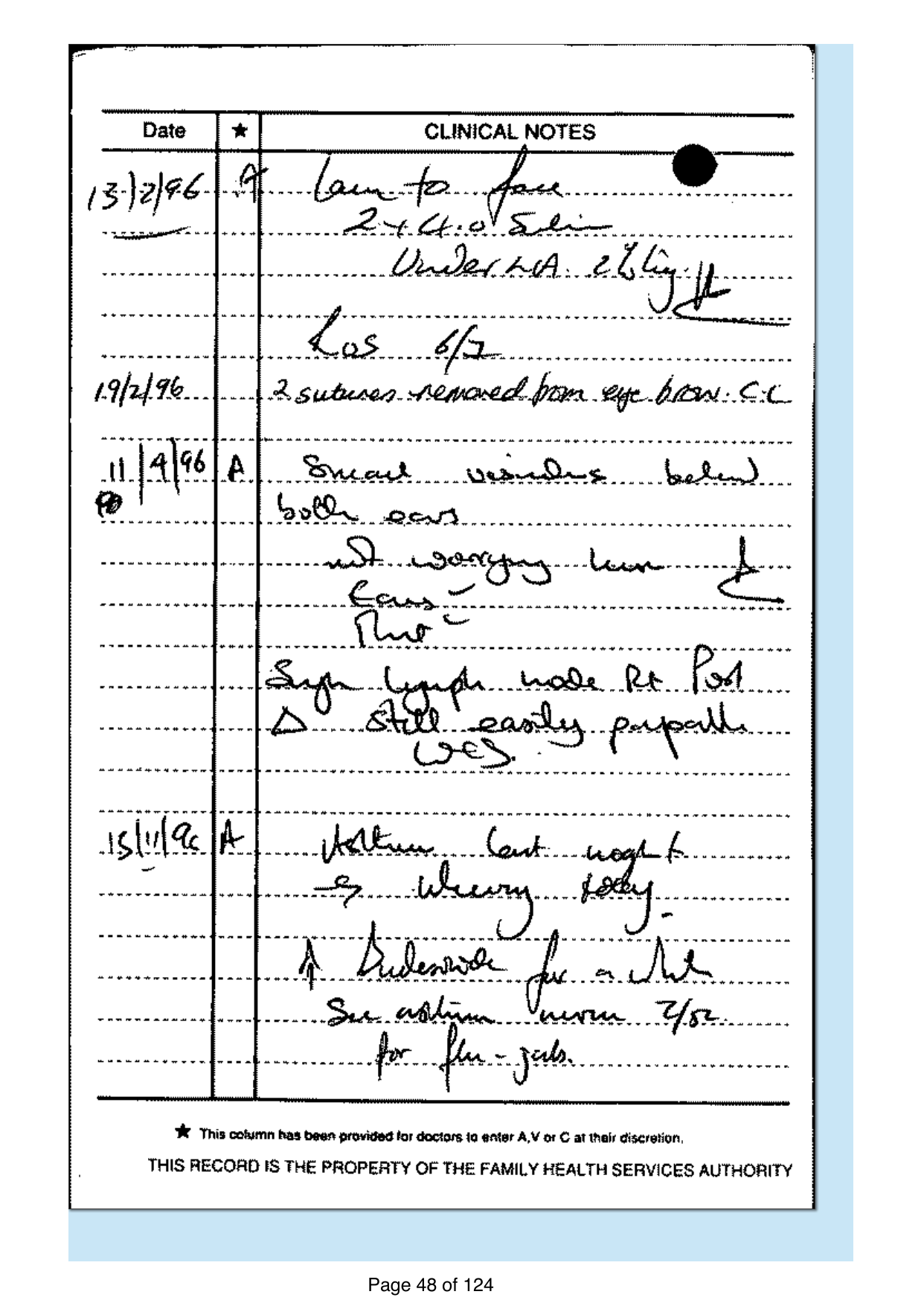
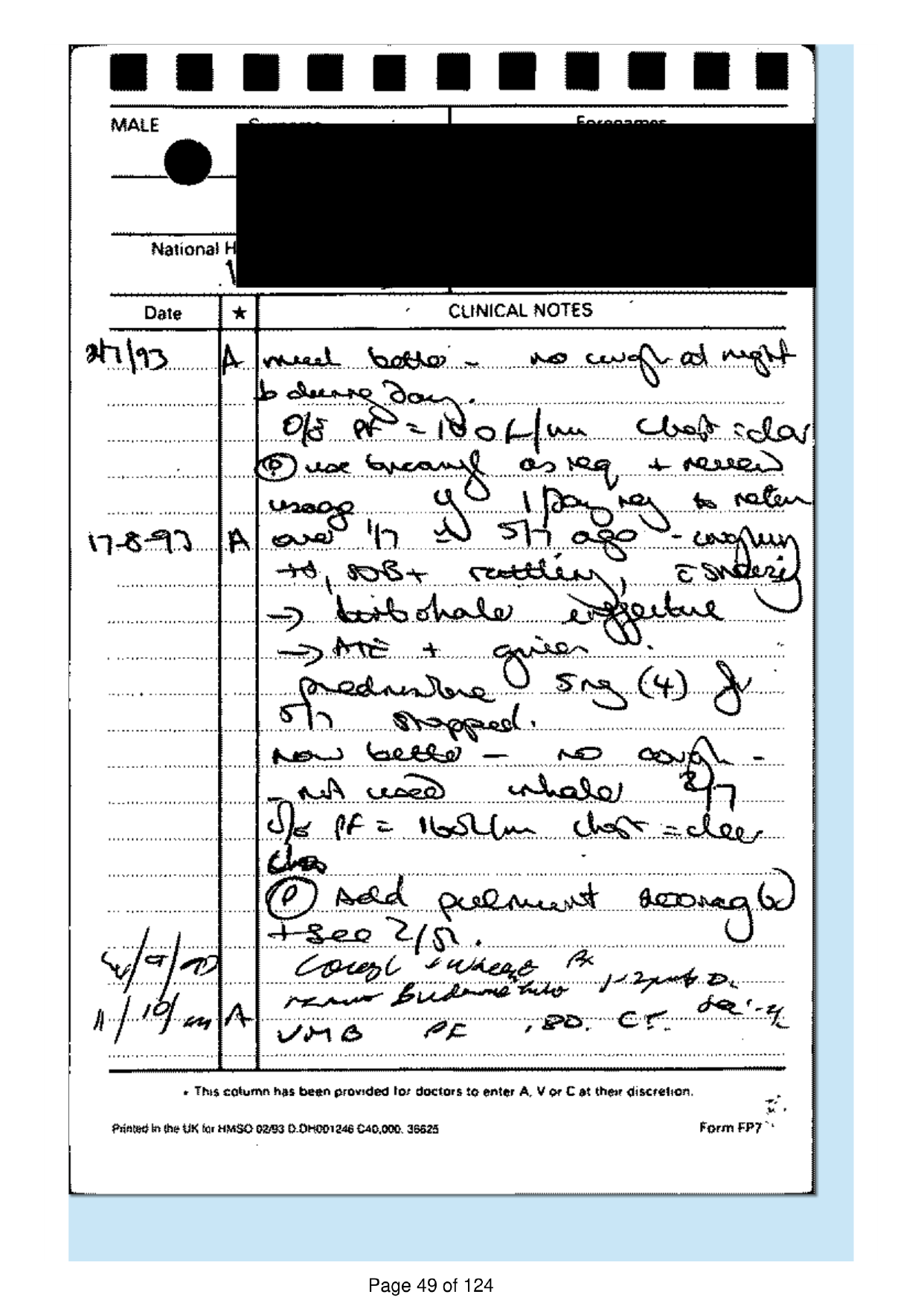
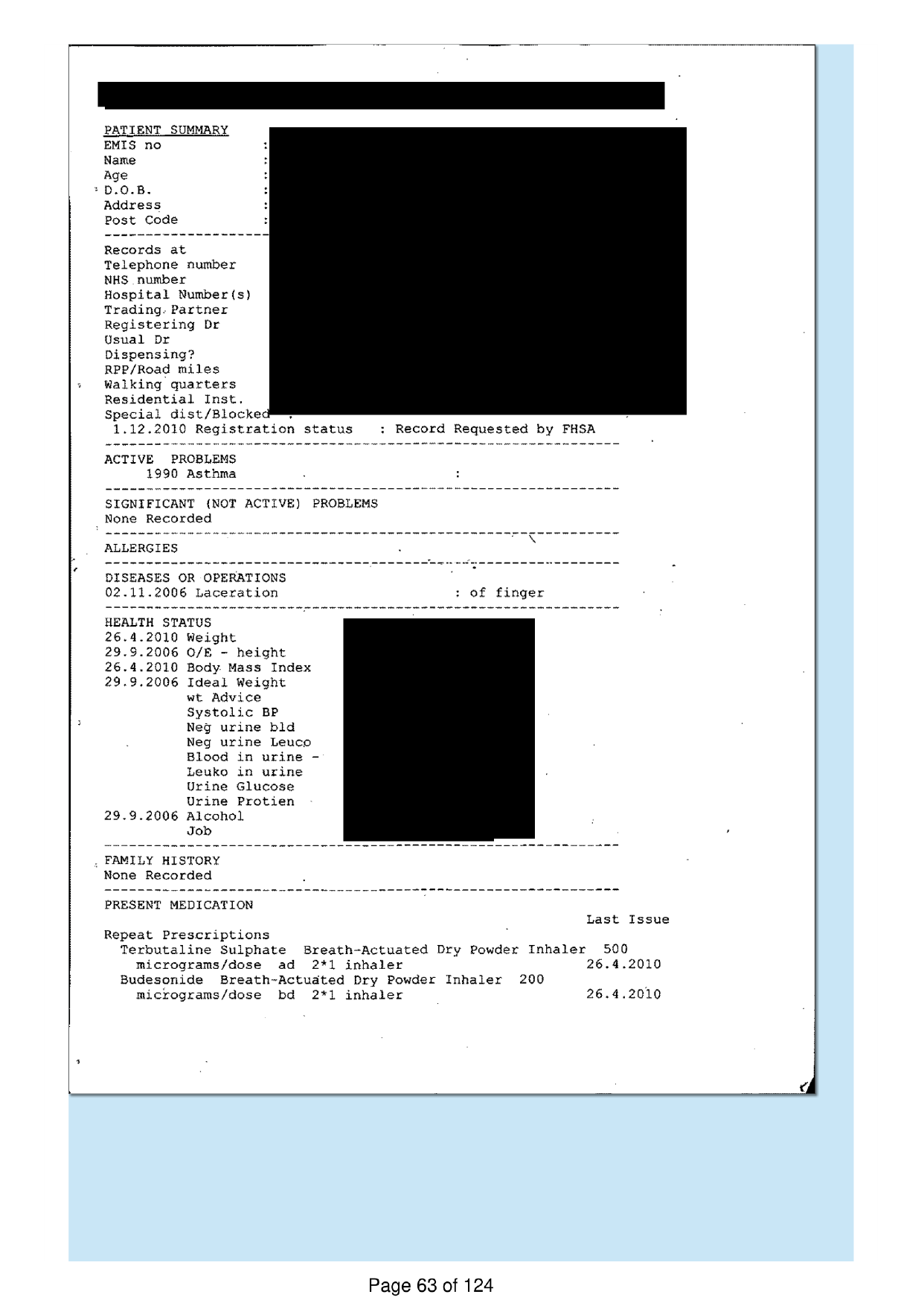
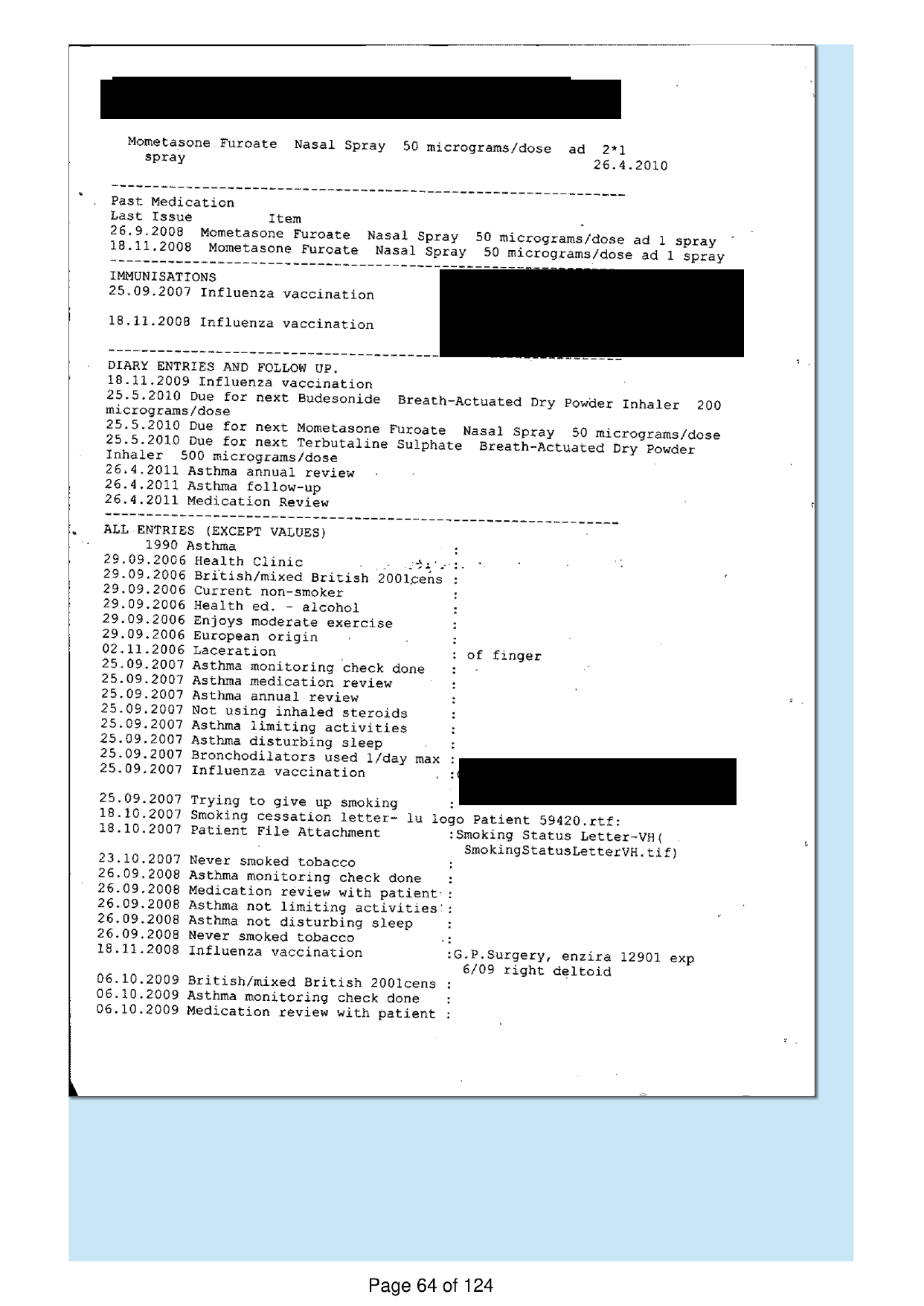
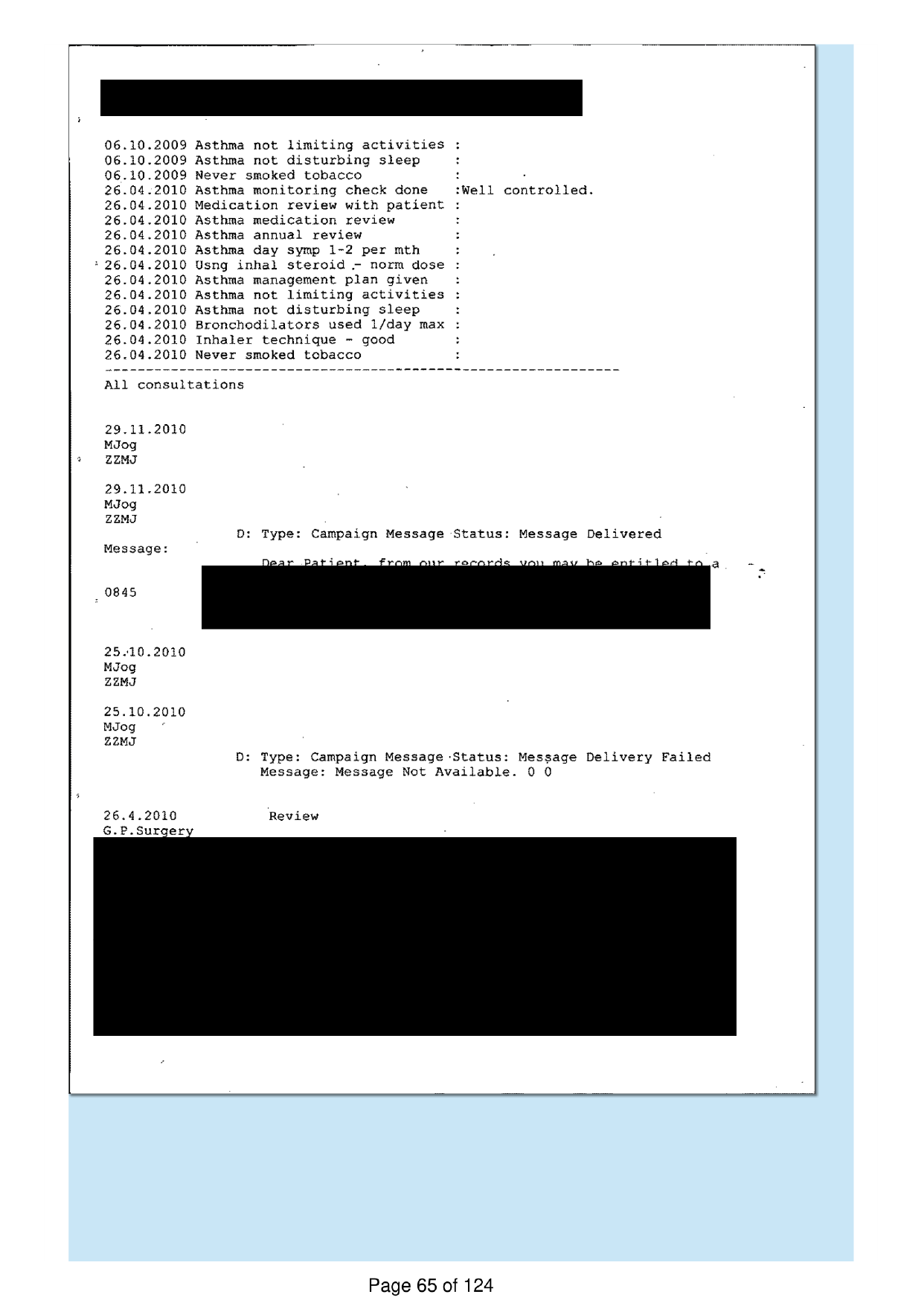
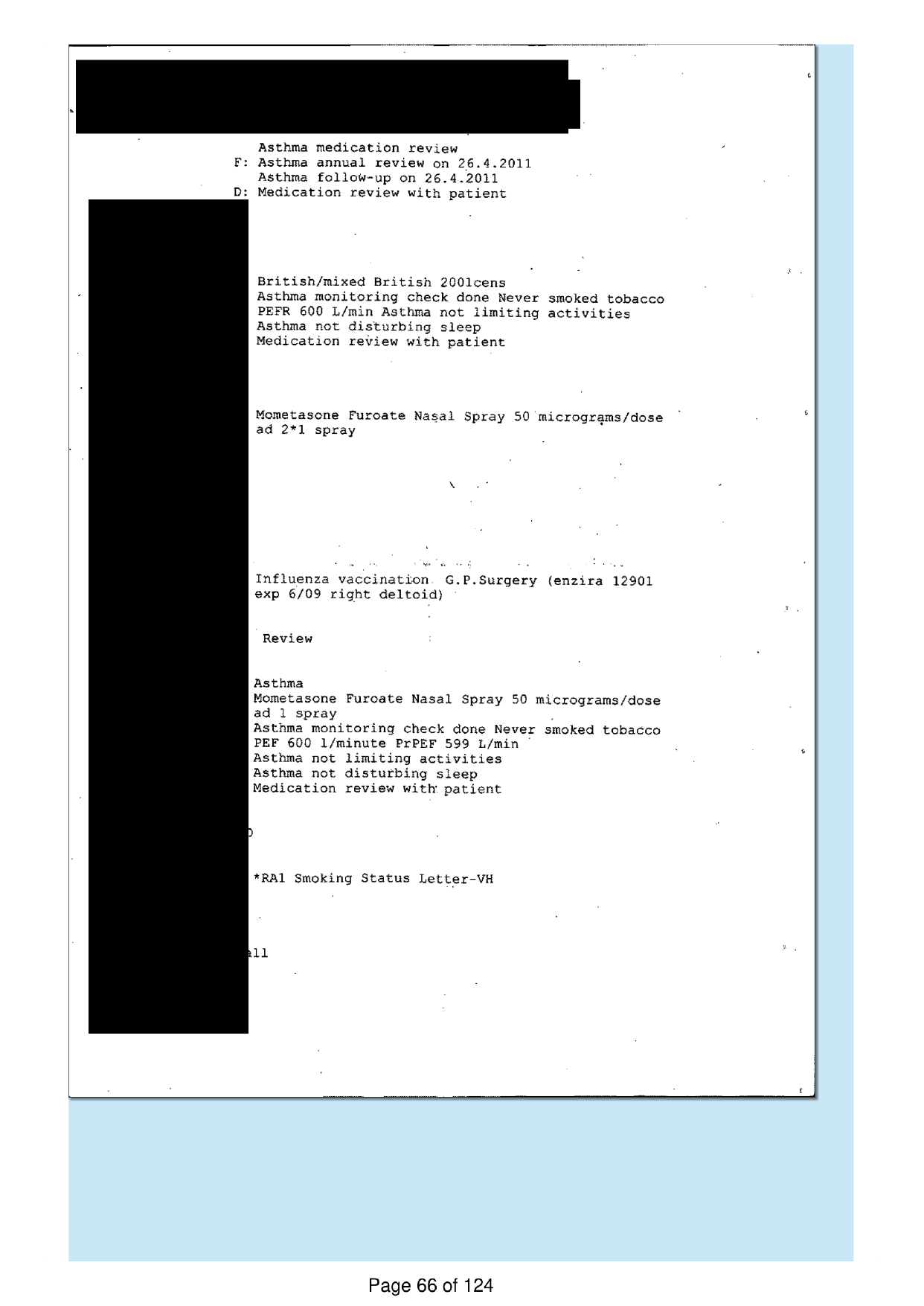
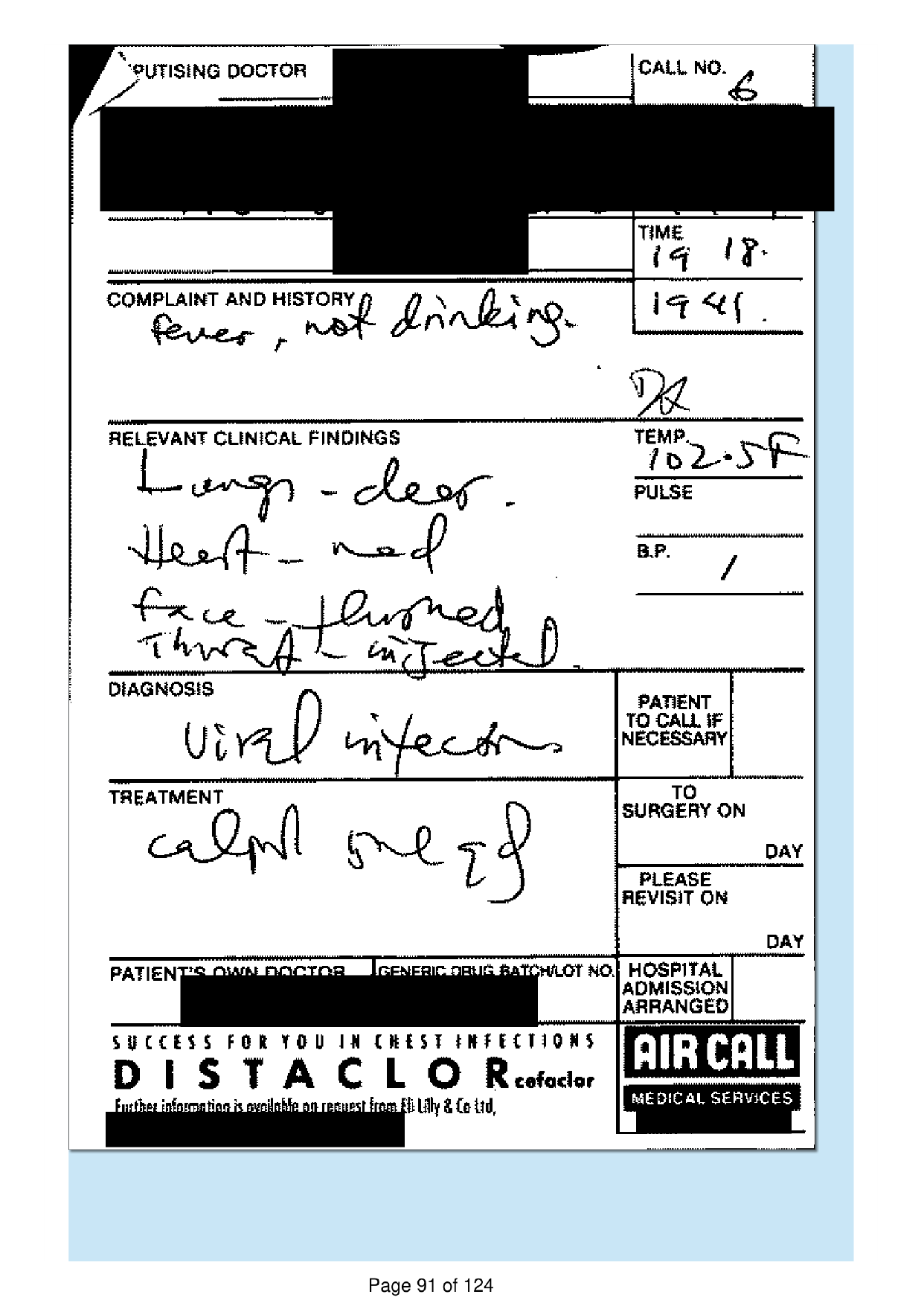
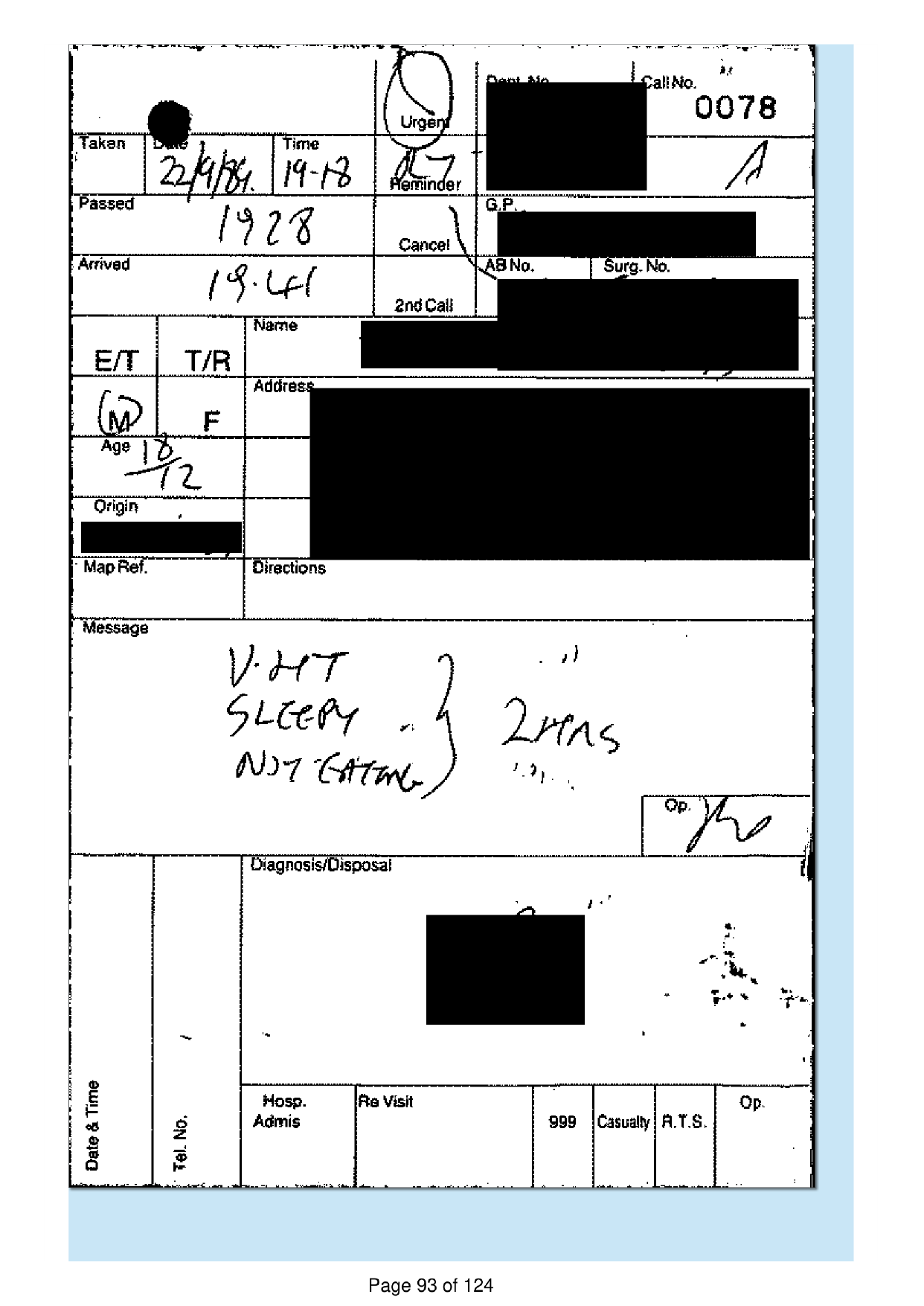
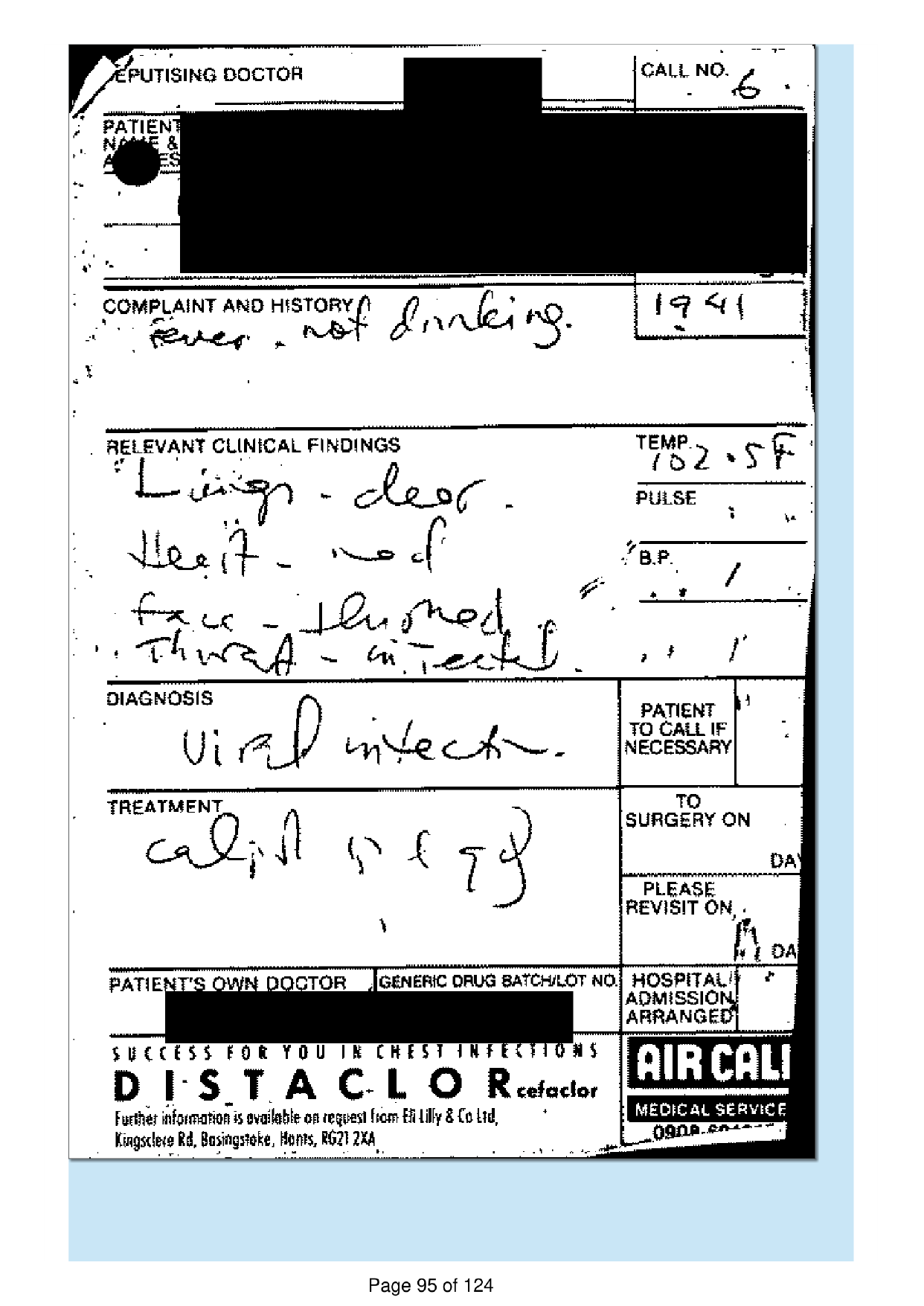
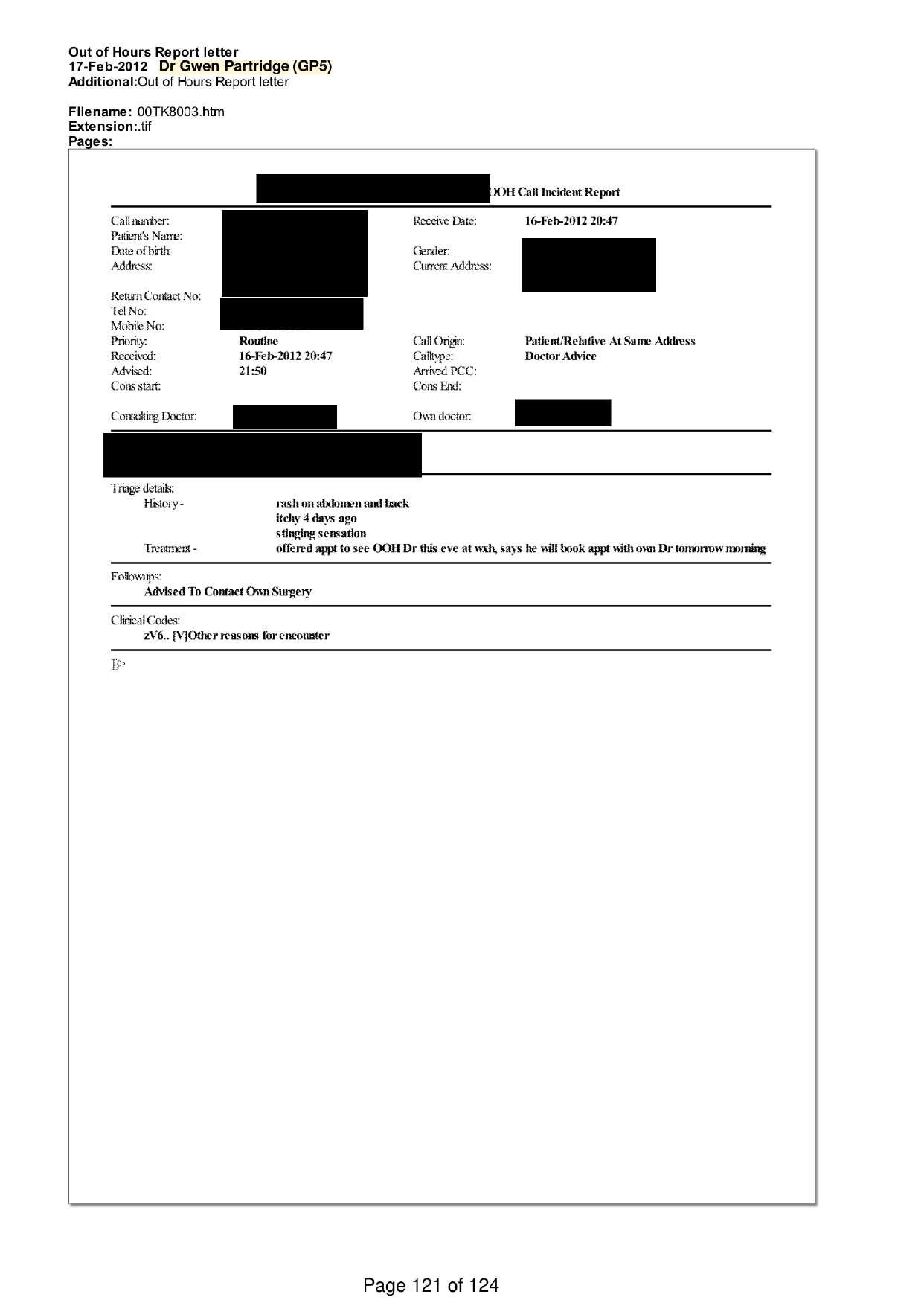
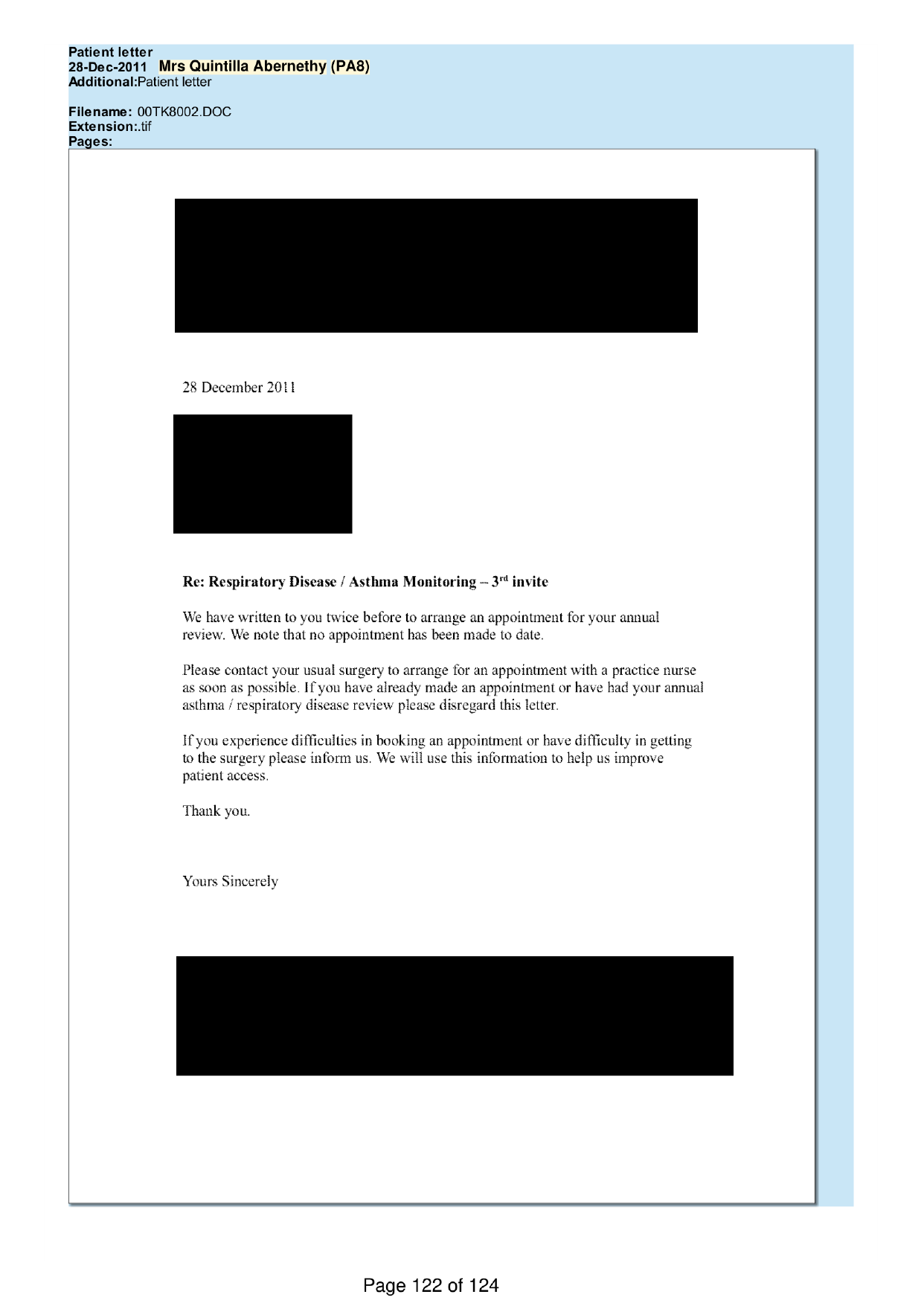
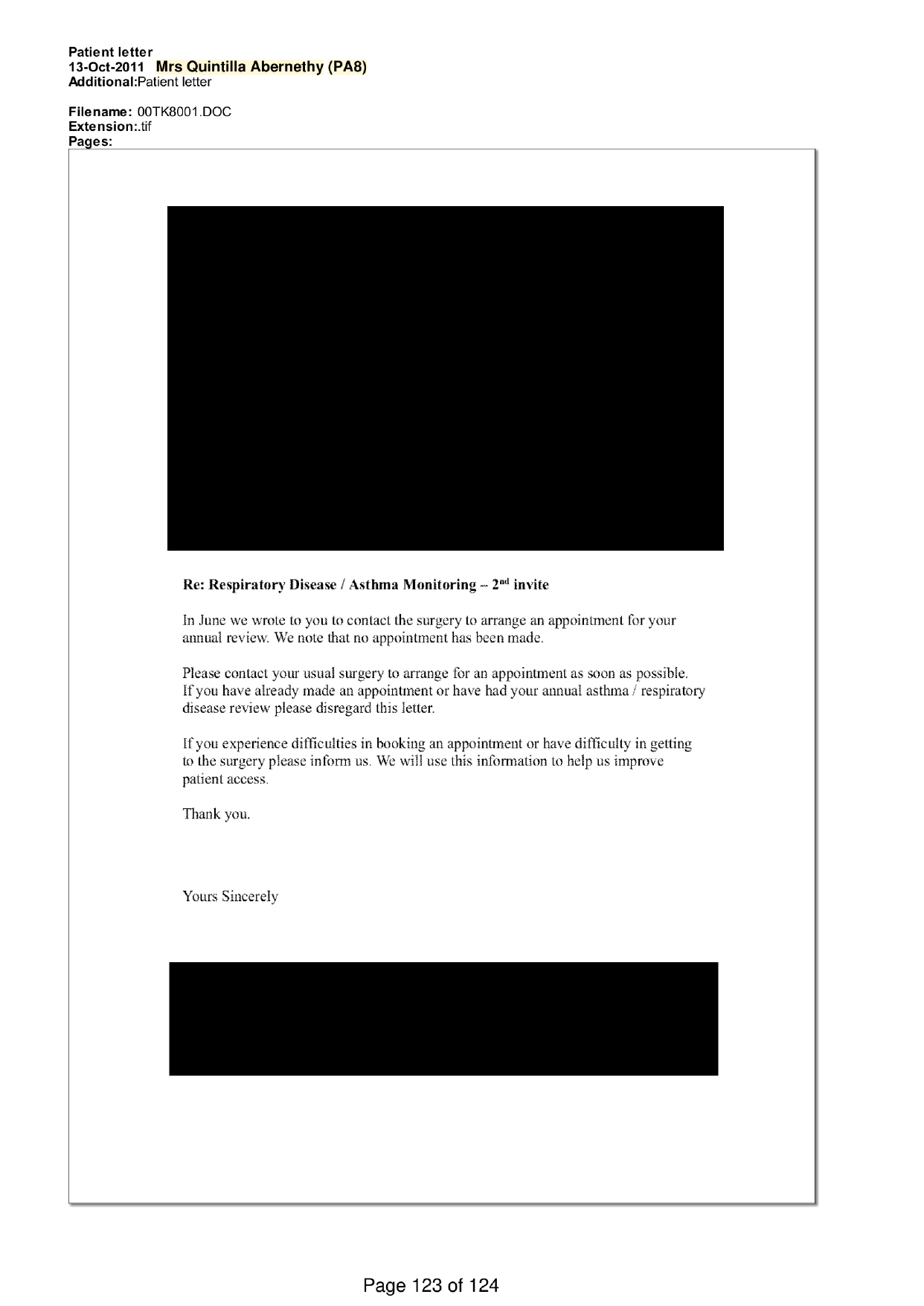
Every page the Chronicle Pack cites is here. Ask your practice for your record and this is roughly what arrives: one long PDF, printed straight out of the practice system, in whatever order the system holds things. Coded entries in a table that assumes you already know what the codes mean, then decades of scanned paper photographed off the old Lloyd George cards.
It is your data and you are entitled to all of it. That does not make it usable, and that is the reason this service exists.
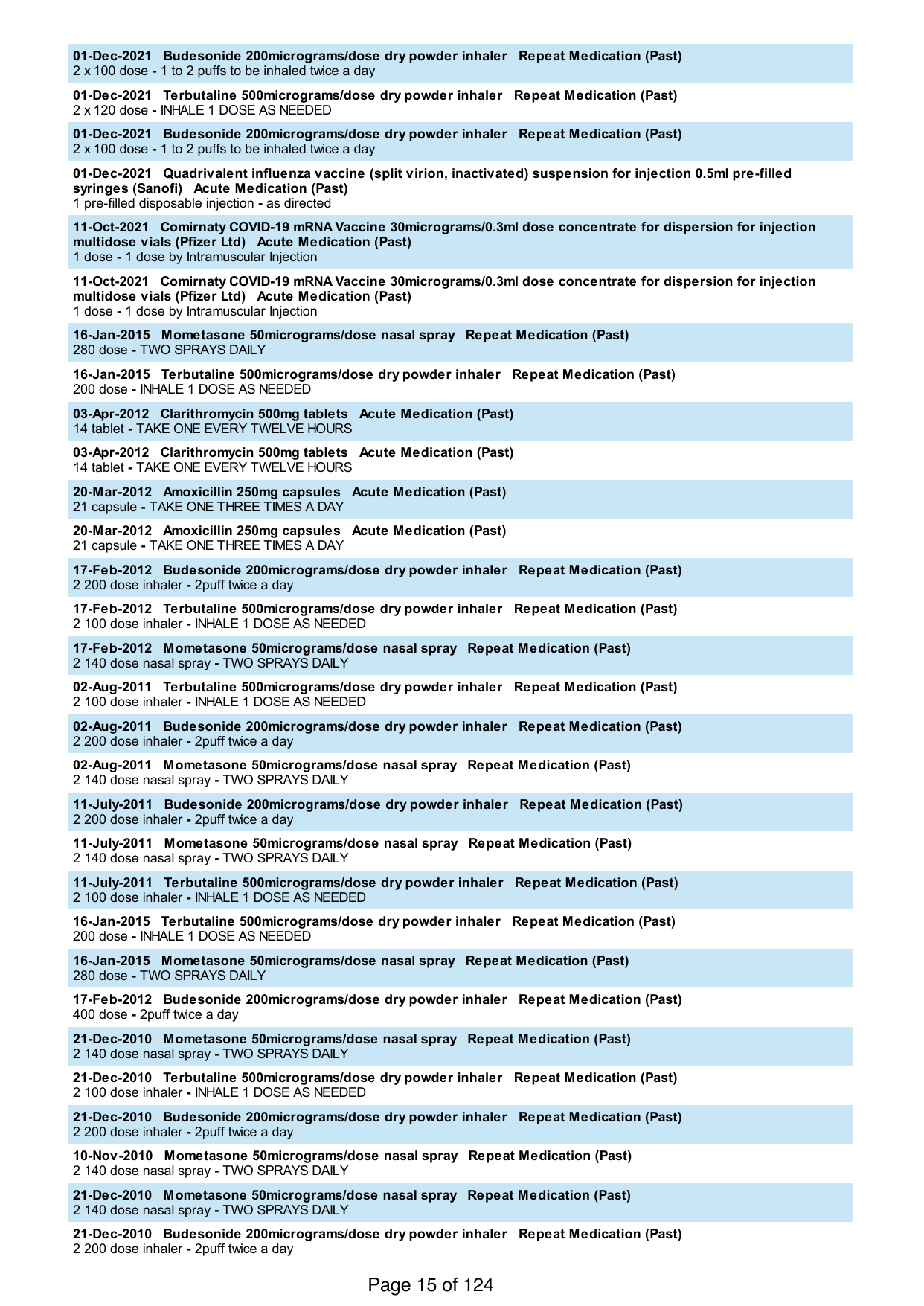
Anything marked in pale yellow is a change we made before publishing: a name swapped, an identifier taken out, a page held back. Everything unmarked is the record exactly as the practice sent it. Page numbers are the numbers the Chronicle Pack cites.
Page 1
Page 2
Page 3

Page 4
Page 5
Page 6
Page 7

Page 8
Page 9
Page 10
Page 11

Page 12
Page 13
Page 14
Page 15
Page 16 · Withheld

Page 17
Page 18

Page 19

Page 20
Page 21
Page 22
Page 23

Page 24
Page 25
Page 26
Page 27
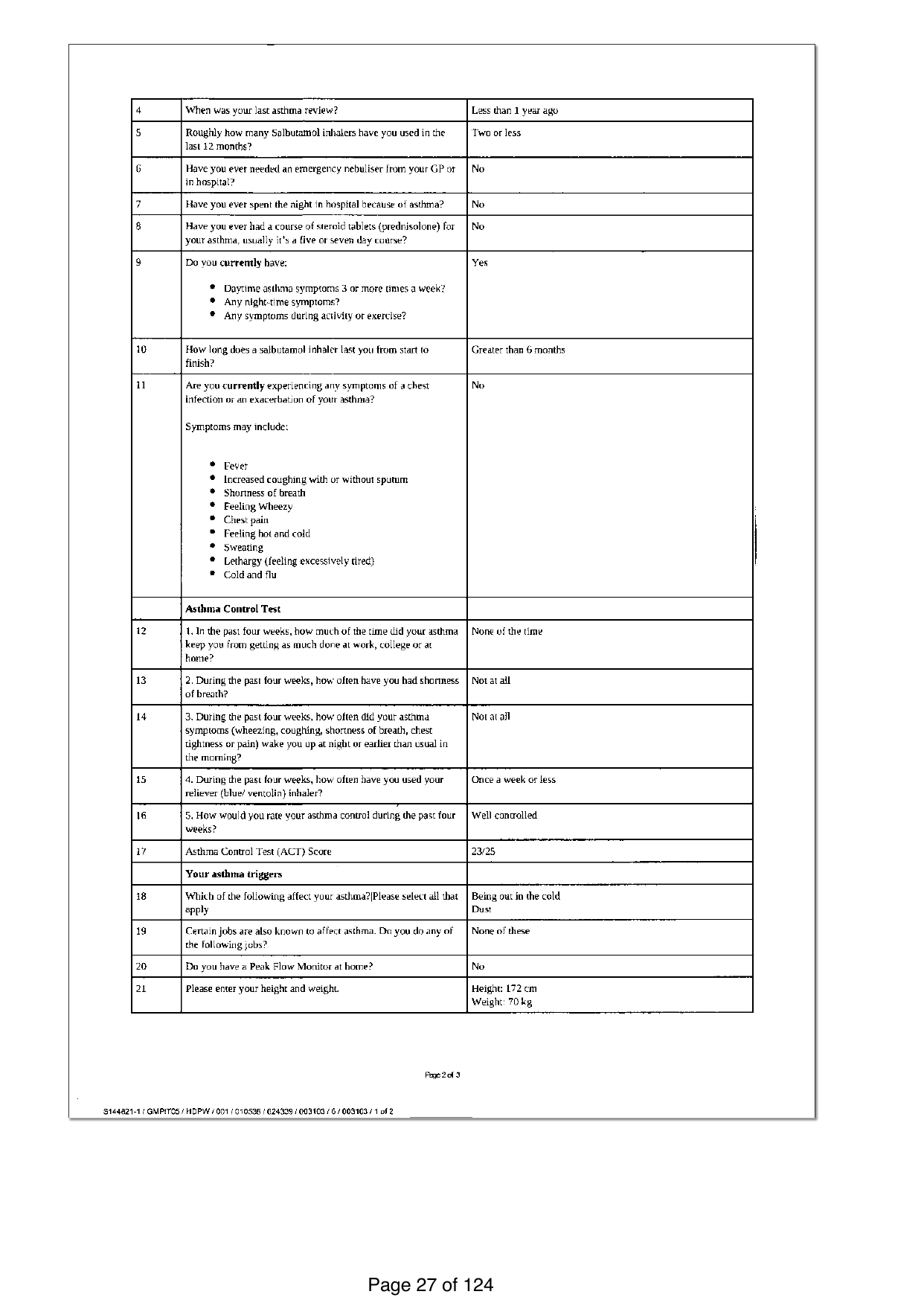
Page 28
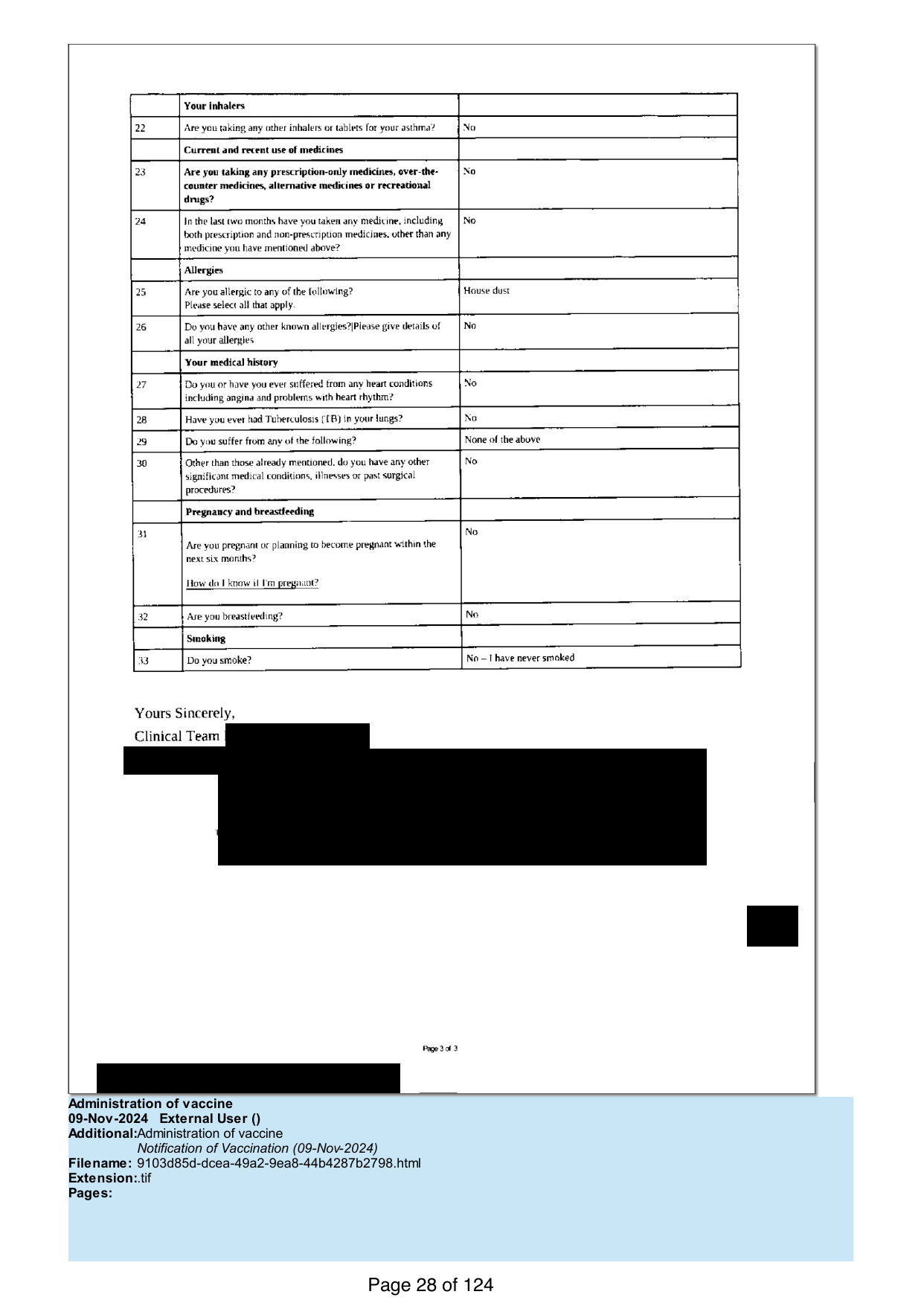
Page 29
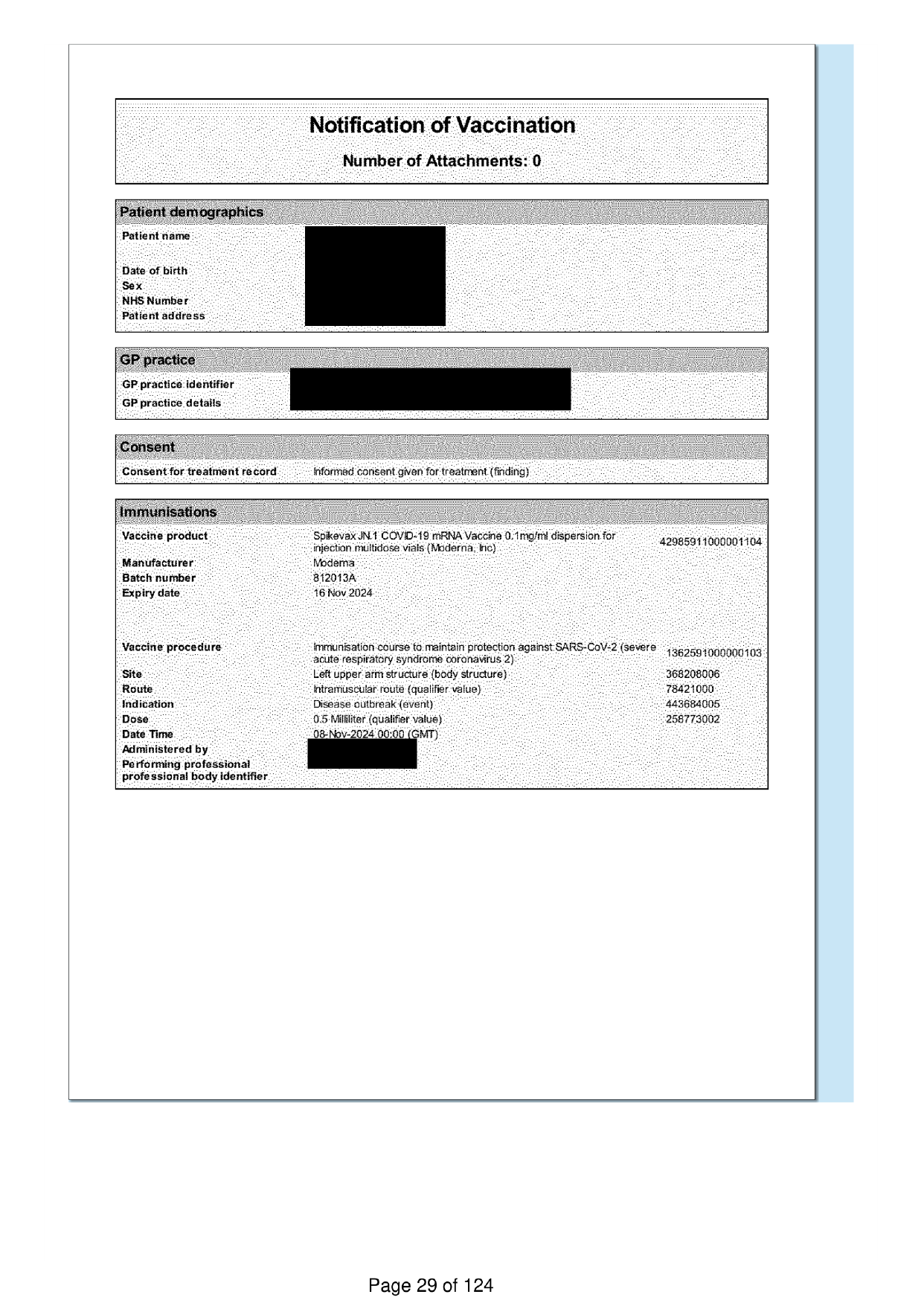
Page 30
Page 31
Page 32

Page 33
Page 34

Page 35
Page 36

Page 37
Page 38
Page 39
Page 40
Page 41
Page 42
Page 43
Page 44
Page 45
Page 46
Page 47
Page 48
Page 49
Page 50
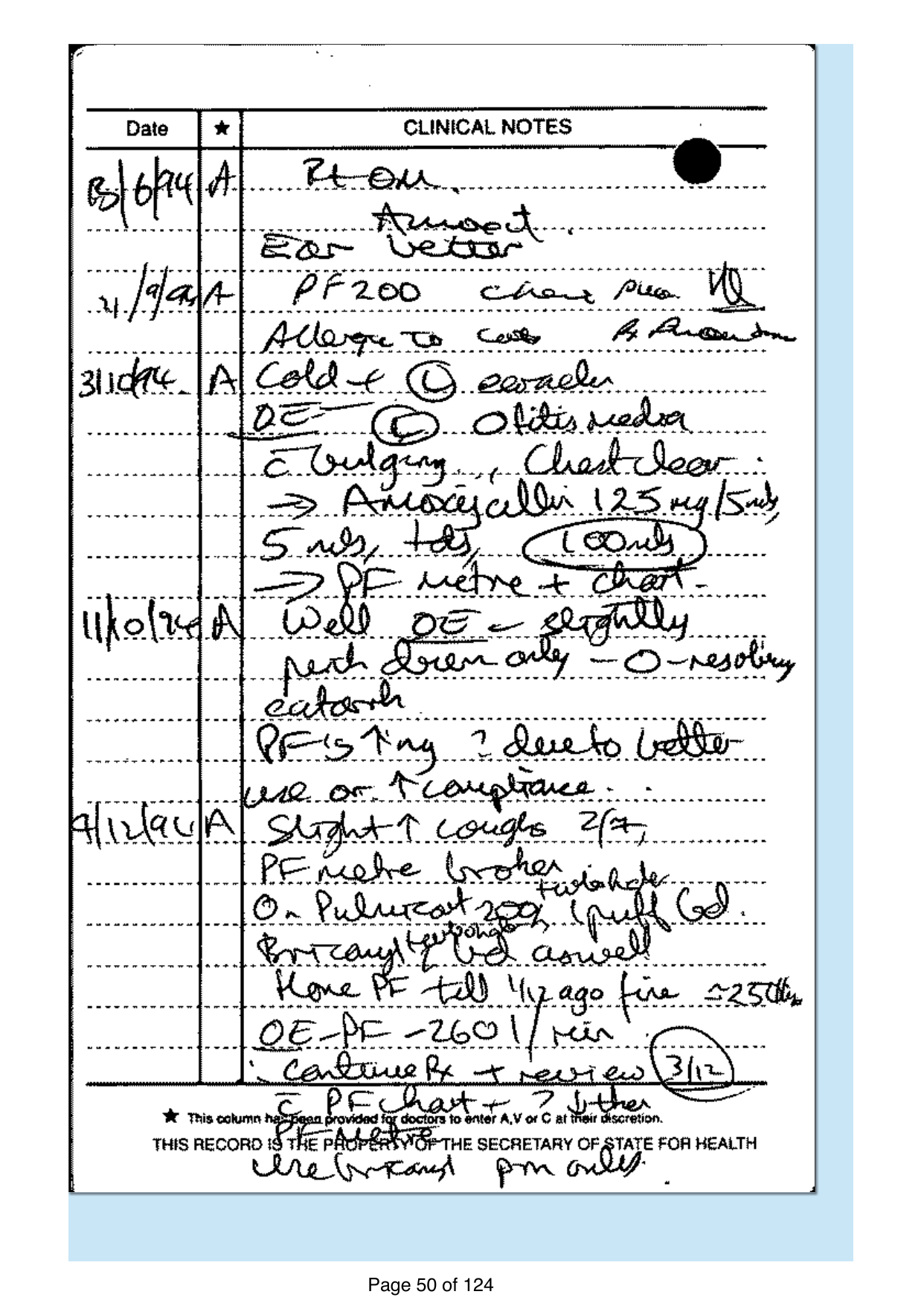
Page 51
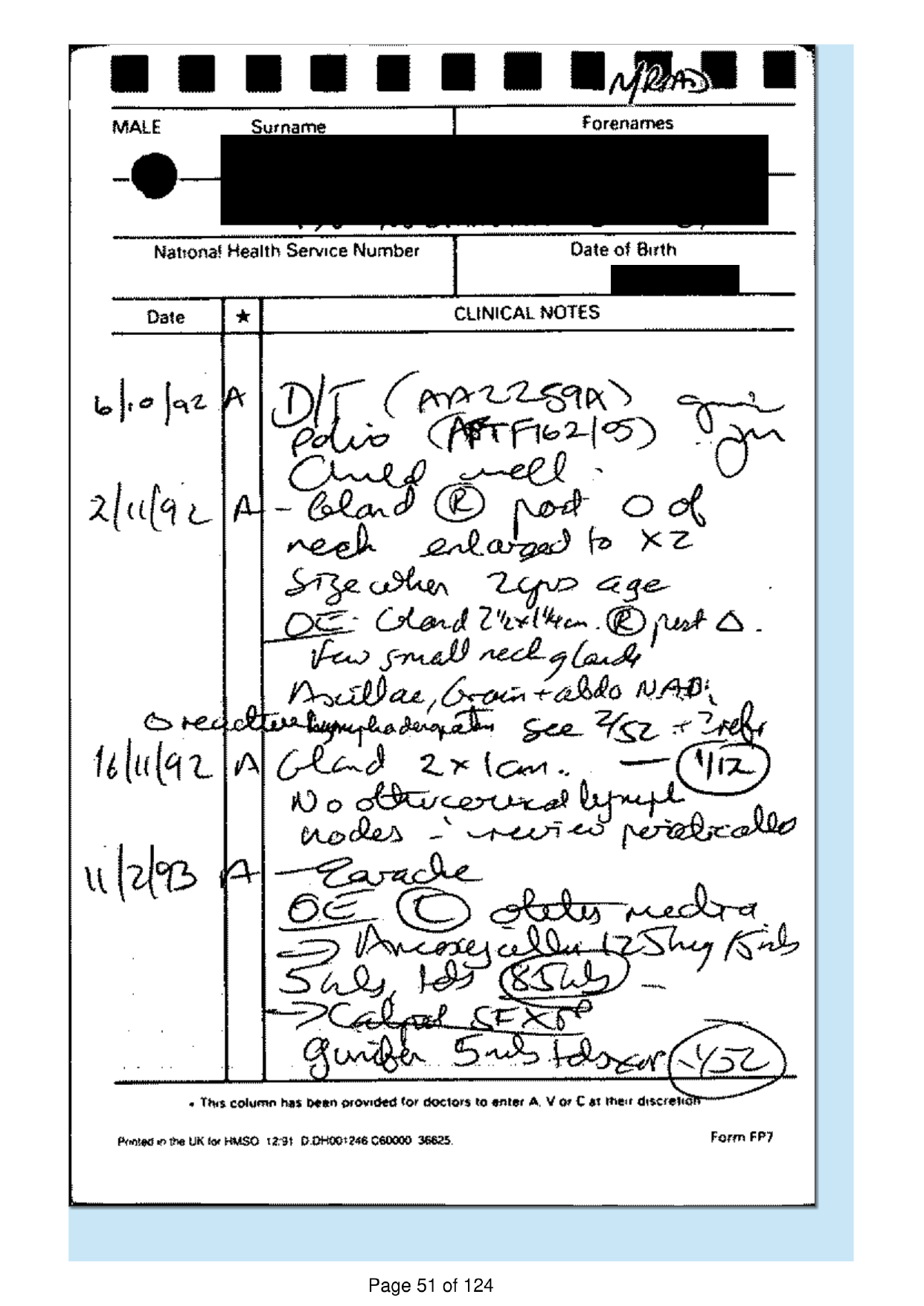
Page 52
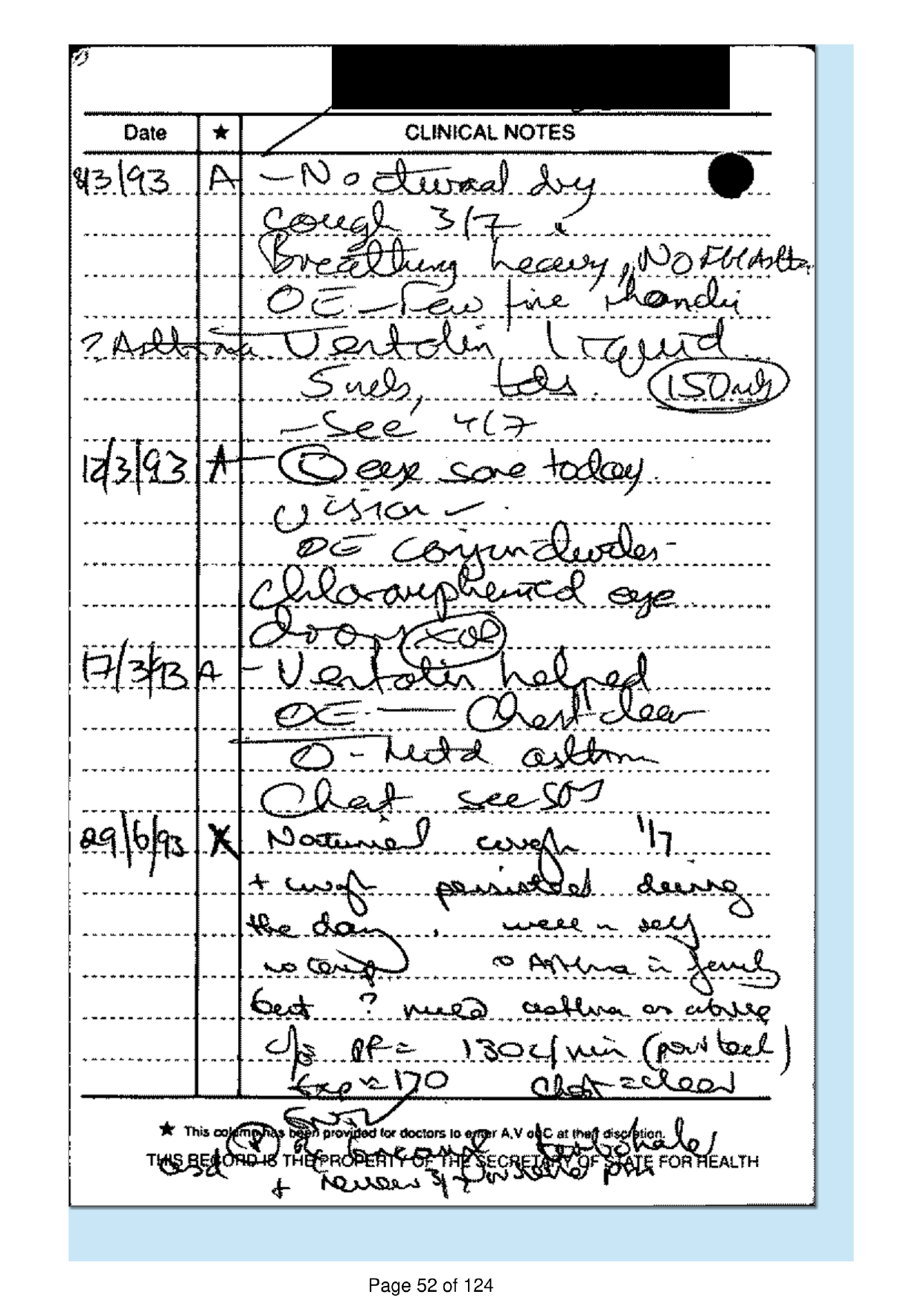
Page 53
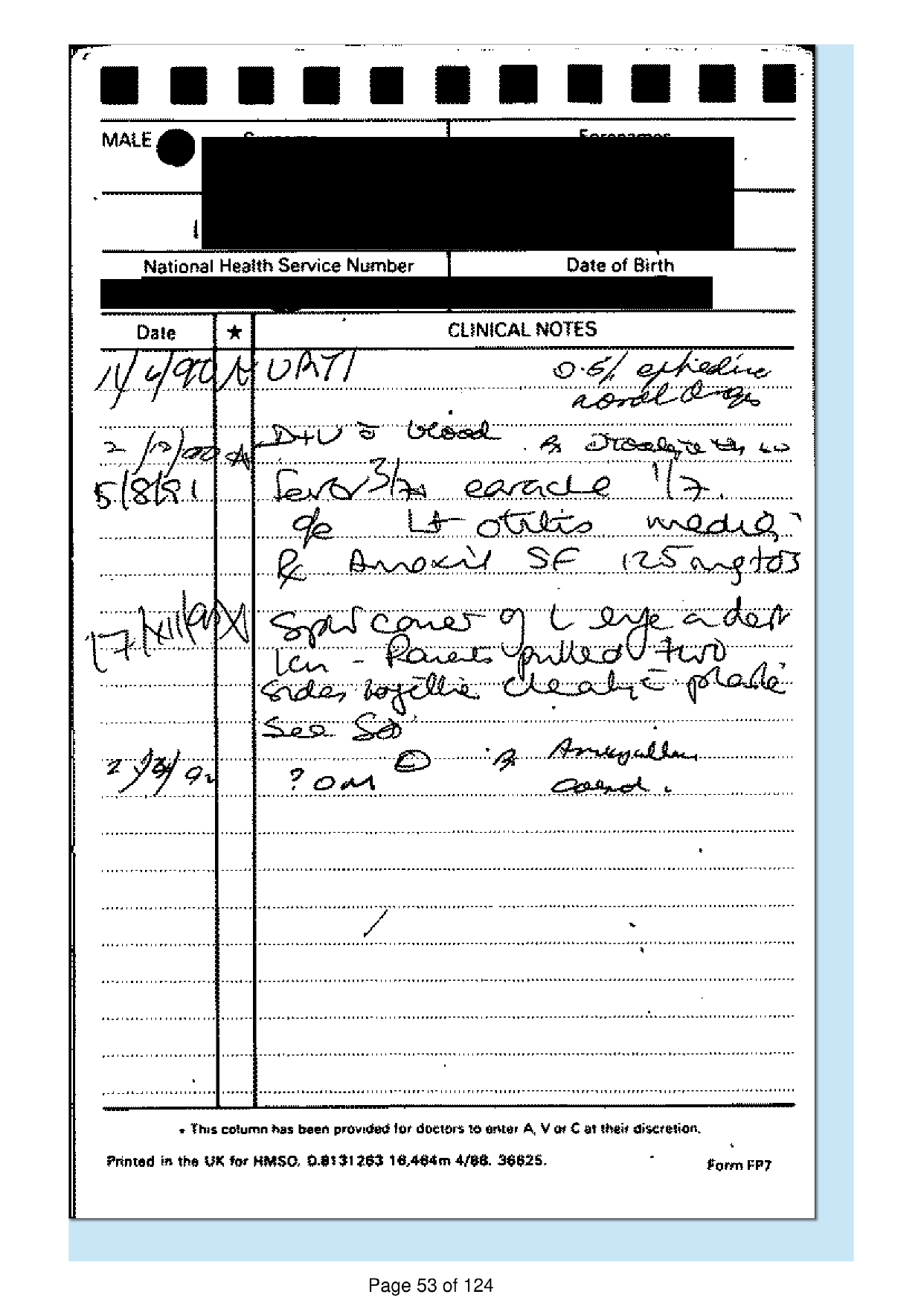
Page 54
Page 55
Page 56
Page 57
Page 58
Page 59
Page 60
Page 61
Page 62

Page 63
Page 64
Page 65
Page 66
Page 67
Page 68

Page 69
Page 70

Page 71
Page 72

Page 73
Page 74

Page 75
Page 76

Page 77
Page 78

Page 79 · Withheld

Page 80 · Withheld

Page 81
Page 82
Page 83
Page 84

Page 85
Page 86

Page 87
Page 88

Page 89
Page 90

Page 91
Page 92

Page 93
Page 94
Page 95
Page 96

Page 97
Page 98

Page 99
Page 100

Page 101
Page 102

Page 103
Page 104

Page 105
Page 106
Page 107

Page 108
Page 109
Page 110

Page 111
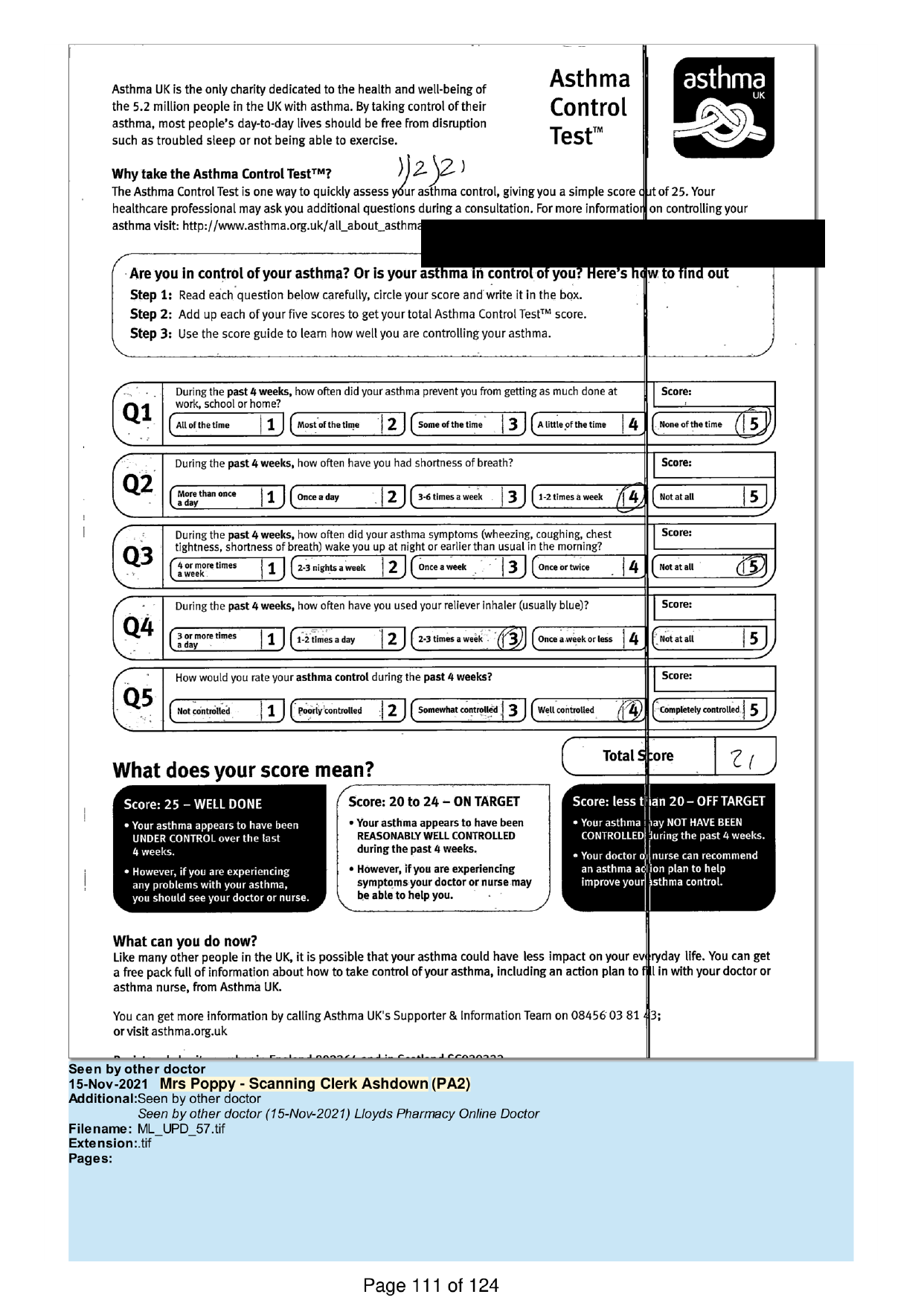
Page 112
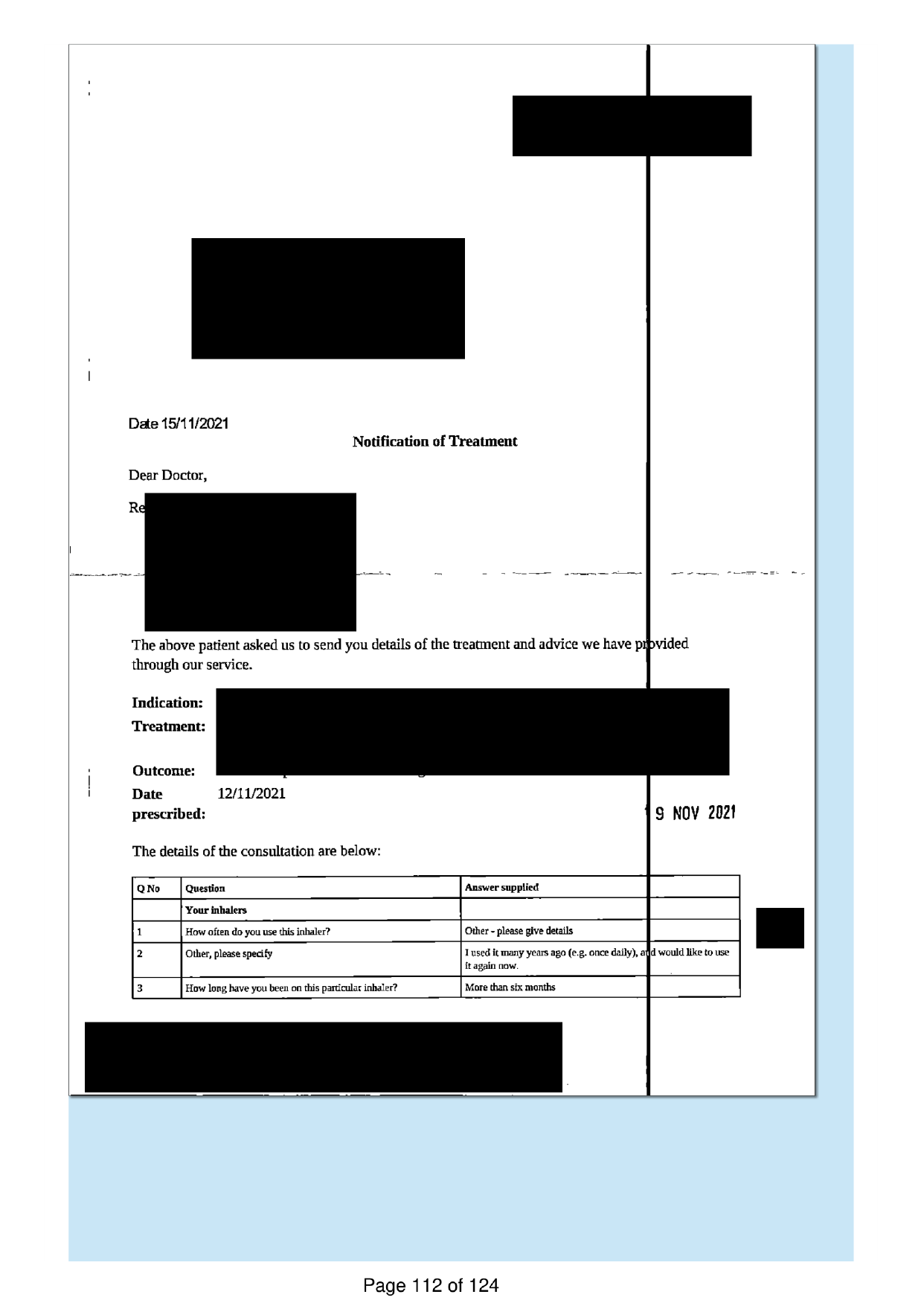
Page 113
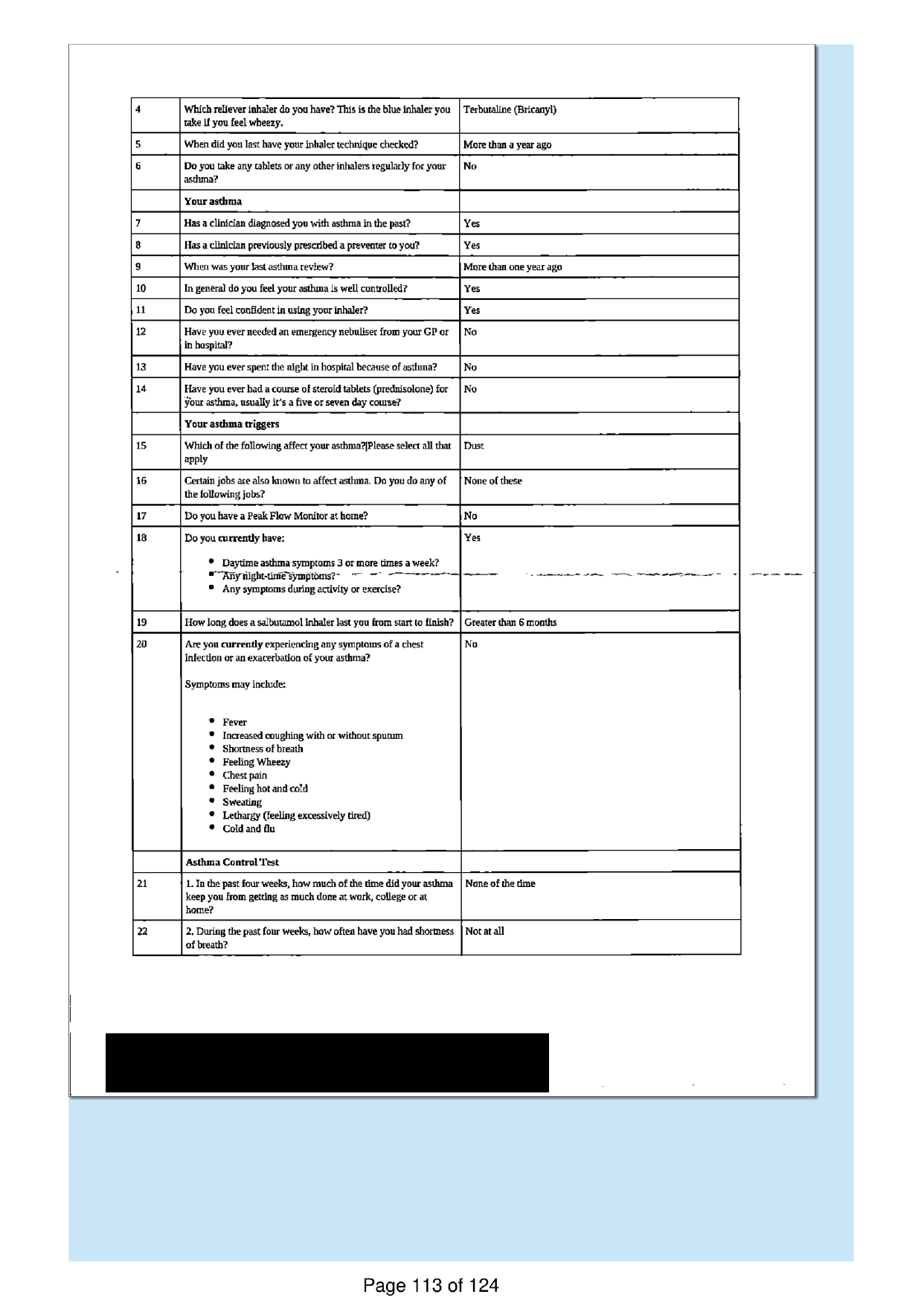
Page 114
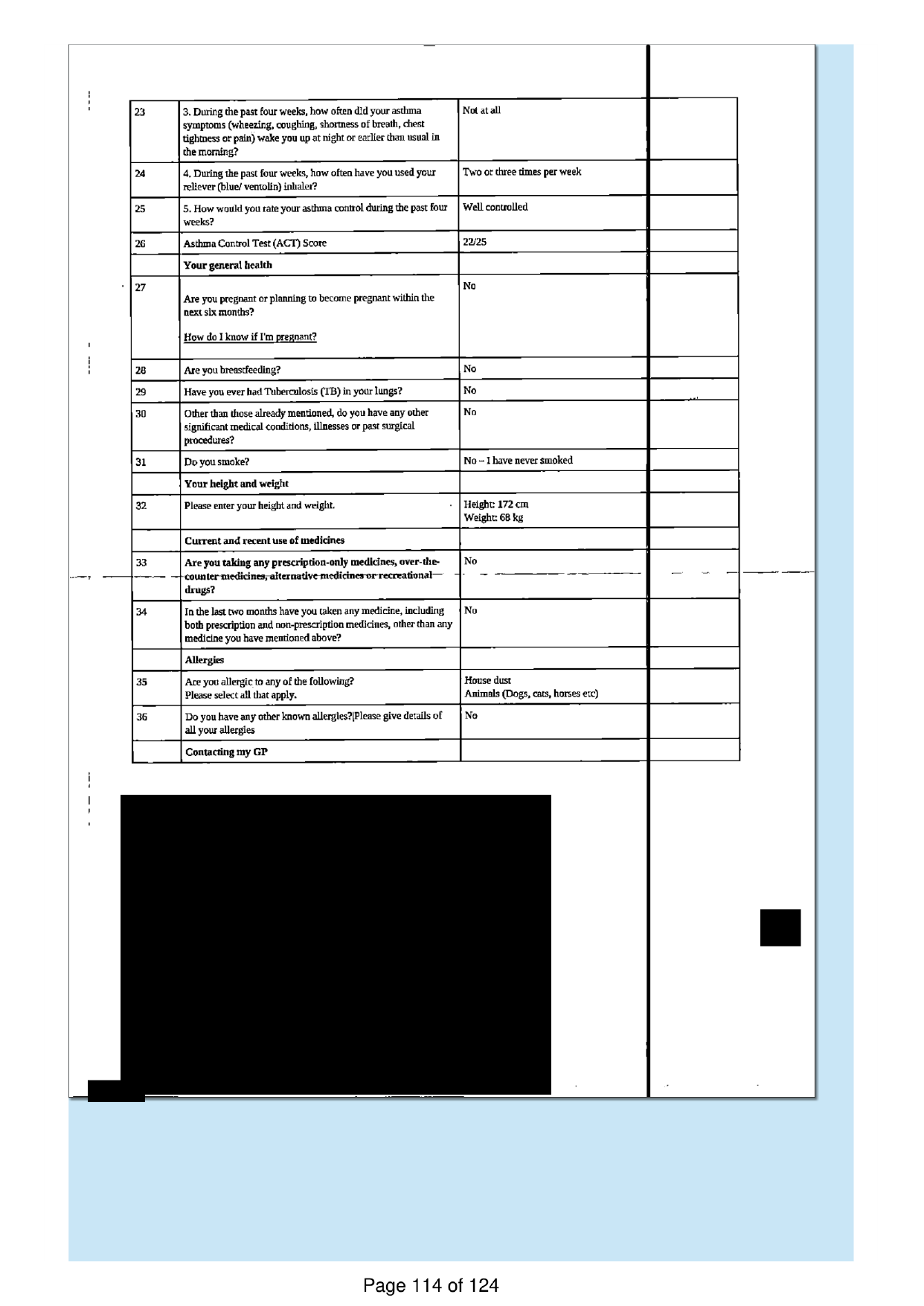
Page 115

Page 116
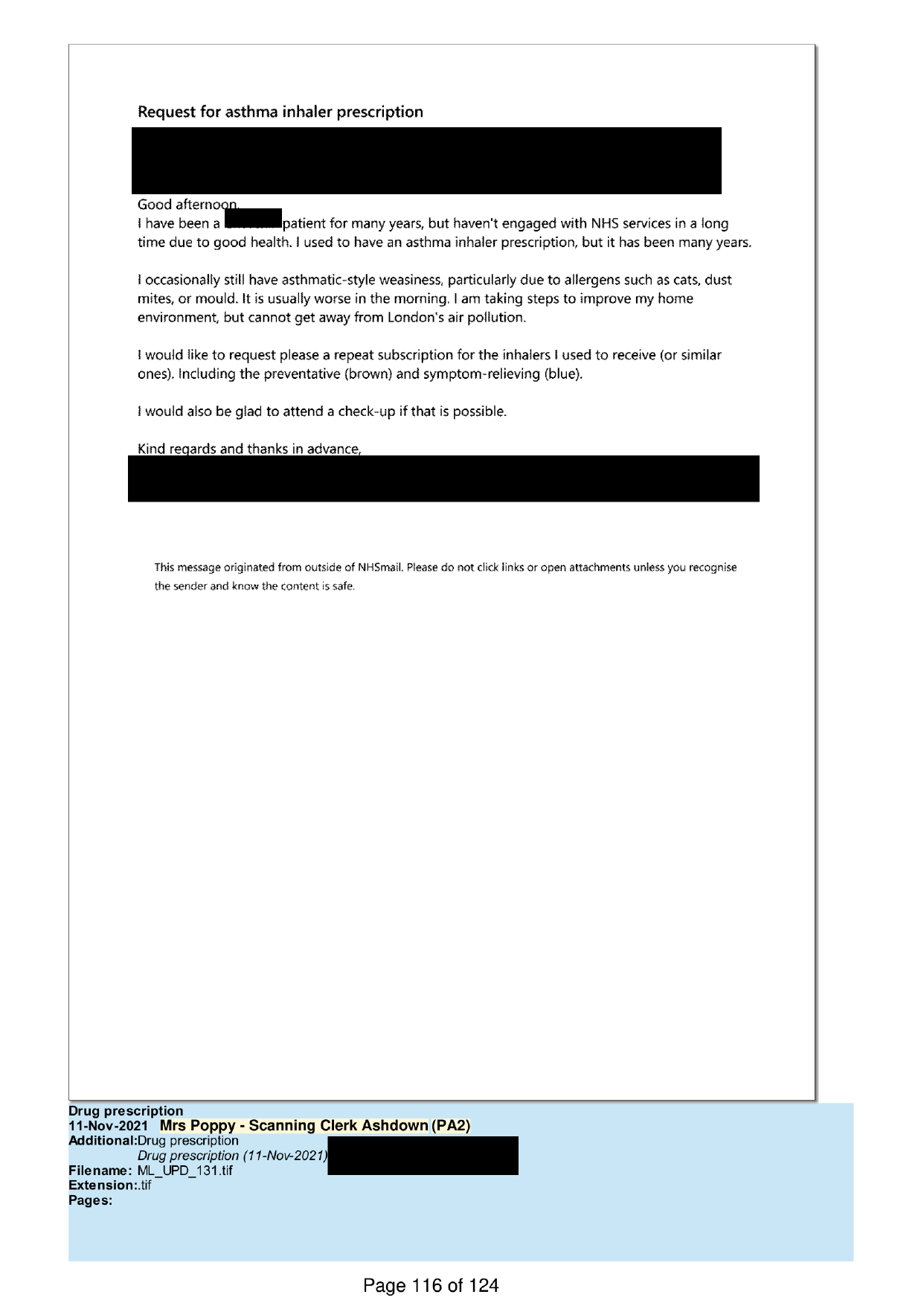
Page 117
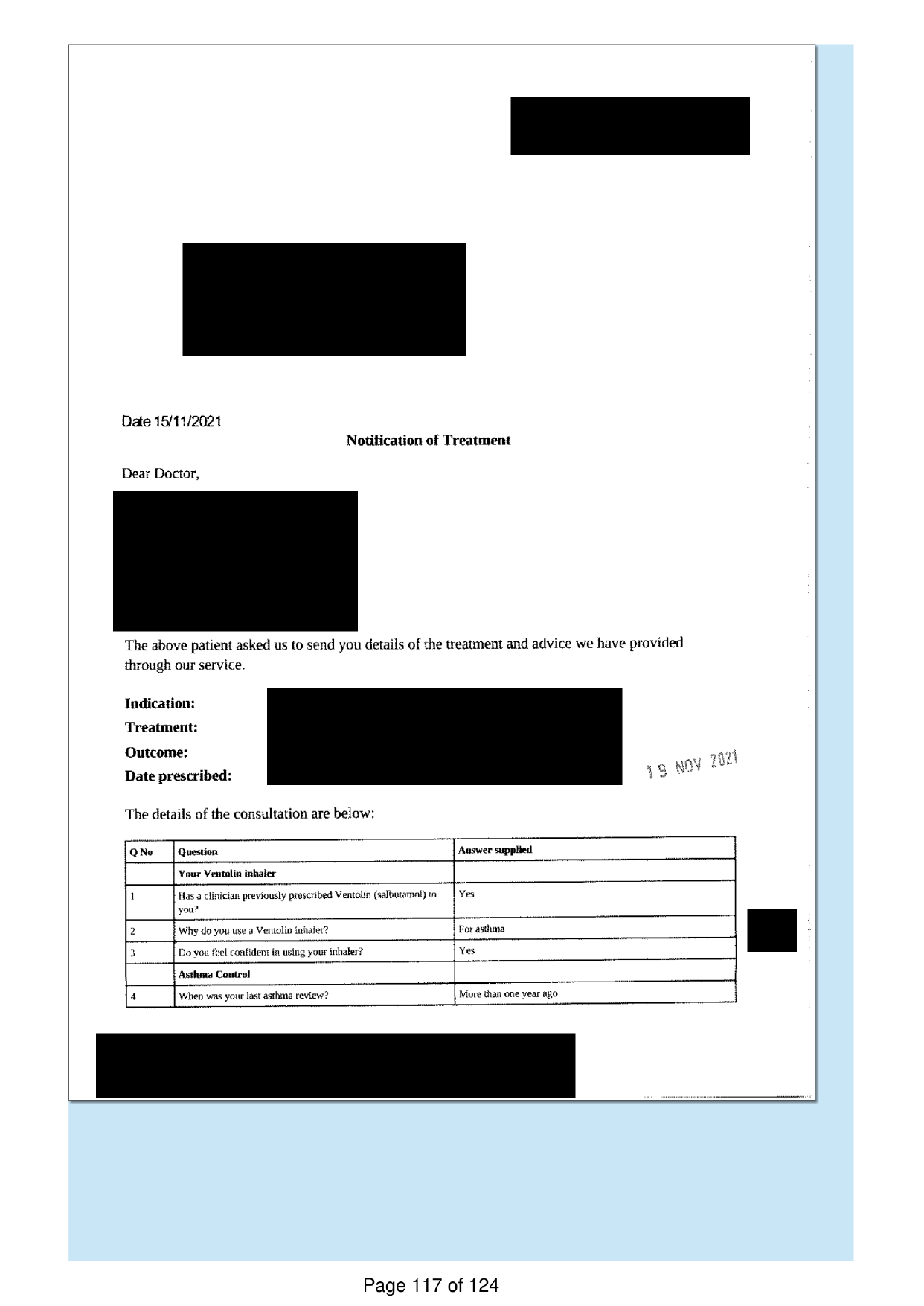
Page 118
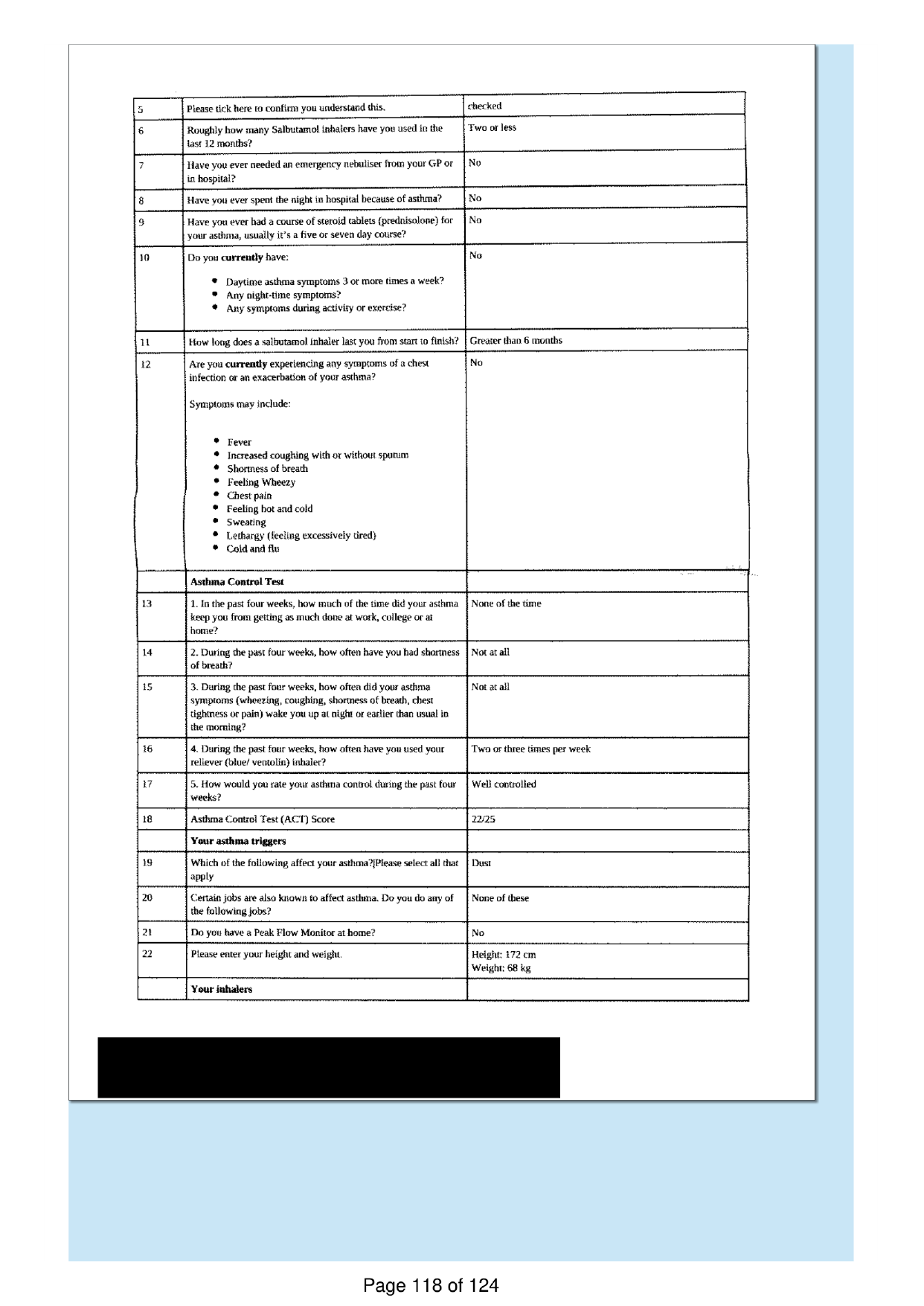
Page 119
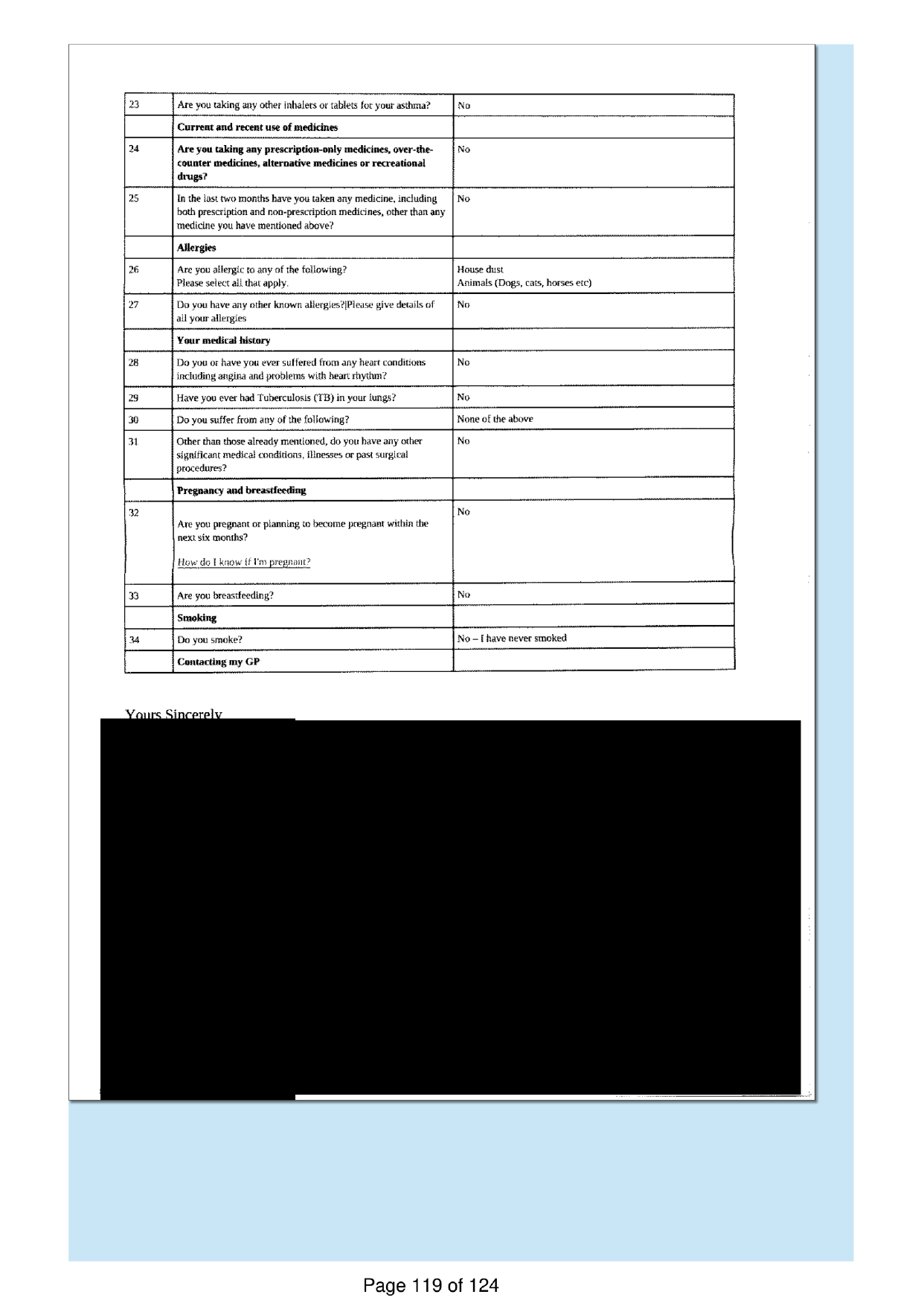
Page 120

Page 121
Page 122
Page 123
Page 124
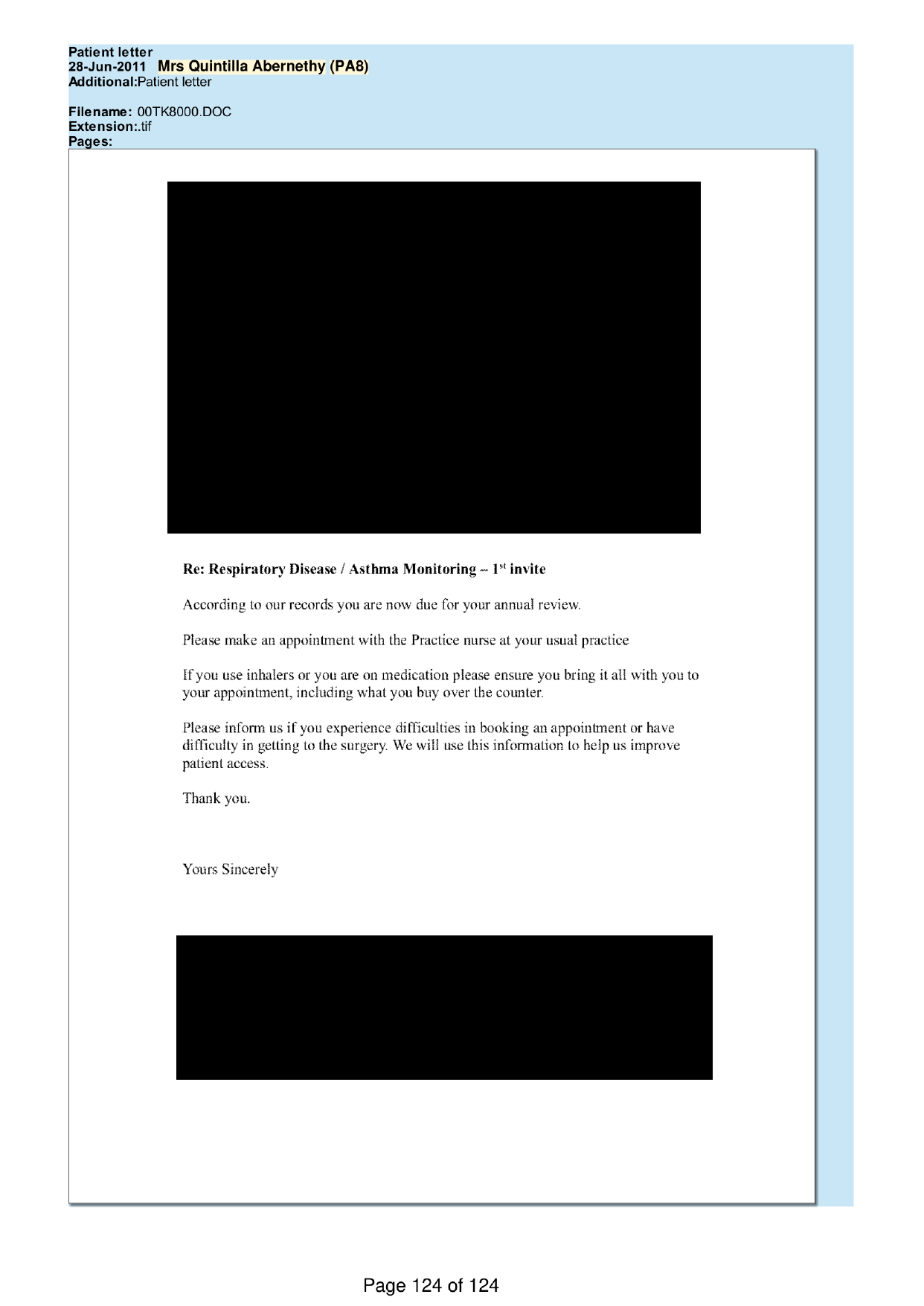
These pages come from one PDF, with the redactions applied to the document itself rather than drawn over it, so nothing is hidden under a black box that could be lifted off. A client's own record arrives in their pack the same way, minus the redaction.

Questions About This Page
Whose record is this?
It belongs to the founder of Chronicle Health, and it is published here as a deliberate decision. It is not a client's record and it is not a customer testimonial. Client records are never published.
Why publish a medical record at all?
Because every other way of showing this work asks you to take it on trust. A synthetic sample proves the format and nothing else, and a client's record is not ours to publish, on any basis, ever.
That leaves our own. It is a one-way decision, made with the permanence understood: once this is indexed, scraped and mirrored, no later deletion undoes it.
How do I know this is a real record and not something you made up?
What you can see is 124 pages that came out of a GP practice system, with its headings, its layout and its page numbering still on them. About half are photographs of the old paper cards, handwritten by a lot of different people. Faking that convincingly would be harder work than getting hold of a real one. And we all have a real one: everyone who has used the NHS in the UK and chosen to ask for it. Believe us or not, this record belongs to the company founder.
Was the pack edited to make it look good?
It looks good? Why thank you! And yes, this one has had more attention than most: anything going on the internet gets read again, and it carries a redaction pass no client copy ever needs.
What we have not done is flatter it. Nothing was cherry-picked, no finding was rewritten to read better, no awkward page was quietly dropped. Showing how the work is done is the whole point of the page, and a sample improved after the fact would prove nothing at all.
So the unimpressive parts are still in: gaps where the record simply does not say, entries no transcription model could read, places where two sources disagree. A real record contains all three, and so does this one.
The process that produced this is the process that produces a client's, so your documents should look about this good. How well they read is down to what your record turns out to hold, which is not something either of us gets to arrange in advance.
What was removed before this was published?
Other people, first. A medical record is full of them: the clinicians who wrote it, the practice staff who filed it, the occasional relative. Every name has been replaced and every contact detail removed, along with the names of the practices and the places care was given.
Then the record owner's own identifiers: name, NHS number, date of birth and address, wherever they appear, including in the letterheads and barcodes printed as page furniture. Whose record this is belongs in the words on this page, not stamped across every scan.
In both cases the content is removed from the document rather than covered over. A black box drawn on top of a PDF can be lifted off with a text selection tool, so we take the text out and check afterwards by extracting everything the file still contains and searching it.
The file's own properties come off too, so the document does not arrive carrying the name of the software that made it, the account it was made under, or the moment it was made.
Every one of those changes is marked in pale yellow. That is the point of the colour: you can see at a glance which words are ours, and treat everything unmarked as the record exactly as the practice sent it.
Why do some of the names look slightly odd?
They are substitutes, and they are meant to be spottable. Every replaced clinician and member of staff has been given a name whose initials give away the role, so a G.P. might appear as Gladis Proctor. It reads as an ordinary name in the flow of a consultation note, and anyone looking twice can tell it is a substitution.
The alternative was labels: "reviewed by [GP]". That reads as a document with holes in it, and it makes the same clinician unfollowable across twenty years of entries. Continuity of care is a large part of what this record actually shows, so it seemed worth keeping.
Where did the private test results come from?
This example is not built from the GP record alone. A few private test results went in alongside it, organised privately and not included in the NHS record. Inside the Chronicle Pack is the only place the two sit together. You can do the same with anything you already hold: private blood tests, a clinic letter, a scan report. It is optional, and there is no extra charge for it.
Those private reports are the one thing on this page we have not published. They belong to the testing companies who wrote them rather than to us or to the NHS, and the legality of publishign them is unsettled (some vendors explicitly say we cannot), so we left them out instead of taking an unnecessary legal risk.
How do I check something in the pack against the record?
Every fact of any significance from the GP record carries the page it came from, printed next to it. Find the page number, scroll back up to that page, and read the original for yourself.
That is the part that is hard to show anywhere else. On any other sample you would have to take the citation on trust, because whatever it points at is not published. Here it is, so you do not have to.
The private test results are the exception. The reports they came from are not published, so those are the only claims in the pack you cannot follow back to something on this screen.
The consultation of 4 March 1993 records "No FH asthma"; the consultation of 29 June 1993, three months later on that same page, records "Asthma in family". A reader following the citation will find both readings on that one page. (p52)
From Record Summary. Read page 52 and check it for yourself.
Can I have the files themselves?
Yes, gladly. Everything is readable here, but if you would rather have the documents on your own machine, to open properly or to try with an AI assistant, just ask and we will send them over.
There is a link to get in touch at the foot of these questions.
How is this different from the pack I would get?
Most importantly - your pack will be about you!
The biggest difference after that is the redaction. This copy is public, so everyone in it had to be protected. Yours is delivered to you and to nobody else, so nothing is taken out of it: your practice, the hospitals and clinics you attended, and every clinician who treated you all appear under their real names, and so do you. The pale yellow marks on these pages have no equivalent in your pack. They exist because this one is on the internet.
Yours is also complete. Three pages are held back on this copy; your pack is built from your whole record, with no placeholders in it.
The set of documents is not fixed either. It follows what your record turns out to hold, so a record with one complicated thread running through it also gets a document written for that thread alone, and a longer record produces longer documents.
How do I keep it up to date?
Keeping your pack current will mean it continues to be useful into the future. We'll be writing about how easy this can be soon (expected this month - Aug 2026). Until then, all documents come as plain text as well as PDF, so you can edit them yourself if you need to.
Could my record end up on a page like this?
No, certainly not via us at least.
As a client, your Chronicle Pack goes to you only. It is not published, shared, quoted or used as an example anywhere.
Any other questions or comments about this page, we would be glad to hear them: get in touch.
Want This Built From Your Own Record?
We request your record from your practice, organise it, and hand the whole thing back to you. Yours to keep, nothing to pay until it is delivered.
Get StartedArrow keys or swipe to move through. Tap the page to zoom. Escape to close.